Get Full Government Meeting Transcripts, Videos, & Alerts Forever!
Get email alerts on the Land Use Rezoning topic
No spam. Unsubscribe anytime.
Montgomery trustees pause vote on Wayside Cross youth center after strong neighborhood opposition
Summary
Trustees tabled three ordinances that would have vacated a right-of-way, rezoned land and approved a development agreement for Wayside Cross Ministries’ proposed youth activity center after hours of public comment and board debate.
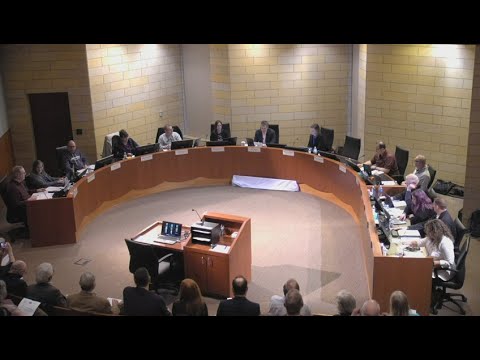
Montgomery trustees on March 24 paused action on a proposed Wayside Cross Ministries youth activity center after more than two dozen residents spoke during public comment and trustees discussed zoning, screening and legal protections.
Supporters said the program has served area children for 14 years and would provide tutoring, sports and year-round programming. Opponents said a 13,000-square-foot building, a 43-space parking lot and rezoning from R-1 to B-1 would erode a long-standing green space, bring traffic and reduce property values.
The proposal would subdivide Saint Olaf Lutheran Church’s property into two lots, vacate part of Elliott Avenue so the lot could be consolidated, rezone the youth-center parcel from R-1 (single-family residential) to B-1 (neighborhood business), and record covenants tied to a 10-year development agreement that the village attorney wrote to limit future uses. Staff said the covenants would be recorded with the plat and would restrict the B-1 lot to the youth-center use being proposed.
Neighbors pressed several points during public comment: security and policing in a border area, light and noise, traffic and parking, potential effects on home values, and a feeling that the neighborhood had not been adequately notified. Edgar Barrons, who said he has lived on Hartway Court 13 years, told trustees the project would be “the irreversible destruction of a beloved green space.” Several speakers urged Saint Olaf to seek an alternative site in Aurora or a commercially zoned area.
Supporters said the program, called Urban Youth Ministries and run by Wayside Cross Ministries, has provided free after‑school and summer services including tutoring and recreation to about 50 children in its regular program and up to 70 in summer sessions. Joni Britton, a retired East Aurora teacher and Saint Olaf volunteer, said Wayside has used the church basement for 14 years and “the children will learn to work together and stay out of trouble.” Jim Pilmer, a retired public administrator with parks-and-rec experience, said youth programming “raises property values from 8 to 10%” in other contexts and praised Wayside’s neighborhood outreach.
Petitioners and Saint Olaf representatives told the board they adjusted the site plan after earlier meetings. Proposed mitigation includes denser evergreen screening, berming along the north and west property edges, limits on hours of operation and building signage, and a recorded covenant limiting permitted B-1 uses on Lot 2. Staff said programming would be limited to Monday–Saturday, ending by 7 p.m., with no Sunday programming per the draft development agreement and conditions in the ordinance.
During trustee deliberations, several trustees said they shared residents’ concerns about rezoning a residential parcel to business zoning. Trustee comments emphasized that R-1 zoning would generally preserve residential character, while B-1 zoning—even with covenants—creates uncertainty if future owners or a future board remove or alter restrictions. Trustee Baumann and others asked staff to pursue options that would keep the underlying zoning residential if possible while still enabling the current proposed youth‑center use.
Village staff and counsel said the development agreement and recorded covenants are intended to run with the land and limit permitted B‑1 uses in perpetuity; the development agreement itself would be 10 years long but the covenants would be recorded with the plat. Staff also said screening, lighting, and a water‑main easement location were addressed in the revised site plan.
After discussion the board voted to table three agenda items related to the project—(1) the vacation of part of Elliott Avenue, (2) the zoning map amendment/special use/variance and preliminary plat, and (3) the development agreement—so staff and the petitioner could pursue additional revisions and community outreach. President Brawley moved to table the three items; the motion carried 5–0.
The board asked staff and the petitioner to (a) explore whether the use could be authorized under R-1 without rezoning; (b) refine screening and berming plans for adjacent homes; (c) clarify whether the assessor would treat a business parcel adjacent to homes in a way that might affect EAV; and (d) provide additional architectural and site visuals at a future meeting. A future meeting date for reintroduction was not set.
The project remains under review. If the trustees and petitioners reach terms that protect neighborhood character and address trustee concerns about long-term zoning outcomes, the board could consider the ordinances again at a future meeting.