Get Full Government Meeting Transcripts, Videos, & Alerts Forever!
Get email alerts on the Building And Business Fees topic
No spam. Unsubscribe anytime.
Staff propose new 0.5% community development fee, 3% tech fee and business‑license restructuring; council asks for carve‑outs
Summary
City staff presented proposed fee changes May 6 that include a new 0.5% community development fee on project valuations, a 3% technology fee on permit costs, plan‑review percentage increases and a restructured business‑license schedule; councilors asked staff to return with refinements and no vote was taken.
City staff presented proposed changes to building and business‑license fees at the Sherwood City Council work session on May 6, including a new 0.5% community development fee on project valuation for building permits, a 3% technology fee on permit fees, increases to plan‑review percentages and a revised, tiered business‑license schedule; councilors asked staff to return with refinements and no vote was taken.
Eric, a Community Development staff member, said the largest proposed change is a 0.5% community development fee applied to project valuation reported on building permit applications. “This would be 0.5% of that project value,” he said, and staff noted that Newberg uses 0.75% while a neighboring jurisdiction has 0.25%.
Staff offered examples to show impact: a 150,000‑square‑foot flex industrial building with an estimated project valuation of $13 million would pay about $65,000 under a 0.5% fee — roughly equivalent to the current building‑permit fee — while a typical 2,500‑square‑foot house with a project valuation Eric cited at $4.75 million would face a proposed 0.5% fee of about $2,300. Eric and Jared Bradbury, the city’s building official, emphasized that system development charges (SDCs) and other utility charges remain the largest single cost components for large projects.
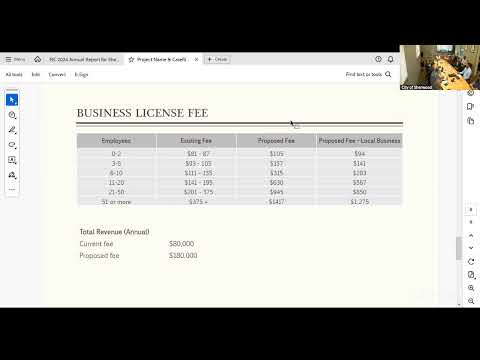
Other proposed changes described by staff: - Technology fee: a proposed 3% technology fee charged to permit fees to cover e‑permitting software, iPads for inspections and electronic plan‑review tools (staff corrected a transcription reference to Accela and Bluebeam as the systems involved). Eric estimated this would raise roughly $10,000–$15,000 annually and cover software and device costs. - Plan‑review fees and baseline increases: staff proposed a roughly 7.5% increase to baseline building, mechanical and plumbing fees and raising plan‑review percentages from about 30% to 50% where a review is required. - Business‑license restructuring: staff proposed simplifying the license to tiered buckets by number of employees (0–2, 3–5, 6–10, 11–20, 21–50, 51+), raising fees for larger employers and offering a 10% discount for businesses headquartered in Sherwood. Under the draft schedule discussed, a business with 51 or more employees would see a proposed local annual fee of $1,200 (current top tier cited at $375).
Council concerns and requested changes Councilors questioned the impact on housing affordability and small businesses. Councilor Giles asked whether the fee would be passed to homebuyers and noted state mandates and rising departmental costs. “On a 2,500 square foot house … the proposed fee at 0.5% would be $2,300,” Eric said in reply to council questions about homeowner cost impact.
Councilor Taylor and others urged staff to consider carve‑outs and waivers for affordable housing, asking whether the building official could be empowered to waive or reduce fees if the council adopted a policy. Eric said the building official does have discretion to waive fees and staff could implement council direction via resolution. Councilors also suggested combining lower business license tiers (for example, 0–5 employees) or adding intermediate tiers between 6 and 20 employees to avoid abrupt increases that could burden small or growing businesses.
Staff sought feedback on annualizing fee adjustments rather than waiting several years; one councilor said, “We should probably annualize these increases and not wait 5 years.” Eric and Jared noted the department has not consistently updated building fees since 2021 and that personnel costs and state mandates are increasing the department’s workload.
No ordinance or fee schedule was adopted at the meeting. Eric said the fee schedule would next appear in the budget committee materials; staff will return with a revised draft that reflects council feedback, possible carve‑outs for affordable housing, options to smooth business‑license tiers and consideration of annualized increases.
Questions and clarifications raised during the session included whether the technology fee should be shown as a separate line item for transparency, how Accela and Bluebeam licensing and devices drive the technology costs, and how SDCs interact with the proposed community development fee. Staff reiterated that revenues currently go to the city’s General Fund and that council could direct staff to create a policy for restricted or targeted use or to allow fee waivers in specific cases.
The presentation included comparative references to neighboring jurisdictions (Newberg, Tigard, Tualatin, Beaverton, Hillsboro and Wilsonville) and to regional practices for plan‑review and technology fees. Councilors asked staff to return with a revised fee schedule before formal adoption so the council would see adjusted tiers and potential carve‑outs for affordable housing projects.