Get Full Government Meeting Transcripts, Videos, & Alerts Forever!
Get email alerts on the State Housing Legislation topic
No spam. Unsubscribe anytime.
City staff warns Salem housing bills could curb local review and speed permit timelines
Summary
City staff briefed the Sherwood City Council at a April 1 work session on multiple housing-related bills moving through the Oregon Legislature and described possible consequences for local land-use review, design standards, permitting timelines and Sherwood West master planning.
City staff briefed the Sherwood City Council at a April 1 work session on multiple housing-related bills moving through the Oregon Legislature and described possible consequences for local land-use review, design standards, permitting timelines and Sherwood West master planning.
Eric (city staff) told the council he would review five bills staff considered among the most potentially impactful and said most were headed in the direction of "less local control, less review timelines, faster funding" unless amended. "I'll go over 5 bills today. 4 of them are really gonna go in the general direction of, you know, less local control, less review timelines, faster funding," Eric said.
Why this matters: the bills could change when and how the city sets design standards, reviews planned-unit developments (PUDs), requires off-site improvements, and how quickly building permits must be issued. The changes would affect local oversight of residential development and may intersect with Sherwood's long-range planning for Sherwood West.
Summary of the bills discussed (staff read)
- Senate Bill 974: Staff said the bill would require cities to waive standards for building design, orientation, parking and landscaping for housing developments with 20 or more units and would impose time limits on engineering and plan review. It also would reclassify many housing-related land-use applications as expedited (limited land-use) decisions, which staff said would reduce public hearings and opportunities for input; staff specifically flagged the prospect that PUD approvals could become limited land-use decisions with only one public hearing.
- (Senate) bill described as a 6‑1 amendment: staff summarized a measure that would require building departments to issue permits for middle- and single-family projects within 45 days of a complete application and require partner agencies to finish reviews within 10 days; staff warned that the bill’s automatic-approval provisions would create liability and practical problems if partner agencies fail to act and the permit were deemed approved in the absence of a timely decision.
- House Bill 2138 (dash 2 amendment): staff characterized this governor-backed middle-housing bill as scaled back from earlier drafts; it would expand the definition of certain middle-housing types (for example allowing attached units within cottage-cluster concepts), direct the Land Conservation and Development Commission (LCDC) to undertake rulemaking and could limit what local siding and design standards LCDC deems permissible for middle housing; staff said that could reduce some discretionary authority in design review.
- House Bill 2258: described by staff as a governor-sponsored bill to create preapproved building plans and sites, the proposal would let the state define when a preapproved design may be built on a lot and could constrain local review of design, parking, tree removal and impact analyses if applied broadly.
- Funding bill (referred to in the briefing as 30/31): staff said the proposal would provide infrastructure funding for housing (lottery funds were mentioned) but impose density and affordability thresholds. Staff noted 25% of the proposed funds would target jurisdictions with fewer than 30,000 residents and that density thresholds often require a threshold such as about 17 units per acre to qualify.
Council concerns and possible city responses
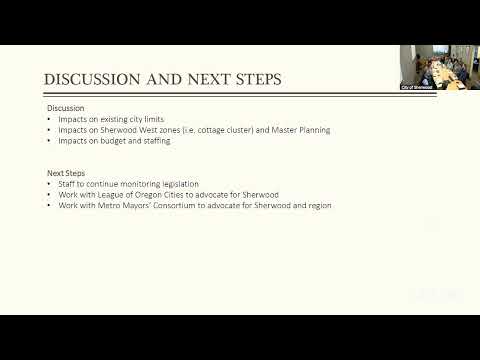
Councilors and staff raised several common concerns: loss of local design and landscaping standards, shortened review timelines that could force denials or require higher staff fees and staffing to meet new deadlines, limits on public participation for what have traditionally been multi-hearing land-use matters, and uncertainty around the interaction with master-planned areas such as Sherwood West.
Staff recommended tracking the bills closely, working with the city’s lobbyists and the League of Oregon Cities, and said the council could consider delaying nonessential local steps (for example, any master-plan submittals or annexations) until the legislative outcome is clear. Eric suggested a follow-up work session after the legislative session ends so the city can calibrate next steps once the final language is known.
Ending
No formal action was taken at the work session; councilors asked staff to continue monitoring the bills, to report any major amendments, and to bring a post-session briefing so elected officials can decide on any local policy or advocacy steps.