Get Full Government Meeting Transcripts, Videos, & Alerts Forever!
Get email alerts on the Public Safety Mental Health topic
No spam. Unsubscribe anytime.
Sherwood police chief presents 2024 annual report, highlights mental‑health response, drones and photo‑enforcement data
Summary
At a March 4 work session Chief Ty Allen told the council the Sherwood Police Department handled 19,201 calls in 2024, acquired three drones, and continued county mental‑health response team work that delivered services in about 65% of contacts; photo‑enforcement data were affected by camera downtime and vendor transitions.
Sherwood — Chief Ty Allen told the City Council at a March 4 work session that the Sherwood Police Department fielded 19,201 calls for service in 2024 and emphasized mental‑health response, new technology and traffic‑safety enforcement in his annual report.
“This last year, we had 19,201 calls for service,” Chief Ty Allen said, describing that total as a combination of 911 calls and self‑initiated activity. He told the council the department operated with about 17.5 officers through much of 2024 while workload increased.
Allen said the city and the department continue to prioritize community engagement and broadened outreach through social media and event attendance as part of community policing. He also described training and staffing steps the department has taken, including academy and field training: the agency relies on a multi‑phase field training program after the initial academy and uses a reserve program to identify and fast‑track candidates into sworn roles.
Mental‑health response: scope and outcomes
Allen described the regional Mental Health Response Team (MHRT) that Sherwood participates in and said clinicians rotate through multiple jurisdictions. He said the county handled roughly 3,000 MHRT‑related calls across participating cities in 2024 and that the Sherwood/Tigard/Tualatin rotation covers Sherwood calls during its assigned period.
“65% of the contacts that are made are getting mental health support,” Allen said, adding that only “9 percent of them become police custody.” He also said, “Out of nearly 3,000 cases in the county, 1 percent is reported in using force on these subjects,” a metric he presented as part of the MHRT outcomes overview.
Allen and council members discussed reasons why some contacts do not lead to enrollment in longer‑term services, and he said refusals, brief hospital stays with rapid discharge and situational factors (substance use, family dynamics, missed medication) contribute to gaps between contact and enrollment in wraparound services. Allen also told the council Sherwood’s clinician partner on MHRT is provided through LifeWorks.
Technology and specialized units
Allen said the department acquired three drones through foundation funding and currently operates multiple certified drone operators; he described drones as useful for search and officer safety. He reported the department has one documented drone deployment to date while training and policies are refined.
Other specialized resources noted included a tracking canine identified in the presentation as “Miss B,” school‑resource officers (two assigned), mobile field‑force participation in county mutual‑aid teams, and an expanded reserve program used to recruit and vet candidates.
Traffic enforcement and photo program
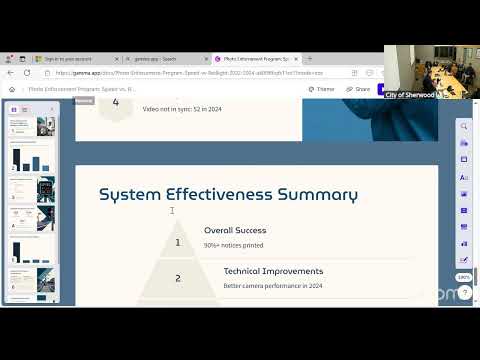
Allen gave a multi‑year summary of photo‑enforcement and speeding data, using 2019 as a baseline year. He noted the program’s historic high of 28,627 speeding violations in early 2019 and said equipment downtime and vendor transitions in recent years produced anomalous counts for 2022–2024. He described VeriMobility (the current vendor) as screening images before the city issues citations and reported the department’s issuance rate on screened speed violations as about 96%; red‑light citation issuance lagged in the 80s (percent) during his presentation.
Allen said the city removed a right‑turn enforcement camera at one intersection, which will reduce a class of right‑turn‑on‑red violations going forward. He also said many violators come from outside Sherwood’s local ZIP code and that registration, address quality and plate‑name mismatches (for example, vehicles registered in a parent’s name but driven by a child) remain common processing issues.
Council questions and data reporting
Council members asked about the countywide MHRT rotations, local clinician staffing and whether MHRT clinicians ride with officers. Allen clarified that the MHRT clinician (identified in the presentation as Crystal) rides with the assigned MHRT officer during the clinician’s rotation; he said MHRT staffing currently provides coverage by rotation rather than 24/7 countywide coverage.
When asked about racial‑bias tracking and transparency, Allen said Sherwood submits stop‑data to the state and to county processes and that traffic‑stop ethnicity fields are recorded; he said he had not seen complaints for 2023–2024 and referred to the state’s traffic‑stop analyses (the presentation referenced the so‑called “veil of darkness” reporting approach used in statewide comparisons).
Why it matters
Allen framed the department’s work as focused on reducing harm through de‑escalation, mental‑health partnerships and targeted traffic enforcement, while continuing officer training and wellness programs. The council’s discussion highlighted that photo‑enforcement program outputs for 2022–2024 are not directly comparable to 2019 or to a 2025 baseline because of camera downtime and vendor transitions; Allen said 2025 will serve as a new operational baseline once systems are fully restored.
Looking ahead
Allen said the department will continue MHRT collaboration, training, and technology rollout (additional drone operators, expanded community outreach and continued photo‑enforcement adjustments). He closed the presentation by inviting questions from council members.