Get Full Government Meeting Transcripts, Videos, & Alerts Forever!
Get email alerts on the Supportive Housing Services topic
No spam. Unsubscribe anytime.
Washington County presenters say SHS helped house more than 1,200 people and built shelter capacity; county outlines costs and next priorities
Summary
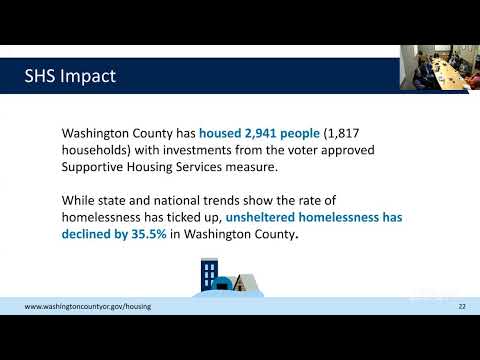
Washington County staff reported serving more than 10,000 people through SHS‑funded programs, moving about 1,200 people into housing last year and budgeting roughly $120 million for FY 2024–25 while flagging a carryover and near‑term budget delta to be addressed.
Nicole Sting, strategic initiatives and relations manager in Washington County’s homeless services division, and Jessie (Jesse) Adams, strategic projects coordinator, briefed the Sherwood City Council on the county’s Supportive Housing Services (SHS) program and results from the prior fiscal year.
Sting described client stories to illustrate program design and said SHS is a voter‑approved measure (2020) funded primarily by a tax on higher income earners and on businesses with high gross receipts. “Every shelter we open is thanks to SHS dollars,” she said, and she cited regional targets tied to the program: a regional objective of bringing 5,000 people inside and stabilizing about 10,000 households across the metro area, with Washington County’s portion targeted at roughly 1,667 households.
Jesse Adams summarized system‑level outcomes and spending. “We went from that system of only $5,000,000 a year…to an over a $100,000,000 a year system,” Adams said, and staff reported that in the most recent year the county’s SHS programs served more than 10,000 people and moved about 1,200 people into housing. Adams said eviction prevention and move‑in assistance were among the most effective interventions for reaching underserved households.
County presenters reviewed program types, operations and outcomes: permanent supportive housing (PSH), rapid rehousing (short‑term rental assistance, typically up to two years), eviction prevention, shelter operations (including pod villages and congregate shelters), access centers, outreach teams, and partnerships with health systems and veteran services. Staff said the county currently funds approximately 433 shelter beds (420 funded by SHS) plus about 60 pod beds, and reported a retention rate for permanent supportive housing of about 90% year‑over‑year.
Budget and capacity questions were a major focus. Staff said the current fiscal‑year SHS budget was built off earlier system‑building work and listed approximately $120 million as the current budgeted figure. They also discussed an approximately $100 million carryover from earlier years; staff said most of that carryover is encumbered for capital and project uses but that about $14 million is not yet board‑actioned and is earmarked for a set of needs including $5 million per access center set‑asides, $2 million for a permanent pod site land purchase, and a reserve to manage a roughly $15 million delta identified between prior revenue estimates and more recent estimates.
Presenters described operations and system improvements in greater detail: access centers (sites for daytime services and referral, not 24‑hour shelters in most locations), coordinated entry via Community Connect, outreach teams that “go out into the community,” and partnerships with providers including Just Compassion, CareOregon, and culturally specific providers. County staff said the program has prioritized hiring staff with lived experience and paying entry‑level wages in the $50,000–$60,000 range to reduce turnover among service providers.
Councilors asked about program rules and eligibility. On eviction prevention, staff noted that many state and federal programs require an eviction notice to prove you are at risk (for example, needing to show you will lose housing in 14 days), which can limit pre‑eviction interventions; staff described move‑in‑ready and rapid rehousing funds that can be used in some cases without an eviction notice. Staff also described differences between rapid rehousing (short term, with expectation of exit to stability) and permanent supportive housing (long term and paired with services and vouchers).
County staff said data and system interoperability remain priorities. They noted that Homeless Management Information Systems (HMIS) are in use across counties but that data sharing and coordinated entry still require technical and privacy work; a vendor change is planned to improve cross‑county data flow. Staff also said they are tracking outcomes and carrying out performance evaluation through a newly formed regional advisory structure (a Homeless Solutions Advisory Council and subcommittees) and invited local officials to follow those meetings.
Presenters closed by describing next priorities: opening remaining access centers and permanent shelters, securing a permanent pod site to reduce administrative burden, tightening performance and procurement rules, and preparing information to demonstrate SHS outcomes to voters ahead of any renewal decision. Staff committed to follow up with council members on carryover and budgeting details.