Get Full Government Meeting Transcripts, Videos, & Alerts Forever!
Get email alerts on the Public Art topic
No spam. Unsubscribe anytime.
Sherwood cultural arts group outlines medallion public‑art plan for new pedestrian bridge
Summary
At a March 18 work session, Sherwood’s Cultural Arts Commission presented concepts for eight medallions on the new pedestrian bridge emphasizing family‑friendly design, local natural history and durability; commissioners and council members discussed materials, digital augmentation and a possible citywide expansion.
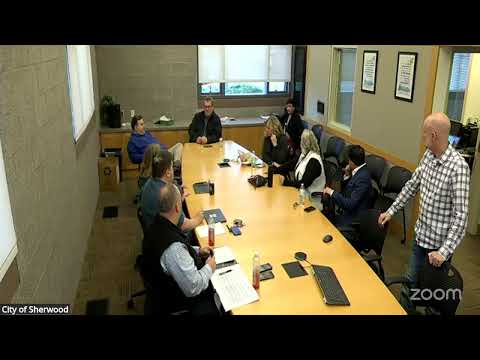
Sherwood City Council held a work session March 18, 2025, where the Cultural Arts Commission presented a plan for decorative medallions to be installed on the city’s new pedestrian bridge.
The commission proposed eight medallions—four 18‑inch and four 24‑inch pieces—sited at the bridge’s belvederes to create “a little moment of discovery,” according to Shanda, a Cultural Arts Commission staff member. The commission said themes that repeatedly emerged during public comment were family friendliness, Sherwood’s natural setting and wildlife, and the area’s history.
The commission circulated examples from other cities and institutions to show possible approaches. The presentation included cast relief medallions, etched stainless steel and composite options; the city’s bridge designer, KPFF, is recommending stainless steel for aesthetic consistency with bridge elements. Shanda said one goal was to engage walkers with the question “the idea of who walked here,” using imagery and short narratives tied to local history.
Council members and commissioners raised materials, durability and maintenance concerns. Jason, a staff member, said he did not know whether KPFF had specified a raised relief or flat, laser‑cut stainless steel finish; the presentation team said that level of detail would be clarified in design selection. Commissioners noted that bronze and composite materials weather differently and that stainless steel carries a higher upfront cost but resists corrosion.
The commission discussed adding digital components to the project, such as a stainless‑steel QR code that could link to audio, image or rotating student work. Shanda noted the advantage of placing a physical, tamper‑resistant metal QR element rather than a printed sticker so changes and tampering would be obvious. Commissioners said separating permanent medallion materials from changeable digital content would preserve a durable, long‑lived artifact while allowing evolving interpretation.
Several commissioners and councilors framed the bridge medallions as a potential pilot for a broader city program. Deborah, a Cultural Arts Commission member, said the medallions could tie into school curricula and local history resources; Estella, who is compiling archival materials, said staff would pull documents and historical sources to support artist research. The group discussed a citywide visual language—an identifying ring, font or logo treatment—so medallions placed elsewhere in Sherwood would read as part of a unified program.
Next steps the commission outlined included drafting a call to artists (RFP) that will request designs for the eight bridge medallions, specifying materials, maintenance expectations and any digital augmentation. No formal council action or vote was taken at the work session; the presentation closed with the commission asking for direction to proceed to an artist solicitation phase.
The Cultural Arts Commission will return with a proposed RFP and cost estimates for materials and installation. Funding questions (including potential use of public art funds and transient lodging tax allocations) were discussed but not resolved during the session.