Get Full Government Meeting Transcripts, Videos, & Alerts Forever!
Get email alerts on the Behavioral Health Facility Expansion topic
No spam. Unsubscribe anytime.
Commission approves Bridal Counseling expansion and residential beds with a one‑year review and conditions after neighbors raise concerns about potential unshel
Summary
Clark County commissioners on May 7 approved Bridal Counseling’s expansion on McLeod Drive to add transitional residential units and a 16‑bed children’s treatment facility, and attached a one‑year operational review plus conditions after neighbors raised concerns about daytime impacts and undisclosed beds.
Clark County commissioners approved a plan amendment, zone change and use permits for an expansion of Bridal Counseling’s McLeod Drive site that adds a multifamily residential building for program participants and an on‑site 16‑bed children’s treatment unit, attaching a set of operational conditions and a one‑year public review to address neighborhood concerns about unsupervised sheltering and daytime impacts.
Bridal Counseling representatives told the commission the proposed 52‑unit residential building (up to a 100 bed maximum in some configurations) and the 16‑bed children’s facility are intended to provide on‑site transitional housing and support for people enrolled in the program; residents must be part of the clinic’s treatment program and pay rent for the residential units. Applicant counsel said the expansion is designed to keep people engaged with treatment and to reduce out‑of‑state placements for the children’s unit.
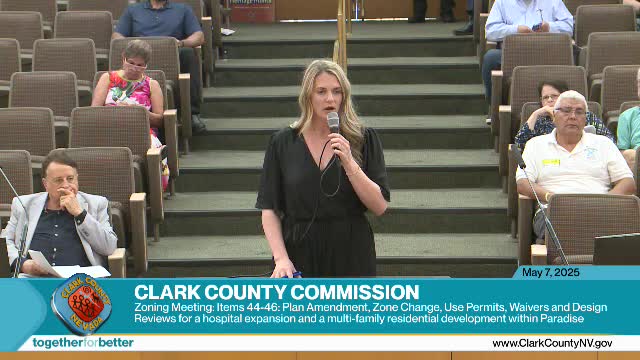
Multiple neighbors, including former board members and long‑term residents within a few blocks of the facility, expressed worries that the organization had not disclosed a shift toward operating shelter‑style beds and that individuals might congregate in nearby parks and libraries during the day. One speaker, a former volunteer board chair who later resigned, alleged that beds and a commercial kitchen have been installed and that staff had denied the existence of those beds at an earlier planning hearing. Neighbors said they have already experienced shoplifting, loitering and trespass incidents they linked to unhoused individuals in the area.
Commissioners and staff discussed the operational limits the county can impose and the fact that state licensure and the organization’s business license will affect how the facility operates. Commissioner Seggerblom (chairing parts of the hearing) and others emphasized that the expansion is not a walk‑in shelter; the applicant said residents must be enrolled in programming and cannot re‑enter the residential building freely if they leave the program.
To address residents’ concerns the commission attached these measures to the approvals: - A one‑year public review after issuance of each certificate of occupancy for the new buildings to assess operations and neighborhood impacts. - A requirement that the applicant reconstruct any driveways closed by the expansion and provide full off‑site improvements where driveways are altered. - A request on the record that the applicant provide a fenced outdoor area or other on‑site outdoor amenity so program residents have a contained place to be outside without walking into the neighborhood, and direction that staff work with the applicant to define that amenity during plan review. - Agreement that the multifamily residential building will be managed and that residents are program participants who pay rent and are under program rules; applicant stated that people must be referred/authorized into the program (not an open overnight shelter).
Several commissioners emphasized they support local treatment options — including the new children’s facility — while acknowledging that neighborhoods have legitimate quality‑of‑life concerns. County staff said they will monitor the site and that code enforcement remains an available remedy if the operation differs from representations made to the board.
The commission approved the plan amendment, zone change and use permits with the above conditions and a one‑year review cycle for the newly completed buildings, while clarifying that enforcement options are limited when state licensure governs clinical services.