Get Full Government Meeting Transcripts, Videos, & Alerts Forever!
Get email alerts on the Meadows Preliminary Plat topic
No spam. Unsubscribe anytime.
Commissioners continue Meadows South preliminary‑plat SUP after contested community meeting, recusal motion and expert testimony
Summary
A 56‑lot conservation subdivision proposed for Powell’s Point dominated the April 21 meeting as the Board of Commissioners heard testimony, a recusal motion, and extended public comment before voting to continue the matter to May 19 for additional information.
A 56‑lot conservation subdivision proposed for Powell’s Point dominated the April 21 meeting as the Board of Commissioners heard testimony, a recusal motion, and extended public comment before voting to continue the matter to May 19 for additional information.
The applicant, South Spot LLC (presented by counsel Ashley Honeycutt Terrazas, Parker Poe), requested a preliminary‑plat special‑use permit (PB‑24‑27) for a conservation subdivision on roughly 62 upland acres with 40 percent preserved open space. The plan proposes two vehicular access points, sidewalks, a wet pond for stormwater, on‑site septic for each lot (site evaluations provided), and connection to county water.
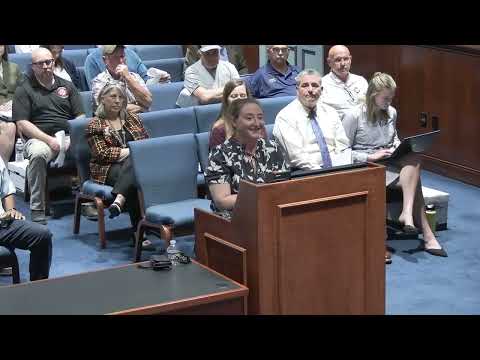
Recusal motion and board response: Before testimony began the applicant’s attorney asked the board to recuse Commissioner Selena Jarvis, alleging she had told attendees at a prior community meeting she would vote to deny the project. Commissioner Jarvis denied she formed a fixed opinion and said she told attendees only that they had the right to organize and present evidence. The board voted 6–1 to allow Jarvis to participate and vote.
Evidence and expert testimony: The applicant presented sworn affidavits and expert witnesses: Mark Bissell (civil/site engineer) described the layout, buffers and access plans; Andy Deal (stormwater engineer) described a comprehensive hydrologic model of the Tigmathar (Tigmeter) Ditch and committed to design targets that reduce 10‑year peak flows from the site to equal or be less than pre‑construction 2‑year flows for a wooded site and to not increase 100‑year peak flows; Andrew Topp (transportation engineer) presented a traffic‑impact analysis (December 2024 counts projected to summer conditions) and said DOT had permitted a driveway location on US 158 with deceleration/turn lanes; Hunter Howell (appraiser) testified the subdivision would be in harmony with nearby development patterns and not reduce adjacent property values given comparable projects in the area. The applicant offered phasing: 35 lots earliest record June 2026 and the remaining 21 lots December 2026.
Public comment and concerns: More than a dozen neighbors and landowners raised objections, focusing primarily on flooding, drainage, and traffic on South Spot Road. Several speakers said Tigmathar Ditch and downstream culverts are already inadequate; some said repeated flooding has damaged nearby properties, caused raw sewage and fish kills, and that dredging or culvert upgrades downstream—not just on the applicant’s parcel—are needed. Others questioned septic impacts on wells, school capacity and the proposal’s fit with the rural character (lots of approximately 25,000 sq. ft.). The developer and engineers responded that modeling will account for off‑site tailwater and wind‑driven tidal effects, that the design includes a large wet pond, swales and berms, and that the project will not increase peak outflows for design storms.
Board action: After hours of testimony and public comment, a commissioner moved to continue the quasi‑judicial hearing to allow the applicant to produce further drainage and related materials and to seek rights‑of‑entry if off‑site ditch work is needed. The board voted to continue the matter to May 19, 2025. Commissioners asked staff and the applicant for supplemental information on stormwater modeling (including tailwater/tidal effects), DOT driveway approvals, school capacity impacts and options for limiting non‑emergency traffic access to South Spot Road.
Why it matters: The case highlights recurring local tensions: new residential growth, drainage and flood risks in low‑lying coastal areas, limited county authority over state‑regulated infrastructure, and neighbors’ concerns about emergency access, traffic and community character.
What the record shows (selected quotes): - Ashley Honeycutt Terrazas (applicant counsel): “We will present competent material and substantial evidence this evening on each of the required SUP factors.” - Andy Deal (stormwater engineer): “The balance that I’m looking for is… reduction on the 10‑year, 24‑hour. ... Additionally, we are committed to… ensuring we do not increase peak flow in the Tigmeter Ditch for the 100‑year, 24‑hour event.” - Public commenter Bobby Haney (adjacent landowner): “40 acres directly south of this property that have flooded severely 3 times over the last 12 years… This is not a 10‑year storm. These are 100‑year storms 3 times in the last 12 years.”
Next steps: Applicant must provide additional drainage model outputs, clarify whether off‑site excavations or culvert work would be required (and obtain permissions), and document the DOT access permit and any conditions. The board will reconvene the hearing May 19 with a reduced quorum expected; commissioners noted any subsequent conditions must be reasonably related to the project impacts.