Get Full Government Meeting Transcripts, Videos, & Alerts Forever!
Get email alerts on the Budget topic
No spam. Unsubscribe anytime.
Ferndale adopts triennial budget for FY26 and approves FY26 tax and utility rates
Summary
Ferndale City Council adopted the triennial budget (FY26 with forecasts for FY27–FY28), approved the associated tax, water, sewer and sanitation rates for FY26 and discussed the possible impacts of a projected $4–4.5 million drop in voted millage in later years.
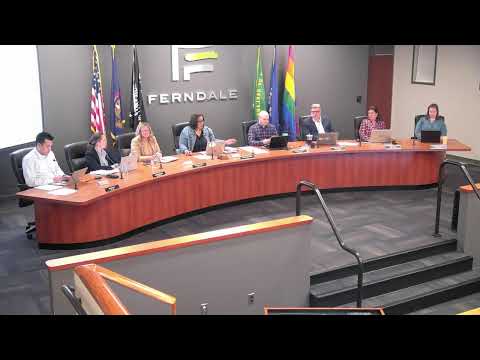
Ferndale City Council adopted a triennial budget covering fiscal year 2026 and forecasts for 2027 and 2028 and set the FY26 tax, water, sewer and sanitation rates at its May 5 meeting.
City staff presented the second reading of the triennial budget and a scenario analysis showing the financial effects if a large voted millage were to lapse in later years; staff said the forecasted loss—roughly $4.3–4.5 million—would require deep staff and service cuts in 2027–28 if not replaced.
During the presentation the finance director and city manager outlined reductions already included in FY26 and scenarios that would be necessary in later years absent additional revenue: elimination of most capital improvement and facilities repairs (except emergencies), extended vehicle replacement cycles, elimination of the IT contract in favor of very limited in-house IT capacity, and the removal of several vacant positions. Staff also said a recent retiree-health cost projection reduced FY26 expenditures by roughly $280,000.
Members of the public asked questions in the hearing about training and membership line items in the budget. Paul Beasley asked whether training and memberships had been targeted for reductions; staff replied that training and education and memberships are relatively modest portions of the budget but that larger savings would come from vacancy and personnel reductions because labor is about 80% of costs.
Council members discussed tradeoffs, noting some membership and training costs are necessary for professional credentials and that targeting vacant positions and head count are the most significant levers. Several council members thanked staff for a transparent forecast that highlights the consequences of revenue loss in later years.
By motion, council adopted the triennial budget as submitted by the city manager and finance director and approved the resolution setting FY26 tax and utility rates. The motion passed on a roll-call vote. Council and staff noted the forecasts serve as a planning tool and that more detailed staffing and service choices would follow if revenues decline as modeled.
Staff also informed council of a recent Oakland County assessing-cost proposal that could increase the city's assessing contract cost dramatically; council directed staff to explore alternatives and to coordinate with neighboring cities if the county commission adopts the higher charges.
The budget adoption provides the city's operating plan for FY26; council and staff will continue to monitor revenue, state policy changes and county decisions that might affect the forecast.