
Committee adopts substitute after trimming proposed racketeering expansions amid debate over prosecutorial use
Get AI-powered insights, summaries, and transcripts
Subscribe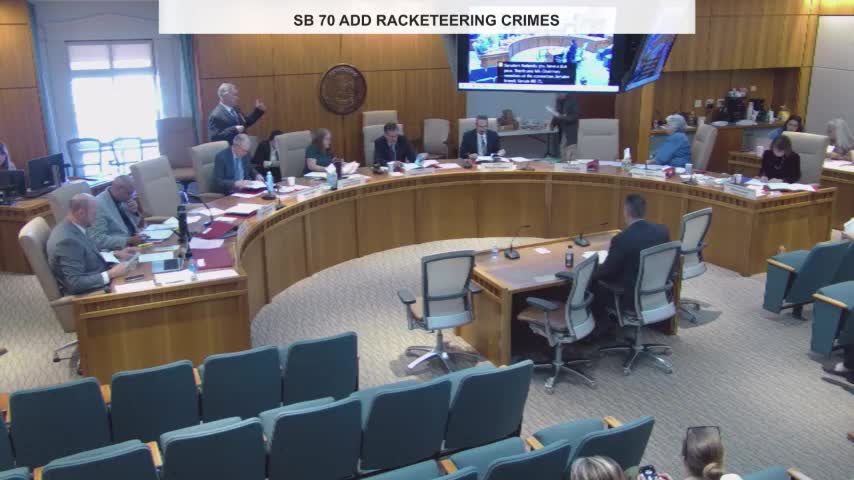
Summary
Senate Bill 70, a proposal to expand New Mexico’s racketeering statute, advanced from the Judiciary Committee as a committee substitute after the sponsor and members removed several contested predicate offenses and clarified the draft.
Senate Bill 70, a proposal to expand the state’s racketeering law to cover additional offenses, passed the Judiciary Committee as a committee substitute after substantial floor‑level debate and multiple deletions of contested sections.
Sponsor Senator Brandt presented a substitute that removes explicit references to “criminal gangs” and reduces the parts of the prior draft that generated broad concern. Deputy Chief Dale Wagner of the New Mexico State Police testified in support, saying a broader racketeering statute would provide prosecutors tools to target organized criminal enterprises involved in large‑scale trafficking, fraud and exploitation. JD Bullington of the Greater Albuquerque Chamber of Commerce also supported the bill, saying prosecutors need more tools to address human trafficking and related organized activity.
Committee members expressed concerns about overly broad drafting and the list of added predicate offenses. Multiple provisions were removed or revised during committee discussion. Members agreed to strike a set of items (numbered in the draft as subparagraphs that had drawn objections), including certain additions that members considered poorly aligned with RICO‑style enforcement; subsections D and E were struck after debate, and section 3 of the bill was removed in further cleanup. The sponsor and staff indicated the agreed‑upon deletions would be reflected in a committee substitute.
Several senators voiced a broader concern that the existing racketeering statute is rarely used and that resources and prosecutorial priorities determine whether expanded tools will be used in practice. Senator Stewart and others questioned whether adding crimes without clear prosecutorial buy‑in would make practical difference; the sponsor and supporters said the changes respond to requests from prosecutors and law‑enforcement partners. The committee also discussed internal penalty gradings and the relationship between conspiracy charges and substantive offenses; staff and counsel explained how conspiracy provisions interact with the proposed predicate offenses.
After negotiation and corrections, the committee voted to advance a Judiciary Committee substitute with a due‑pass recommendation. The substitute will incorporate the deletions and cleanups agreed to in committee; the sponsor thanked members for the work and the bill will move to the Senate floor with the committee substitute.