
Senate panel advances bill to transfer Clean Water Act permitting to New Mexico
Get AI-powered insights, summaries, and transcripts
Sign Up Free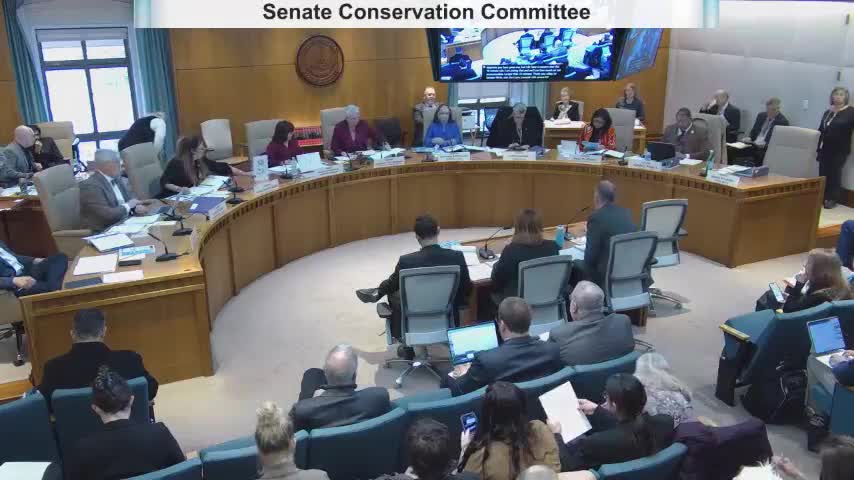
Summary
Senate Bill 21 moved out of the Senate Conservation Committee on a 6-3 vote after hours of testimony and questions about enforcement, fees and a private right of action.
Senate Bill 21 moved out of the Senate Conservation Committee on a 6-3 vote after hours of testimony and questions about enforcement, fees and a private right of action.
Sen. Daniel Wirth, the Senate sponsor, told the committee that "Senate Bill 21 lays the groundwork for the Environment Department to implement the federal Clean Water Act." The bill would allow New Mexico to seek state authorization to issue and enforce National Pollutant Discharge Elimination System permits now administered by EPA Region 6 in Dallas.
Why it matters: Committee supporters said bringing permitting to New Mexico will localize decisions and speed reviews for projects and dischargers; opponents warned the new program could impose fees and penalties on municipalities, farmers and small entities and create litigation. Vidal Gonzales of the New Mexico Farm/Executive Association said the change would "bring permitting ... home to New Mexico." Carlos Matotes of Green Latinos testified that recent court decisions have left "95% of New Mexico's surface water is no longer protected by the Clean Water Act," and called for state action.
What the bill does: SB21 directs the New Mexico Water Quality Control Commission to adopt rules so the New Mexico Environment Department (NMED) can administer a state NPDES-style permitting program. Sponsor testimony said the change is intended to replicate the federal program and that NMED has worked with EPA and convened a 49-member Surface Water Advisory Panel that met six times in 2024 to advise rule and policy development.
Key points raised in committee: - Enforcement and funding: Committee members and local agencies asked where fees and penalty revenues would flow. NMED said penalties would flow to the state school fund while permit fees would come to a Water Quality Management Fund to support the program; the department told senators it already has appropriations from prior sessions but will need additional recurring resources and roughly 50 additional full-time staff for full implementation by the late 2020s. - Private right of action and litigation: Several opponents, including agricultural and industry groups, urged removal or revision of a private right of action in the bill that would allow private suits to enforce discharge laws; sponsor and committee members said that federal law already contains a private right of action and the provision was modeled on federal language but likely will be refined in Senate Judiciary. - Exemptions and industry concerns: Agriculture, oil-and-gas and municipal flood-control authorities sought assurances that longstanding federal exemptions (for many normal farming and ranching activities and some industry practices) would carry forward. Sponsor and department representatives said an amendment and the companion bill (SB22) are intended to align state exemptions with federal practice.
Public testimony: Dozens of proponents — including environmental groups, tribal representatives, acequia advocates and some irrigators — urged the state to take control. Opponents included the New Mexico Cattle Growers Association, the New Mexico Oil and Gas Association, municipal flood-control authorities and chambers of commerce, who warned of fee burdens, staffing shortages and uncertain impacts on local infrastructure.
Committee action and next steps: Senator Hamblin moved that SB21 be reported with a do-pass recommendation; the committee secretary recorded a 6-3 vote, and the chair sent the bill to the next committee referrals (including Senate Judiciary and Senate Finance) for further scrutiny of penalties, the private right of action and funding.
What remains unresolved: The bill language as presented leaves open the final fee structure, the handling of attorney-fee awards in private suits, the precise scope of exemptions, and some criminal penalty provisions. Committee members repeatedly said those technical and legal issues would be the subject of additional hearings in Judiciary and Finance.
For now the committee's action advances the bill to the next step in the legislative process; several senators said they expect substantive amendments in subsequent committees.
Ending: The committee advanced SB21 with direction that Judiciary and Finance review the private right of action, penalty levels and the fee/funding approach before the bill reaches the floor.