Get Full Government Meeting Transcripts, Videos, & Alerts Forever!
Get email alerts on the City Budget Health Insurance topic
No spam. Unsubscribe anytime.
Jefferson City budget committee hears repeated shortfalls in self-funded health plan, seeks $1.15 million gap
Summary
Council members and city finance staff discussed persistent shortfalls in Jefferson City’s self-funded employee health insurance, reviewing past supplemental appropriations, updated 2025 projections and options for tracking and chargebacks; no new appropriation was adopted at the meeting.
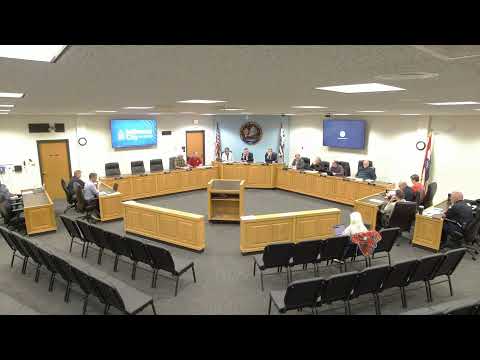
Councilmember Hobelson called the meeting to order and moved to approve the committee’s agenda. The committee then focused on the city’s recurring shortfalls in its self-funded health insurance fund and on updated projections for fiscal 2025.
The most immediate issue is a projected shortfall in the city’s 2025 health-insurance budget. Sheila (finance staff) told the committee that an earlier projection showed a shortfall of about $1,600,000 for 2025, and that after removing projected “quantify” savings and adjusting the opt-out estimate the current enrollment-based shortfall stood at about $1,151,000. “So what you have on the right side of the page is actually the same funding rates, 2025 funding rates, and it's based on our actual 2025 enrollment,” Sheila said as she reviewed the handout.
Why it matters: committee members said repeated supplementals have drained funds that otherwise could have paid for core city services. Councilman Lester noted the pattern of rising supplemental appropriations in recent years and asked why 2023 spiked; Sheila said the cost pattern is claims-driven. “So that is a draw,” she said, describing how large claims years draw the health-trust fund down to zero and require supplemental appropriations.
Background and figures: Sheila reviewed supplemental appropriations tied to the self-funded health program over recent years: 2020 — $125,000; 2021 — $350,000; 2022 — $1,227,000; 2023 — $2,400,000; and a later supplemental of $750,000 for 2024. She told the committee that, from 2020 through the most recent supplementals, city funds spent directly on the self-funded health plan total about $4,842,000. Those figures were presented as part of explaining why the fund balance has been repeatedly drawn down.
Projections and assumptions: earlier 2025 modeling from the city’s broker (McGriff) produced the larger $1.6 million shortfall, which included an assumed $1.12 million in quantified savings and an opt-out credit calculated originally on 73 employees. After removing the quantified-savings assumption and updating the opt-out to 84 participants at $343 per month, the updated shortfall was presented as roughly $1,151,000. Sheila also said the broker provided an overall 2025 cost estimate used for planning.
Tracking and timing concerns: several council members said the city needs better month-to-month tracking of claims and payments to understand trends earlier. Sheila said the city tracks expenditures when it is obligated to pay and provides a monthly fund-balance report that flags anticipated supplemental needs; she told the committee she would prepare a month-by-month payment document for the committee. Council members noted that claims processing has a lag and that final, verifiable totals typically do not stabilize until late in the following fiscal year.
Options discussed: committee members raised administrative chargebacks (allocating the shortfall by department/fund) and other internal adjustments as stopgap measures. One committee member voiced concern that repeatedly zeroing the health-insurance reserve forces the city to delay or cancel capital and operating purchases — for example, road work, police vehicles and fire equipment — because limited general-fund dollars are diverted to cover insurance supplementals.
Outstanding uncertainty: the committee was told the opt-out/cafeteria-plan adjustment is in litigation and therefore may change; Ryan Flushing was named in the discussion as connected to that dispute. Several members emphasized that actual claim activity, not assumptions, determines the eventual supplemental request and that the 2025 shortfall will not be fixed until claims for the service period have been processed.
Outcome and next steps: no formal appropriations or policy changes were adopted at the meeting. The committee approved the meeting agenda at the start of the session. Staff committed to providing more granular monthly payment and fund-balance information to the committee so members can monitor claims trends and to return with allocation proposals (administrative chargeback schedules) that would spread a shortfall across funds. The committee will use that information to consider whether to propose policy changes, reserve targets or supplemental appropriations before April, when the city must finalize its approach for fiscal 2025.