Lifetime Citizen Portal Access — AI Briefings, Alerts & Unlimited Follows
Committee backs recognizing 911 telecommunicators as first responders; PERA raises funding questions
Loading...
Summary
Senators advanced Senate Bill 173 to reclassify public-safety telecommunicators (911 dispatchers) as first responders. Supporters cited high trauma, turnover and training costs; the Public Employees Retirement Association (PERA) urged further valuation of the cost and population before permanent reclassification.
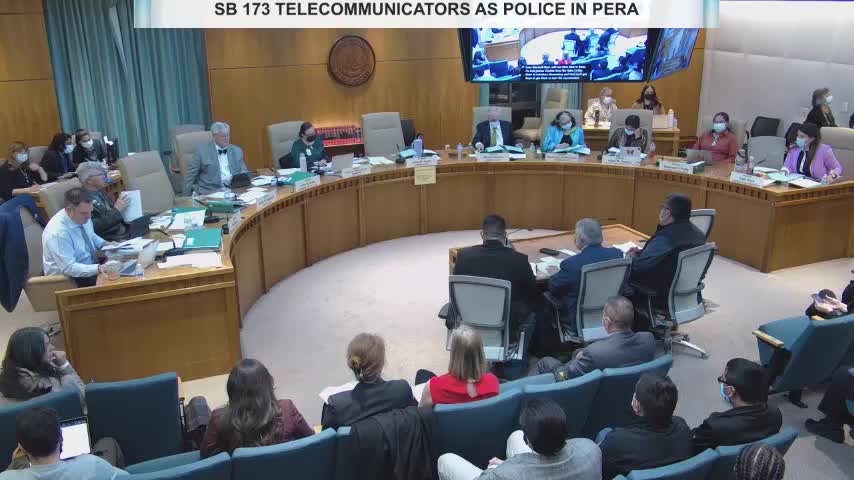
Senate Bill 173, which would reclassify public-safety telecommunicators (commonly known as 911 dispatchers) as first responders for purposes of benefits and retirement, received a favorable committee recommendation after extensive testimony from dispatch directors, union representatives and a coalition of public-safety groups.
Marshall Abdi, training coordinator at the Santa Fe Regional Emergency Communication Center, told the committee dispatchers are the "first voice" in life-or-death calls and deserve recognition and resources aligned with that role. "These professionals are not simply answering phones," he said, describing duties that include giving CPR instructions and coordinating multiagency responses.
Joshua Archuleta, executive director of the Espanola 911 Regional Communication Center, said high call volumes, repeated exposure to trauma and rapid turnover make retention difficult. "A 2022 study shows 32 percent of 911 dispatchers develop PTSD due to repeated exposure of trauma," Archuleta said; witnesses also cited a 30–40 percent turnover range among New Mexico centers and an estimated $40,000 cost to train a new dispatcher.
Unions, municipal dispatch directors and public-safety partners — including AFSCME, the New Mexico Federation of Labor and local fire chiefs — urged the committee to pass the bill to improve recruitment, retention and mental-health supports for dispatchers who work long shifts and high-stress conditions.
Several dispatch center directors provided operational detail: New Mexico handles a high per-capita 911 call volume, one witness said, and some rural areas cover large territories (one center described a 6,000-square-mile dispatch area). Testimony also noted existing recruitment and retention problems: median tenure figures cited during the hearing put typical dispatcher tenure at about five years; advocates argue reclassification would enable longer careers and reduced turnover.
PERA executive director Greg Trujillo appeared in opposition or to register concerns about the retirement-fund impact. He said accurate actuarial valuation requires a comprehensive list of affected employees; earlier estimates the sponsors have used ranged from a few hundred to more than a thousand dispatchers. "We don't know what that population actually is," Trujillo told the committee, and recommended working with sponsors in the interim to build a complete roster for valuation before fully implementing a benefit change.
Supporters said they have compiled registration numbers with Department of Public Safety and other dispatch rosters: testimony cited roughly 1,037 dispatchers registered with DPS, 832 currently employed and 519 certified dispatchers, figures sponsors offered to PERA for analysis. Committee members pressed for further cost modeling; sponsors agreed to work with PERA and other stakeholders.
After testimony and questions, the committee recorded a roll-call vote and reported the bill with a favorable recommendation (9 yes, 1 no). Supporters acknowledged PERA's analysis will likely be necessary in later phases and said they would work with the retirement system and public-safety agencies to refine implementation details.