Get AI Briefings, Transcripts & Alerts on Local & National Government Meetings — Forever.
Senate committee advances bill to require state process for U-visa certifications amid preemption debate
Loading...
Summary
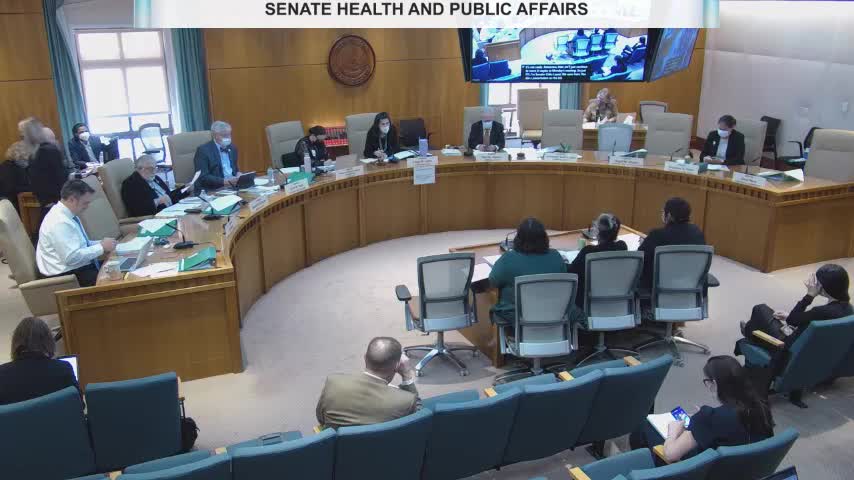
The Senate Health and Public Affairs Committee voted 6–3 to recommend Senate Bill 177 to the Judiciary Committee after a lengthy debate over whether the state may require a uniform process for U‑visa certifications without conflicting with federal immigration law.
The Senate Health and Public Affairs Committee voted 6–3 to recommend Senate Bill 177 to the Judiciary Committee after an hours-long debate over federal preemption and the proper role of state agencies in the U‑visa certification process.
The bill would require agencies that can sign U‑visa certification forms — including police departments, district attorneys and courts — to establish a public process and timelines for responding to certification requests, and it would create internal review steps at the attorney general’s office and, ultimately, allow judicial review if a request is denied, according to sponsors and witnesses.
Supporters said the change does not alter federal authority to grant or deny U visas, which is held by U.S. Citizenship and Immigration Services, but instead ensures survivors of crimes who cooperate with investigations do not lose access to a needed federal procedural step because local agencies lack a written policy or refuse to act. "SB 177 does not regulate immigration status, and thus, there is no preemption issue here," said D'Shonda Zapata, an immigration practitioner testifying for the bill. "This provides the same scheme that's under federal law but applies it to state actors."
Opponents — including several committee members and a written comment from the Administrative Office of the Courts — warned the measure could create additional state-level procedures that conflict with federal law or would impose burdens on small local agencies. Senator Scott argued the bill could be read as creating a private right of action or otherwise removing appropriate discretion from certifying agencies. The sponsor countered that the proposal establishes a review process, not a new private tort.
Several senators raised case law concerns, citing Arizona v. United States (2012) and other rulings that limited states' authority when laws directly regulate immigration enforcement. Supporters responded that SB 177 was narrowly drafted to address only state actors' participation in the federal U‑visa certification step and to mirror federal regulatory language for eligibility and timing.
Committee discussion also included practical examples supporters said justify the bill: witnesses described instances in which law enforcement or prosecutors declined to sign certification forms for reasons unrelated to whether the victim had assisted an investigation, leaving victims unable to proceed with federal applications.
After debate the committee approved the measure on a 6–3 vote and referred it to the Senate Judiciary Committee for further consideration. The motion to "do pass" was moved on the floor and recorded as referred to Judiciary.
What happens next: Judiciary will receive SB 177 and may hold hearings, adopt amendments or vote to send it to the full Senate. If enacted, the law would require agencies to document procedures for handling U‑visa certification requests and create a state-level review path short of removing federal adjudicatory authority.
Votes at a glance: The committee recorded a 6–3 recommendation to refer SB 177 to Judiciary.