Get AI Briefings, Transcripts & Alerts on Local & National Government Meetings — Forever.
Committee approves technical updates to Off Highway Vehicle Act to reflect larger vehicles and clarify reciprocity
Loading...
Summary
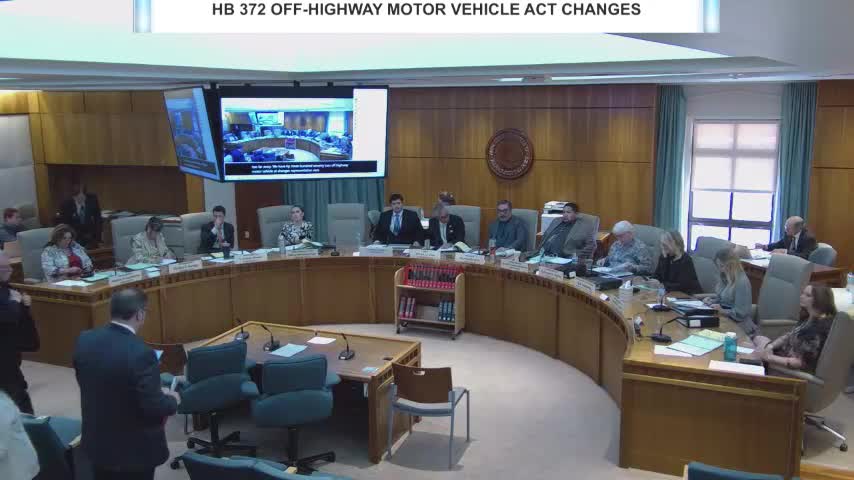
HB 372 — described by sponsors as primarily clean‑up — was advanced by the House Transportation, Public Works & Capital Improvements Committee to update statutory definitions for recreational off‑highway vehicles, correct passenger restrictions for young operators and stop reciprocity that exempts nonresident riders from registration fees.
Representative Dow presented House Bill 372 as a package of technical updates to the Off Highway Vehicle Act, saying much of the bill "is mostly clean up" to reflect changes in vehicle size, engine displacement and industry practice. "This bill aims to update and correct several provisions of the Off Highway Vehicle Act," Christopher Johnson, who testified for NMOHVA, told the committee.
The nut graf: HB 372 updates the statutory definition of recreational off‑highway vehicles (ROVs) to capture newer, larger machines; clarifies that reciprocity with other states will be eliminated so New Mexico can capture nonresident registration revenue; and fixes a provision that prevented some supervised teen operators from carrying a passenger in a side‑by‑side vehicle even when a parent or guardian sat in the passenger seat.
Johnson noted four major elements: update the ROV definition to include machines that exceed prior gross vehicle weight and engine displacement limits; remove the reciprocity clause that has allowed out‑of‑state riders to avoid New Mexico registration (reducing state revenue); fix a statutory inconsistency preventing a supervised 17‑year‑old from carrying passengers in ROVs; and other clarifying language so enforcement and registration officials can apply the law to modern machines.
Public testimony came largely from OHV owners, event organizers and local officials who said the sport and vehicles have changed since the 2016 iteration of statutes. Charles Warren of Elephant Butte said the bill "is a necessity" to update language and help the state capture revenue from nonresident riders. Edna Traeger of Elephant Butte urged the committee to support reciprocity changes and noted family participation in modern OHV events.
Representative Lester moved a do‑pass recommendation; the committee took a roll call and recorded affirmative votes by a majority of members, and Chair Dela Cruz announced a do pass.
Ending: The committee advanced HB 372; sponsors and supporters said the bill will help law enforcement and the Game and Fish Department administer registration and safety outreach more effectively as OHV equipment evolves.