Get AI Briefings, Transcripts & Alerts on Local & National Government Meetings — Forever.
Committee advances bill letting municipalities, counties allow off‑highway vehicles on paved roads
Loading...
Summary
The House Transportation, Public Works & Capital Improvements Committee voted to give HB 371 a do‑pass recommendation after testimony from rural officials and recreation stakeholders urging local control and clearer rules for off‑highway vehicle (OHV) use on paved streets and state highways inside municipal or county boundaries.
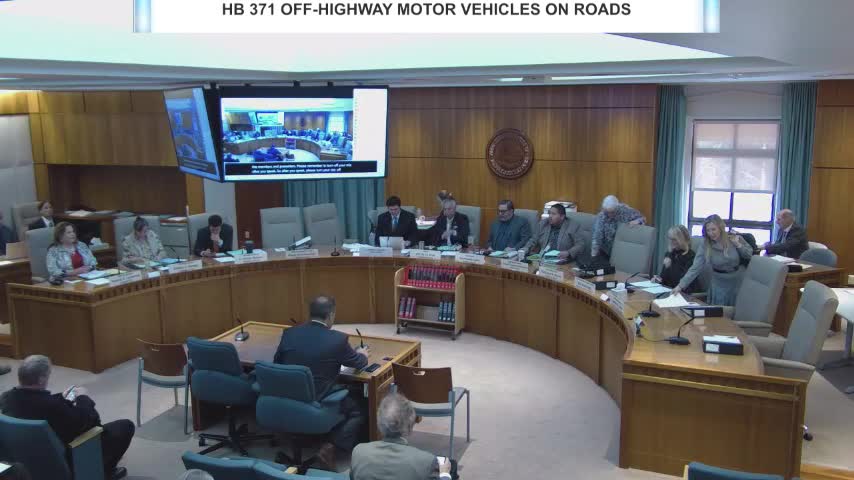
Representative Terrazas presented House Bill 371 to the House Transportation, Public Works & Capital Improvements Committee, saying the measure would transfer final authority to allow off‑highway vehicles (OHVs) onto paved streets and state highways within a municipality’s or county’s political boundaries from the State Transportation Commission to the local elected authority. "This bill would basically remove them from the deciding factor," Terrazas said, describing conflicts where communities have sought permission but the commission has not acted.
The nut graf: Supporters told the committee the change would clear confusion for riders and boost local economic development, while proponents and committee members emphasized that local governments would still control when and where OHVs could operate and that interstates would remain excluded.
Committee testimony came largely from rural officials, event organizers and businesses. Howard Hutchinson, a registered lobbyist for the Coalition of Arizona and New Mexico Counties, said counties have pushed for OHV loops and expect local rules and enforcement to address trespass on private lands. Les Gaines, who represents Grants, said a high‑attendance event was canceled because OHVs could not legally traverse short paved stretches that connect trail segments. Amy Gaines noted that some OHV owners pay for license plates and insurance and expect clarity about where they may ride.
Christopher Johnson, appearing later as a witness for a companion clean‑up bill (HB 372), described technical changes to the Off Highway Vehicle Act and said some OHVs now exceed statutory size and weight thresholds. Johnson also told the committee that reciprocity provisions currently allow New Mexicans to use out‑of‑state registrations even though neighboring states do not reciprocate, which reduces nonresident registration revenue.
Committee members raised questions about urban versus rural impacts, safety for other motorists and whether municipalities could be more restrictive. Representative Borrego asked whether municipalities could adopt stricter rules for urban areas; Terrazas replied that local authorities would set limits and that the bill does not permit interstate access. Representative Brown and others said the confusion over signage and where plates and permits apply is a major local concern.
Votes at the committee level: Representative Armstrong moved a do‑pass recommendation, seconded by Representative Brown. The roll call recorded affirmative votes from Representatives Armstrong, Borrego, Brown, Dow, Hernandez, Hockman Behel, Jones, Lundstrom, Romero, Vice Chair Latta and Chair Dela Cruz; the committee reported a do pass on HB 371.
Ending: Supporters said the bill aims to let local elected officials design ordinances that match local road networks and tourism patterns; opponents were not recorded during this hearing. The committee advanced HB 371 to the next chamber step.