Panel advances $12 million military base impact fund, repeals sunset for planning office
Loading...
Summary
The House Labor, Veterans and Military Affairs Committee voted to send a committee substitute for House Bill 158 to the next stage after testimony supporting a $12 million Military Base Planning Commission Project Fund and repeal of the office's sunset.
Representative Debbie Serranana introduced House Bill 158, the Military Based Planning and Impact Act, to create a project fund to help communities supporting federal military installations address infrastructure needs outside base fences, and to repeal a sunset on the Office of Military Base Planning and Support and the Military Base Planning Commission.
“The Military Base Planning Commission is proposing the creation of the project fund within our authorizing legislation to assist installations in addressing critical infrastructure needs and contributing to the mission of resiliency as well as the overall quality of life for military personnel,” said Paul Cassidy, a member of the Military Base Planning Commission, testifying in support. Cassidy said the commission proposes a $12 million appropriation to create the project fund and noted other states have larger programs used to attract and retain missions.
Supporters described a range of potential projects and local matches: Clovis has identified a failing wastewater treatment plant with an estimated cost in the tens of millions; Kirtland has a failing 72‑inch sewer line that near‑term county investments helped fix; and communities have asked for help with roads, railroad crossings, fencing and other infrastructure immediately outside installation gates.
Megan De La Rosa of the Kirtland Partnership Committee and Sherman McCorkle of the Greater Albuquerque Chamber of Commerce emphasized strategic value: De La Rosa called the bill “a vital initiative” to modernize facilities and attract investment, and McCorkle said the Department of Defense increasingly evaluates community support when assigning missions.
Paul Cassidy said the committee substitute includes a 10 percent local match requirement and that the commission intends the $12 million to be nonreverting to allow time to develop grant rules and evaluate projects. He told legislators the appropriation could be leveraged many times over as communities combine state funds with federal or local dollars.
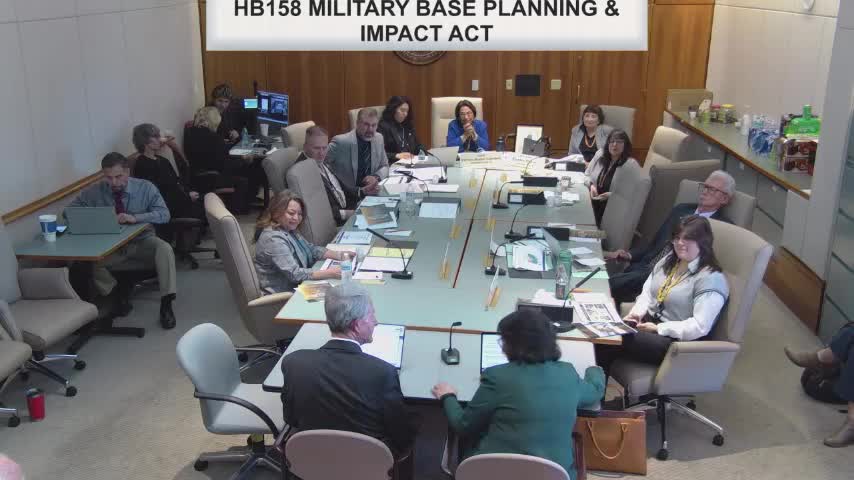
The committee heard additional testimony from the lieutenant governor’s office, the veterans caucus and municipal representatives; no members of the committee registered opposition on Zoom or in the room during the hearing.
After discussion, the committee moved a procedural pair of motions and by voice agreed to a do‑not‑pass on the original House Bill 158 while approving a due pass for the committee substitute (the committee substitute is the bill vehicle that will advance). The committee recorded no formal opposition during that voice action. The substitute creates the Military Base Planning Commission Project Fund, authorizes grant awards for infrastructure and repeals the statutory sunset for the office that administers the commission.
Supporters said the fund could be used for projects “immediately outside the fence” — a phrase the commission used to describe base service areas — and emphasized flexibility so grants can cover varied needs rather than a strict mile radius.
Committee members asked about rules, match requirements, leveraging potential and whether the commission intends to fund only capital projects. Cassidy said the fund will prioritize critical infrastructure and quality‑of‑life projects but that program rules will determine eligible project types and that many projects will be partnered with federal and local funds. He said the commission intends to test the grant process with a $12 million appropriation and then return to the legislature if additional funds are justified.