Lifetime Citizen Portal Access — AI Briefings, Alerts & Unlimited Follows
Committee advances bill letting retired educators change designated beneficiary once
Loading...
Summary
House Bill 251 would allow members of the Educational Retirement Board to change a previously designated spouse beneficiary one time (mirroring PERA rules). The committee gave the bill a due pass with no recorded opposition.
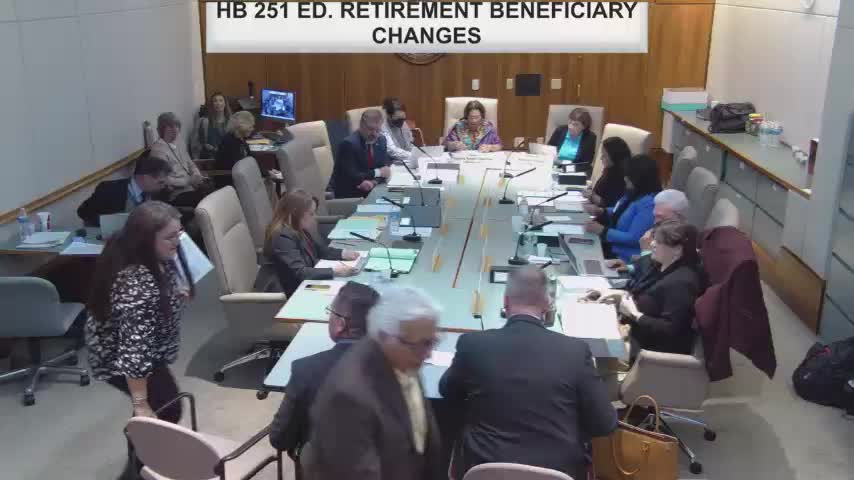
A bill to permit retired members of the Educational Retirement Board to change a spouse beneficiary one time cleared the House Labor, Veterans and Military Affairs Committee on Wednesday. Sponsors said HB251 aligns ERB law with similar provisions under the Public Employees Retirement Association and drew no opposition in committee.
Representative Hall presented the bill and said the measure “provides additional options to change the beneficiary for retired members who have designated a spouse as a beneficiary.” Witnesses from ERB and school-superintendent groups urged support, describing the change as a modest technical alignment that would help retired educators and other ERB participants manage beneficiary designations.
David Archuleta, executive director at the Educational Retirement Board, told the committee ERB currently performs actuarial adjustments when a retiree elects a beneficiary option. He explained the one-time, irrevocable change is an actuarial decision: “Once the retiree selects the benefit, there's an actuarial calculation that's performed,” he said, and changing it again would alter the benefit value. Committee members asked about the $100 processing fee referenced in the bill; ERB staff said the fee covered administrative costs tied to an actuarial calculation and that removing or waiving it would require drafting changes in multiple bill sections and a fiscal analysis.
School superintendents and the American Federation of Teachers-New Mexico testified in favor, saying the change would help districts retain experienced educators and provide administrative clarity. Representative Hall said the request was prompted by conversations with a retired teacher constituent and said the measure was intended to be narrowly tailored to match PERA’s current approach.
Representative DeRaza moved a due pass, seconded by Representative Mejia; the committee recorded no opposition and advanced the bill.
Committee members asked staff to review the fee language and consider whether the $100 charge could be reduced or waived and to provide any fiscal impacts for future committee action.