Get AI Briefings, Transcripts & Alerts on Local & National Government Meetings — Forever.
Committee supports one‑time $66 million payment to provide a thirteenth check to PERA retirees
Loading...
Summary
House Bill 96, which would appropriate about $66 million for a one‑time thirteenth check to public retirees, received a do‑pass recommendation with no recorded opposition. Sponsors and union representatives framed the payment as short‑term relief while the Public Employees Retirement Association continues long‑term solvency reforms.
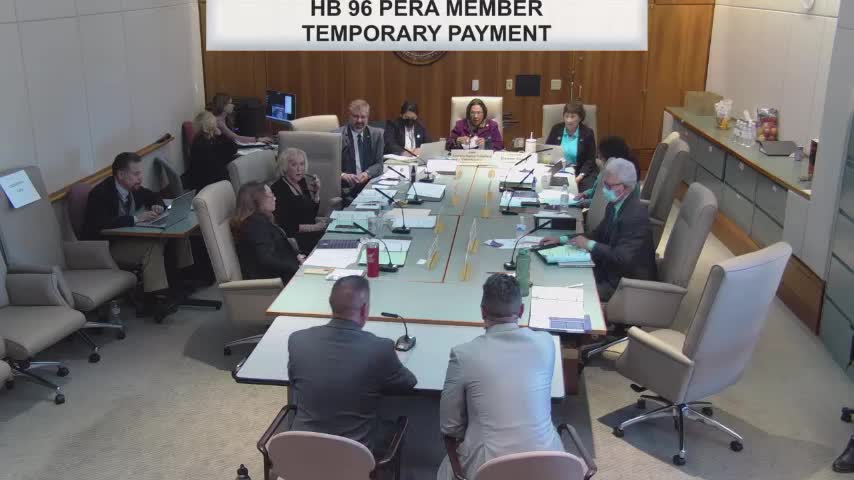
House Bill 96, an appropriation that would fund roughly $66 million to pay a non‑recurring “thirteenth” check to Public Employees Retirement Association (PERA) retirees, received a do‑pass recommendation from the committee by acclamation and no recorded opposition.
Greg Trujillo of PERA told the committee the payment is intended as limited relief for retirees who have lost purchasing power; PERA’s funded ratio was cited in committee as about 67 percent. Trujillo and witnesses said that more structural fixes to PERA’s long‑term solvency are in place or underway — including contribution increases enacted in prior reforms — but that those reforms take decades to fully affect the system.
Union witnesses and retirees’ representatives urged support. “Our retirees clearly need a bigger COLA. They lost a lot of ground over the last five or six years,” said Carter Bundy of AFSCME. Supporters asked that any payment be fully funded so the appropriation does not worsen long‑term solvency.
Committee members asked technical questions about funding, amortization and reform history. PERA staff provided high‑level figures: PERA’s unfunded actuarial accrued liability was discussed in the hearing as roughly $8.7 billion, with assets near $18.2 billion and promised benefits in the mid‑$20‑billion range. Witnesses described prior reforms (2013 and 2020) that reduced automatic compounded COLAs and increased contribution rates; speakers said those reforms require years to materially change the funded ratio.
Action: The committee moved a due‑pass on the bill with no recorded opposition; the bill was forwarded to the House for further consideration. The committee record shows advocates and PERA staff asking that any benefit be fully funded and not impair long‑term solvency.
End: The committee recommended the appropriation; next steps are House floor scheduling and final budget negotiations.