Get AI Briefings, Transcripts & Alerts on Local & National Government Meetings — Forever.
Committee endorses six‑year pilot for community criminal justice diversion project
Loading...
Summary
House Bill 354, creating a six-year Community Criminal Justice Diversion Project to route eligible people with behavioral health needs away from prosecution and into treatment, received a "do pass" recommendation after extensive testimony on structure, local implementation and data collection.
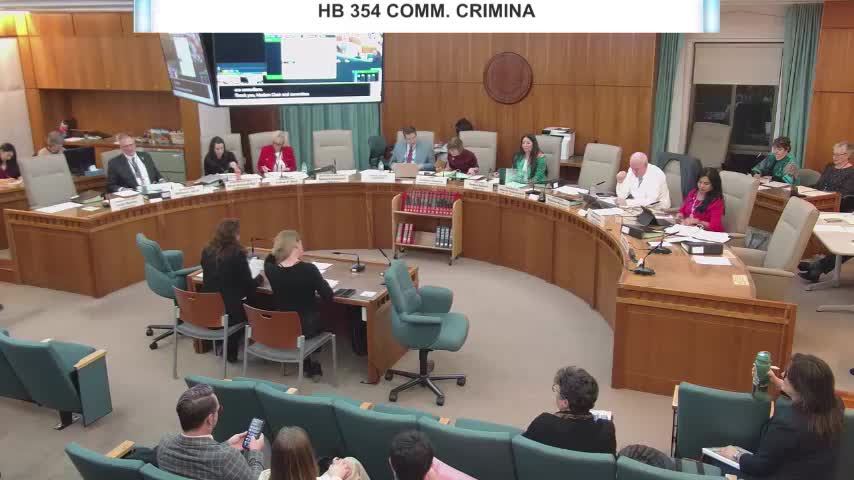
The House Judiciary Committee voted to give a "do pass" recommendation to House Bill 354, which would establish a six‑year pilot Community Criminal Justice Diversion Project housed in the Behavioral Health Services Division of the Health Care Authority.
Representative Luhan, sponsor of the bill, said the project does not amend existing statutes but adds a new section within statutory authority to establish a pilot fund and program guidelines. The measure defines diversion as an agreement interrupting criminal proceedings to allow eligible people to receive mental‑health and behavioral‑health interventions instead of traditional adjudication. The bill creates a Community Criminal Justice Diversion Project Fund to provide financial assistance for participants and to support program operations.
The pilot would require collaboration among law enforcement, judiciary, behavioral‑health service providers and local jurisdictions. Required program components include a community referral process, mobile crisis response teams and pre‑arrest diversion policies for at least petty misdemeanors and municipal violations; post‑arrest diversion for some full misdemeanors requires district attorney approval.
Supporters from disability advocates, civil liberties groups, Equality New Mexico, the New Mexico Coalition to End Homelessness, NAMI and others said diversion is often a better fit for people whose offenses stem from untreated mental illness. Ellen Pines (Disability Coalition) said, "There are cases where there is no next of kin to step forward," emphasizing the need for continuity of care. Daniel Williams (ACLU/Public Safety Coalition) and other witnesses urged the committee to approve the pilot as a way to reduce recidivism and community harm.
Committee members asked detailed questions about entry points (pre‑arrest, post‑arrest or law‑enforcement‑initiated), victim notification and the relationship to existing pre‑prosecution diversion programs. Sponsors and experts said the pilot is intentionally flexible to accommodate local models and will require reporting to the legislature, with an annual report and a final report at the end of the six‑year pilot to inform any permanent implementation.
The motion for a "do pass" carried and the chair announced a "do pass" recommendation. Supporters urged follow‑up with the Health Care Authority and Behavioral Health Services Division on administrative and evaluation details.