Get AI Briefings, Transcripts & Alerts on Local & National Government Meetings — Forever.
Committee advances bill to allow tenant co-ops chance to buy mobile home parks
Loading...
Summary
House Bill 426 would create a time-limited right for a resident group to organize and make an offer to buy a mobile home park when the owner accepts a third-party purchase; the committee reported the bill out on a do-pass recommendation as a committee substitute after extensive questions about thresholds and financing.
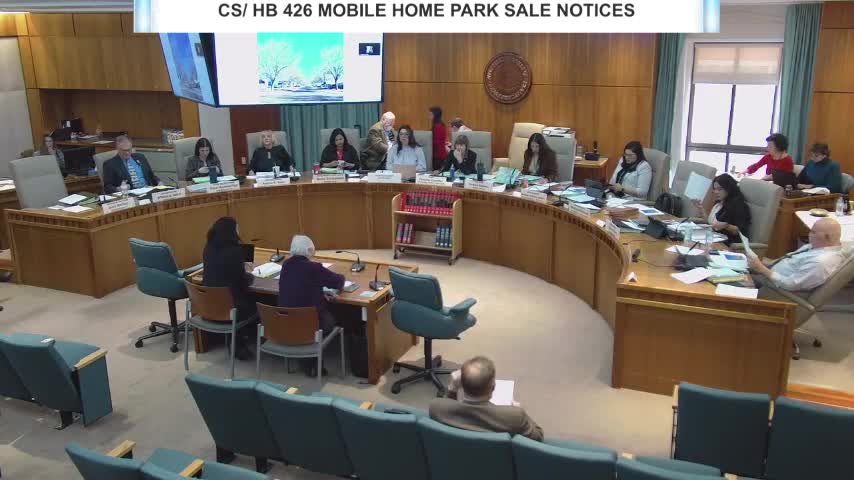
The committee issued a do-pass recommendation on the Commerce and Economic Development committee substitute for House Bill 426, legislation designed to give residents of manufactured-home communities an opportunity to organize and buy the park if an owner accepts an offer from a third party.
Sponsors and proponents framed the measure as a stability tool for thousands of residents who live in manufactured-home communities. Representative Barajone and a co-sponsor told the committee there are roughly 380 mobile-home communities statewide that represent about 17% of New Mexico’s housing stock; residents fear sale of their parks to out-of-state investors could lead to rent hikes, neglected maintenance and displacement.
Under the committee substitute, when an owner receives a bona fide offer to buy a park, the owner must notify residents and certain state housing finance entities. If at least 51% of residents agree to proceed, residents have a statutory window to organize, form a cooperative or similar entity, and make an offer that is "substantially equivalent" in price and terms to the third-party offer. The resident group would typically obtain financing — proponents described working with Community Development Financial Institutions, the Mortgage Finance Authority and other public lenders — and close within prescribed timelines. The bill includes exemptions similar to statutes in other states (foreclosures, transfers to family members or related-party transactions) and a mechanism allowing owners to accept a new higher offer, which would restart the resident-notice period.
The committee substitute's 51% threshold and the timelines drew extended questioning from committee members who pressed sponsors on what happens to the other 49% of residents, how "substantially equivalent" will be assessed, whether the required disclosures include the third-party price and terms, and how financing would be secured. Witnesses from ROC USA and ROC USA partner organizations described typical cooperative structures used in other states: once organized, a resident cooperative owns the land and rents lots to homeowners under proprietary leases; evidence from other states showed high buy-in rates when resident purchases occur.
Brent Moore of the New Mexico Association of Realtors testified in opposition, saying the bill restricts owners’ property rights and raised concerns about ambiguous language such as "substantially equivalent" in price and terms. Proponents — including the New Mexico Center on Law and Poverty, Conservation Voters New Mexico, Lutheran Advocacy and residents who described sudden sales and rent hikes — urged the panel to pass the bill to preserve affordable housing and community stability.
Representative Romero moved a do-pass on the committee substitute; the chair announced the committee had a due pass on the substitute for House Bill 426. The transcript records the chair’s announcement that the substitute received a due pass; the numerical vote tally is recorded in the transcript as a roll call but the published text here does not reproduce each individual recorded vote count.