
Committee advances companion carbon‑sequestration bills; one gets do‑pass, stewardship fund moves forward
Get AI-powered insights, summaries, and transcripts
Subscribe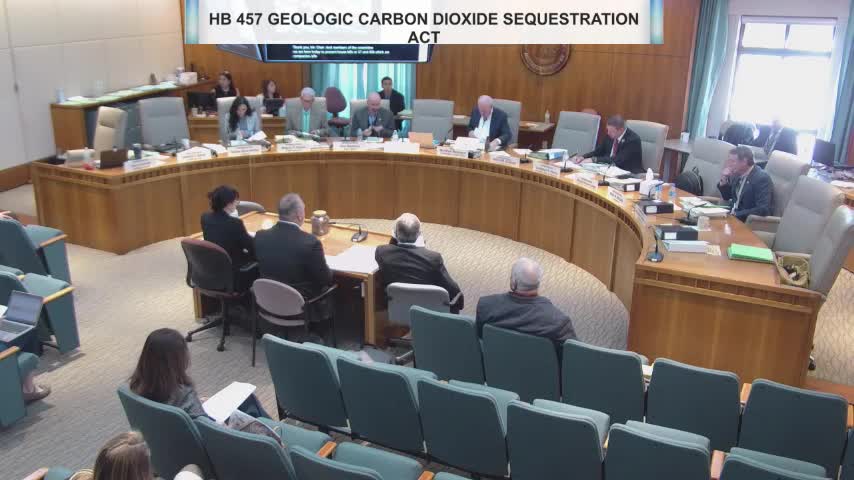
Summary
The House Energy, Environment & Natural Resources Committee on March 1 gave a do‑pass recommendation to a bill establishing a state regulatory framework for geologic CO2 storage and approved a companion stewardship fund bill with an amendment delaying state takeover for at least five years after injection stops.
The House Energy, Environment & Natural Resources Committee on March 1 advanced companion bills aimed at enabling geologic carbon dioxide sequestration in New Mexico and creating a state fund to support long‑term site stewardship.
Representative Andrea Dixon presented House Bills 457 and 458. HB457 would create a state‑led regulatory framework for carbon dioxide injection and storage and position New Mexico to seek Class VI primacy under the EPA underground injection control (UIC) program. HB458 would establish a Geologic Carbon Dioxide Stewardship Fund, financed by a per‑metric‑ton fee on injected CO2, to pay for post‑closure monitoring and any necessary remediation.
Supporters, including the governor’s senior climate adviser Travis Kellerman and Clean Air Task Force, argued the bills are necessary to attract investment in carbon management, diversify the energy economy and enable industrial decarbonization. Kellerman said the bills provide certainty around pore‑space ownership, unitization and financial assurance, and called the package “a triple win for the industry, the environment, and the state.” Dr. Robert Balch of New Mexico Tech stressed there is a long history of CO2 injection for enhanced oil recovery and disposal and said the science and federal regulations (Class VI) are mature enough to be implemented with state primacy.
Opponents, including Sierra Club Rio Grande, Earthworks and frontline coalition New Mexico NoCCS Solutions, expressed concerns that carbon‑capture-and-storage (CCS) could prolong fossil‑fuel infrastructure, pose groundwater and seismic risks, and shift long‑term liability to taxpayers. Charles Goodmacher of Earthworks urged stronger emergency response planning and said that many states retain operator liability for many years after closure; he warned New Mexico’s draft would allow a more immediate transfer of responsibility to the state.
The committee adopted an amendment to HB457 clarifying that pore‑space ownership is separable from the mineral estate, adding a requirement for a community benefits plan and requiring notice and other technical corrections. After discussion, the committee gave HB457 a do‑pass recommendation as amended on a recorded vote.
For HB458 (the stewardship fund), an amendment was adopted to require that an operator cannot receive a certificate of closure for not less than five years after injection has ceased; the amendment also clarified language about the fund’s permitted uses. The committee approved HB458 as amended; sponsors said the fee (10¢ per metric ton in the bill) would fund post‑closure monitoring and trust obligations and help the state avoid future orphaned‑site liabilities. The sponsor estimated the fund could collect several hundred million dollars over multiple decades with large projects in operation; critics and independent analysts noted the early years’ revenues would be small and urged a longer required operator liability period.
Votes at a glance: HB457 (primacy and framework) received a do‑pass recommendation as amended on a recorded vote the chair announced as 5–4. HB458 (stewardship fund) passed as amended on a recorded vote the chair announced as 5–3.
What’s next: With committee approval on the framework bill and stewardship fund, sponsors said they will pursue EPA Class VI primacy applications and continue stakeholder outreach; opponents urged further safeguards, stronger emergency response and longer post‑closure operator responsibility.
Reporting note: Quotations and vote language drawn from March 1 committee testimony and roll call.