Get Full Government Meeting Transcripts, Videos, & Alerts Forever!
Get email alerts on the Energy Storage Tax Credit topic
No spam. Unsubscribe anytime.
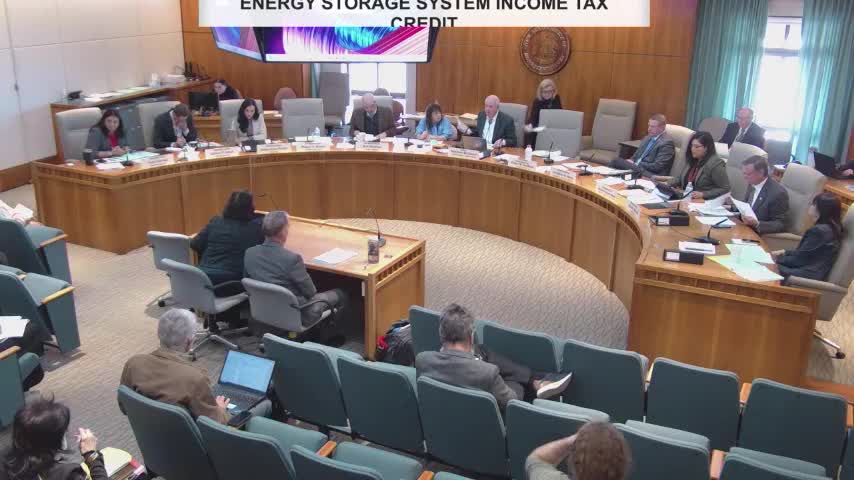
Committee approves income tax credit for energy storage systems, 6-4
Summary
The committee approved HB51 to create a state income tax credit for qualified energy storage installations; the measure passed on a 6-4 roll call after questions about safety, equity and lifecycle disposal.
The House Energy, Environment & Natural Resources Committee voted 6-4 to pass HB51, a bill creating a state income tax credit for certified energy storage systems, after public support from municipal and industry witnesses and questions from committee members about insurance, disposal and equity.
Representative Sarajan presented the measure, which would add new sections to state income-tax law and the corporate income and franchise tax act to create a nonrefundable credit equal to 40% of system cost for certified energy storage systems placed in service between Jan. 1, 2025 and Jan. 1, 2030. The sponsor and witnesses said the credit would encourage homeowners and businesses to pair storage with rooftop solar and increase grid resilience.
Under the bill text described during the hearing, the maximum credit would be $6,000 for a residential property and $150,000 for commercial, industrial or agricultural properties; the aggregate amount of credits that the Energy, Minerals and Natural Resources Department (EMNRD) may certify each year is capped at $6,000,000. Credits that exceed a taxpayer’s liability may be carried forward for up to five years.
Representative Sarajan said the credit aims to boost adoption and resilience: "House bill 51 would provide would promote wider adoption of energy storage throughout New Mexico and provide localized energy storage to property owners," the sponsor told the committee. Jim Deschardins, executive director of the Renewable Energy Industries Association of New Mexico, described storage as "the future of the solar industry" and said New Mexico’s storage attachment rate was about 1 percent compared with 12–15 percent nationwide.
Public testimony was broadly supportive. Randy Saglick of Positive Energy said incentives lower costs and provide resiliency; JD Bullington, representing the city of Santa Fe and Public Power New Mexico, called storage "absolutely vital" as the state moves through an energy transition. Several professional and civic organizations endorsed the bill, including the New Mexico Society of Professional Engineers and local clean-energy advocates.
Committee members pressed for more detail about program design and equity. Representative Murphy asked whether the residential/commercial distinction would exclude workers who operate businesses from home; witnesses said eligibility is tied to property type and that a home office would generally count as residential. Several members — including Representative Henry, Representative Montoya and Representative Cortez — asked about battery life expectancy, end-of-life disposal and insurance implications. Witnesses said typical warranties are roughly 10 years and that recycling and product-recovery practices are evolving; they recommended further work on cradle-to-grave management.
The sponsor offered an amendment that clarified that a single physical energy storage system may be claimed in only one category (residential versus nonresidential); the committee adopted the amendment without objection. On the final roll call to pass the bill as amended, the committee recorded six yes votes and four no votes (yes: Representative Abeta, Representative Dixon, Representative Garcia, Representative Grolla, Representative Small, Chair McQueen; no: Representative Cortez, Representative Henry, Representative Montoya, Representative Murphy). The clerk announced the motion to pass as amended carried 6-4.
Supporters said the credit would accelerate residential and commercial storage adoption, improve grid reliability during outages and integrate intermittent renewable generation. Detractors on the committee and in discussion urged further review of equity (because tax credits favor taxpayers with sufficient tax liability), insurance and recycling/disposal infrastructure before wide adoption.
With the committee vote, HB51 will proceed in the legislative process as a committee-approved bill (subject to the normal chamber and cross-committee steps).