
Judiciary asks Legislature for more staff pay, courtroom security and transcription technology as AOC seeks to absorb pretrial services
Get AI-powered insights, summaries, and transcripts
Subscribe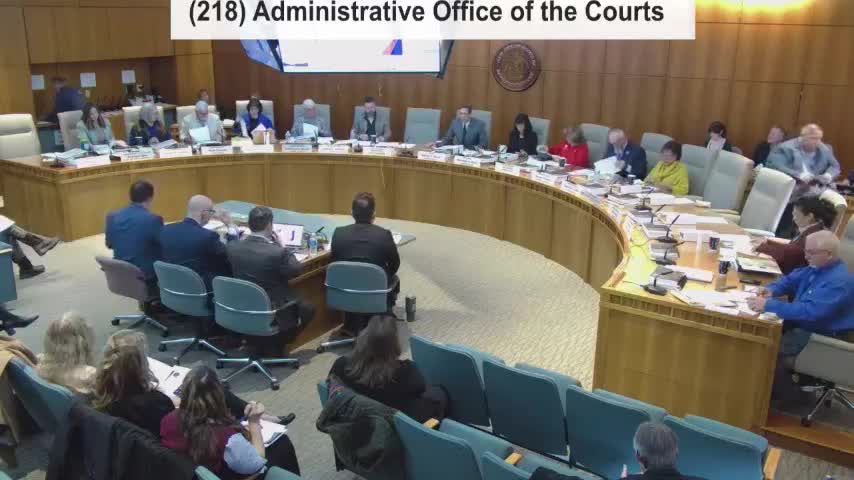
Summary
The Administrative Office of the Courts told the House Appropriations & Finance Committee it needs recurring funding for staff pay, jury costs and courtroom modernization, and that the Legislative Finance Committee recommended moving pretrial services into AOC’s budget.
The Administrative Office of the Courts told the House Appropriations & Finance Committee on Feb. 1 that it needs larger, recurring appropriations to stabilize staff pay, cover rising jury costs and update courtroom technology — and that the LFC recommendation to transfer pretrial services to AOC accounts for much of the program-level changes.
Chief Justice David Thompson, who and administers the courts statewide, told the committee that the judiciary’s top priorities this year are judicial raises, court security and improved technology, especially systems that deliver searchable, near‑real‑time trial transcripts. “Our judges deserve it. Our employees deserve it,” Thompson said, urging lawmakers to treat jury funding and security as core functions.
Why it matters: AOC and the courts said pay and security shortfalls are already affecting operations — employees often take second jobs and clerk offices are experiencing turnover — and that some county court infrastructure and interpreter contracts require recurring support. Modernized transcription is presented as a productivity tool for judges, prosecutors and defense attorneys because it would allow quicker access to trial records and more efficient appeals work.
What officials told lawmakers - Felix Chavez, the LFC analyst for the judiciary, summarized the budget differences and said the LFC recommendation exceeds the executive on several items because LFC included moving pretrial services funding into the AOC base and added one-time funding proposals for jury and automation funds. - Carl Ryfsek, director of the Administrative Office of the Courts, said AOC is a small slice of the state’s general fund — “we're less than 2½ percent of state government, general fund appropriations” — and described a multi‑part request that included staff, interpreter rate increases, permanent funding for IT security and a phased courtroom modernization plan. He told the committee the automation and hardware together are required: “If we don't fund both the hardware and the software, it doesn't happen.”
Key program details and numbers cited - AOC staff and turnover: AOC reported 214 employees statewide, with 97 hires in FY24 and 55 hires in FY25 — an indicator of high turnover. Several witnesses said dozens of AOC employees hold second jobs to make ends meet. - Jury and witness fund: AOC said it needs roughly $2.2 million to cover jury and witness costs through FY26; juror pay is set by statute at at least minimum wage, and increases in minimum wage have increased the judiciary’s cost. - Courtroom modernization: Officials described a multi‑year effort that could cost tens of millions. The chief justice cited a long‑term target of about $40 million for a full program to modernize audio, microphones, cabling and a searchable transcription backbone; DFA recommended a smaller, initial investment. - Security: The judiciary reported repeated, recent security incidents and described a request for capital and operating security investments (individual figures were described in the presentations and LFC/DFA narratives). - Interpreter and language access: AOC said demand for non‑Spanish interpreters (Vietnamese, Mandarin/Cantonese, Russian and others) is growing, pay lags neighboring states, and some language services must be provided remotely, expanding the hiring market nationwide.
Policy and process notes - Pretrial services transfer: LFC recommended transferring existing pretrial services funding into the AOC budget (previously funded through various district budgets). AOC officials cautioned that, if funds move administratively, locally based pretrial staff need to remain district employees in practice so they can be supervised and deployed across courthouses. - Behavioral health programs: The judiciary said pilot programs (competency diversion, assisted outpatient treatment/AOT and other treatment courts) have been launched in multiple districts and that one‑time special appropriations helped start them. Officials urged that recurring funding is needed to sustain and expand successful pilots.
What the committee did - The committee adopted the LFC recommendation for the AOC budget at the meeting (motion carried). That action was part of a sequence of votes on individual judicial entities’ budgets during the hearing.
Where things go from here Lawmakers and agency staff flagged the need for follow‑up work: more precise cost estimates for the transcription/hardware request, clarification about how pretrial operations would be administered if funding moves to AOC, and quarterly reporting on pilot behavioral health programs so the Legislature can evaluate and, if warranted, provide ongoing funding.
Ending note Several members praised the AOC for convening partners and developing pilot programs but said the committee must evaluate recurring funding to avoid leaving successful efforts underfunded after initial special appropriations end. AOC representatives said they would provide follow‑up breakdowns and work with LFC and DFA on implementation details.