Get Full Government Meeting Transcripts, Videos, & Alerts Forever!
Get email alerts on the Student Research topic
No spam. Unsubscribe anytime.
Longmont High students present protein research to board, cite CU Boulder mentorship and ASBMB conference
Summary
Students from Longmont High School’s Smart Team presented research on DNA gyrase and acetylcholinesterase, described mentorship from graduate students at the University of Colorado Boulder and recent presentations at the ASBMB conference in Chicago and a Northwestern University tour.
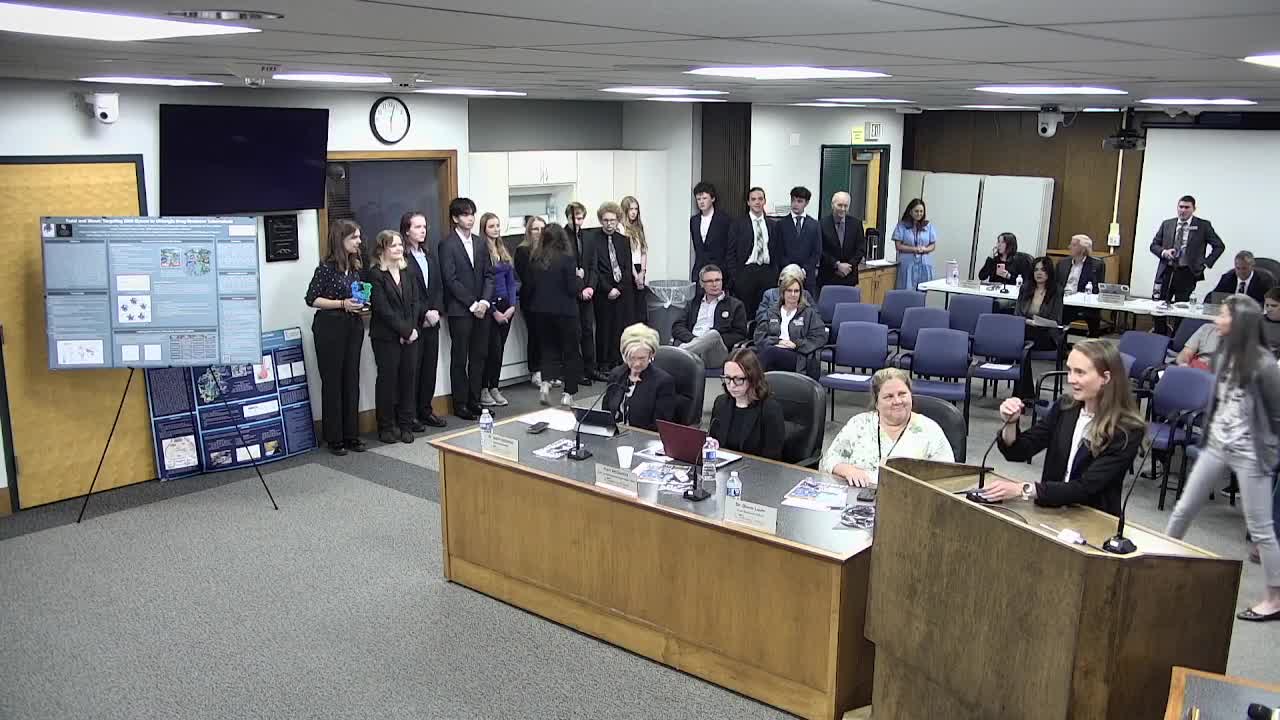
Students from Longmont High School’s Smart Team presented their year‑long protein research to the St. Vrain Valley Board of Education on May 20, describing laboratory modeling, 3‑D printing of protein subunits and conference presentations.
Kelly Loopman, chemistry teacher and MBSA coordinator, introduced the team and said their primary mentors were graduate students at the University of Colorado Boulder’s biochemistry and chemical engineering programs and that students “had the opportunity in April to attend the American Society for Biochemistry and Molecular Biology conference in Chicago where they got to present their work and also take a tour of the Northwestern School of Medicine.”
Seniors Sydney Zirdi and Leah Oldroyd presented the DNA gyrase project. Oldroyd explained in technical terms that “DNA gyrase is a type 2 topoisomerase, which means it is a protein that unwinds DNA during DNA replication,” and described how the team used 3‑D modeling and printing to study a specific subunit. Zirdi noted DNA gyrase’s relevance to tuberculosis, saying the protein “is uniquely found in tuberculosis cells” and that targeting the protein could present opportunities in addressing multidrug‑resistant tuberculosis.
On acetylcholinesterase, senior Anya Weeter described the protein’s role in muscle relaxation and discussed how a deep active site enables very fast chemistry: “how is it that acetylcholinesterase can break down 10,000 molecules of acetylcholine a second? That's because the gorge actually acts like a vacuum,” she said. Students noted that inhibitors of the enzyme range from medically useful drugs to toxic nerve agents and venoms, and discussed medical research into inhibitors for conditions such as Alzheimer’s disease.
Multiple students said the program’s mentors and travel opportunities were a highlight: students named tours and conferences in Seattle and Chicago and praised graduate student mentors from CU Boulder. Board members thanked the students for their work, praised the program’s role in developing future scientists and asked for a group photo at the end of the presentation.