Get Full Government Meeting Transcripts, Videos, & Alerts Forever!
Get email alerts on the Infrastructure topic
No spam. Unsubscribe anytime.
Public works official Gary Marks previews a busy summer of water, sewer and street projects in Dallas
Summary
Gary Marks gave his final committee briefing, listing completed water and parks work, and previewing multiple infrastructure projects slated for summer construction, including water-plant filter upgrades, sidewalk and ADA ramp work near schools, a major sewer phase and bridge funding tied to ODOT.
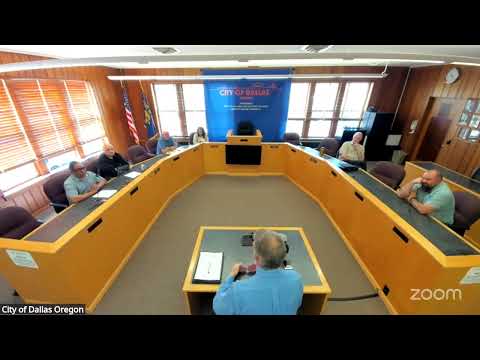
Gary Marks, a longtime public works official, told the committee at his final meeting that the department completed several capital projects this fiscal year and is entering what he described as “probably the most active summer for the public works department in, I think, anybody’s memory.” Marks gave a line-by-line status update on completed work, contracts, funding and near-term schedules.
The overview matters because the projects affect city water and sewer reliability, school-area safety, major road access and an out-of-service bridge that disrupts truck and resident travel. Several projects rely on outside approvals or external funding, which affects timing and who will build the work.
Completed this fiscal year: the city reclaimed a 6.4-acre poplar farm and arranged for the adjacent farmer to assume farming operations; completed the Japanese garden improvement and the Siebert Fredriksen shelter roof at City Park; purchased replacement equipment for parks and for the fleet; installed a UV disinfection system at the wastewater or water treatment facility (Marks said early billing indicates energy and cost savings); added a manager’s office at the treatment plant; replaced the headworks screen at the wastewater plant; replaced a lift-station control panel on River Drive; repaired a leak in a Clay Street reservoir that had been losing about 150,000 gallons per day; completed the Mercer Reservoir fish-passage project (state-funded); implemented a fleet fuel-tracking system; and added a davit rescue hoist to improve worker safety following an OSHA consultation.
What’s coming this summer and next year: the city will open bids for ADA ramps and sidewalk improvements near the high school and elementary school and has reserved a construction window when school is out (June 16–Sept. 1). Michael Pierce is managing that project. The city is updating its water master plan (expected by June 30) and continuing a sewer master-plan update projected to finish by the end of the calendar year; the master-plan updates are being used to recalculate systems development charges (SDCs).
The Ash Street waterline project is in design with Jacobs Engineering; Marks said design work is underway and construction is projected in fiscal 2026–27. The Wall water-plant filter upgrade, awarded to JW Fowler, is intended to improve processing capacity by an estimated 20–30 percent and is expected to provide the city roughly an extra decade of capacity under current growth projections; a preconstruction meeting was scheduled for the day after the briefing. Marks said the water-filter work is budgeted at about $1 million.
Douglas Street water-main replacement, budgeted at $1 million, returned a low bid of $413,000. Marks characterized the bids as “solid” and said the work will proceed.
A Levins and Ellendale intersection project and a separate Lehi signals and school-safety effort received state grant support. Marks said the Safe Routes to School award covers roughly $1,900,000 (about 90 percent of that project), with developer contributions and roughly 5–6 percent from the city’s water funds. The Lockrail Node sewer Phase 1 contract was awarded to Pacific Excavation; Marks said staff is coordinating permits with Polk County for portions of Hawthorne Avenue under county jurisdiction and seeking ODOT’s transportation-control plan for work at Ellendale.
Other items: the Public Works Building had a target construction start of May 12 after delays caused by utility relocations; Godsey Road improvements are pending ODOT’s signature on an amended funding agreement (Marks said the funding agreement expires March 2027 and staff anticipates construction in fiscal 2026); ODOT has tentatively awarded $2.5 million for the out-of-service bridge as part of the State Transportation Improvement Program (STIP), and because federal funding will be used the state — not the city — will likely construct the bridge under federal requirements; DKS Associates is completing an intersection control evaluation for the Furtville–Ellendale crossing (due June 30) as a required ODOT step to consider a traffic signal; the James Howe Road reservoir (design RFQ; anticipated 3,000,000-gallon tank) is in design procurement, with funding via a Business Oregon loan process that has deferred the city’s priority; the Mercer raw-water project requires a mitigation and bypass study before a storage permit will be issued; staff is evaluating a chemical-handling upgrade at the water treatment plant to reduce manual handling and worker risk; Jacobs is under contract to upgrade plant SCADA and firewall access; and an I&I (inflow and infiltration) lining project on Church Street is scheduled to begin in mid-May with West Coast CIPP.
On intergovernmental and funding matters, Marks emphasized dependencies: Polk County permit conditions are holding up the Hawthorne portion of the Lockrail sewer work until an agreement or permit is resolved; the bridge funding allocation must still clear the Transportation Commission; and the James Howe reservoir remains in a Business Oregon funding queue and will move forward as money becomes available. Marks repeatedly noted that several projects require coordination with ODOT, Polk County or state permitting offices and that those external approvals affect construction timing.
Tom, a consultant or engineering staff asked to address traffic studies, described the intersection-control-evaluation process for potential signals: “They look at everything. They’re looking at traffic volume, recent crashes, pedestrian use, right-of-way and turning movements — it’s a complete comprehensive evaluation of the intersection.”
The committee approved the February meeting minutes at the start of the session (motion moved and seconded; all four members present voted yes). Marks said he is retiring soon and passed thanks to the public works staff; he said he believes his successor can continue the ongoing work. The meeting then moved on to other items and public-comment opportunities.