Get Full Government Meeting Transcripts, Videos, & Alerts Forever!
Get email alerts on the Land Use Redevelopment topic
No spam. Unsubscribe anytime.
City, consultants present preferred plan for 66‑acre Dallas Mill Site; Ash Creek relocation flagged as critical path
Summary
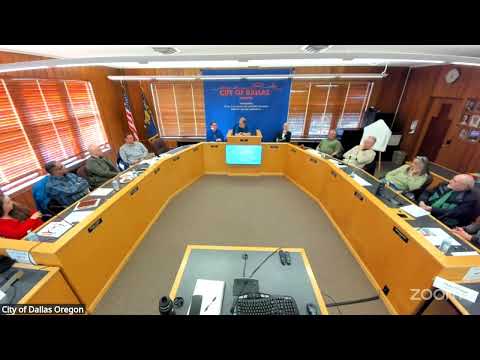
Consultants and ODOT presented a preferred redevelopment concept for the 66‑acre Dallas Mill Site at a joint City Council and Planning Commission work session March 17, 2025, emphasizing Ash Creek relocation as the early action needed to unlock development and noting roughly $40 million as a preliminary cost estimate for that work.
Consultants from David Evans and Associates and Oregon Department of Transportation staff presented a preferred redevelopment plan for the 66‑acre Dallas Mill Site at a joint Dallas City Council and Planning Commission work session on March 17, 2025, and said relocating Ash Creek is the project’s critical path.
The plan calls for a mix of retained industrial uses, new commercial frontage linked to an east–west street, and limited residential development on the hillside, with parks and a multi‑use path integrated near the relocated creek. Consultant Jim Henke, project manager for David Evans and Associates, said the overall project purpose is “land use and transportation guidance for on and around the 66 acre former mill site.”
The consultants said the site’s redevelopment depends on flood control work. Henke described a high‑level cost estimate for relocating Ash Creek as “$40,000,000 or so at least” and said the figure could rise depending on design choices. Michael Duncan of the Oregon Department of Transportation described the TGM (Transportation Growth Management) grant that funded the planning and said the program focuses on aligning project outcomes with community values.
City staff and the consultant team presented how community input shaped the preferred plan: three surveys (the first drew about 1,000 responses; the most recent closed with about 114 responses), five advisory‑committee meetings and two public open houses. The advisory committee emphasized three priorities—welcoming, safe and livable community design; economic development and tax revenue; and flood control to unlock the site.
Key elements shown in the preferred plan included: - Retaining some industrial zoning in the site’s northeast quadrant while introducing commercial frontage along a proposed East–West street that parallels the relocated creek. - Extending the Central Business District zoning down Maine Avenue to improve pedestrian and bicycle connections between downtown and the site. - A hillside park and limited residential conversion on the sloping southern portion of the site where industry is harder to develop. - Preserving the rail corridor for future options: either upgraded freight service or conversion to a multi‑use trail; the rail operator and ODOT described the corridor as in a period of disuse but still on state inventories and requiring investment to be fully operational.
On financing and timing, the team outlined near‑term, mid‑term and long‑term actions. Near term (immediate to 3 years) could include code and comp‑plan updates, streetscape improvements on peripheral streets and grant writing; mid term (3–7 years) focuses on securing partnerships and public‑realm improvements; long term (7+ years) anticipates creek relocation and major construction. Henke said the plan will likely require a comprehensive‑plan amendment and suggested adding a section to 2.9 called “mill site policies” to adopt the vision by reference.
Council members pressed on ownership, revenue and phasing. When asked who currently owns the parcel, staff identified the owner as Dallas Mill Properties LLC and said the owner has been engaged in the process. Brian (city staff) said the city has pursued multiple prospective buyers over several years and that “the city has entertained, through our partner with, the Strategic Economic Development Corporation, at least, you know, between a half dozen and a dozen interested buyers.”
On tax revenue, staff said there is some taxable value from a handful of small industrial businesses on the property but that current receipts are “nothing compared to what we used to receive” when the mill was fully operational. Staff also cautioned that public ownership would make the parcel tax‑exempt until redeveloped.
Councilors asked what parts of implementation do not depend on Ash Creek relocation. Henke and Duncan said rezoning, comp‑plan changes, and some peripheral street and bike improvements could proceed while creek work is planned and funded; both recommended the consultant team add explicit phasing that identifies actions that can move forward independently of creek relocation.
The project team committed to deliver a draft plan for council and commission review in the next one to two months, aligning with the TGM grant schedule. Henke said the preferred alternative had been finalized about a week prior and that the next steps were to compile technical memoranda and produce a coherent draft for adoption consideration in April–June.
The plan materials and public‑engagement summaries are to be provided to the council, including the demographics and ZIP‑code breakdown of survey respondents. The team said they will also refine cost estimates, phasing that prioritizes near‑term actions not tied to creek relocation, and regulatory tools (a regulating plan and urban frontage standards) for future permitting and design review.
Development proponents, council members and some commissioners voiced support for planning the site carefully rather than leaving its future to a single industrial buyer, while others pushed for the city to consider acquisition. Staff said the city is not in a position today to purchase the land for several million dollars without dedicated financing and that public ownership would not necessarily speed implementation.
Next steps identified at the meeting: the consultant team will finalize the draft plan, include a phasing sequence that separates actions dependent on creek relocation from those that are not, provide demographic details of public engagement, and present the draft for local review in coming weeks.