Get Full Government Meeting Transcripts, Videos, & Alerts Forever!
Get email alerts on the Public Safety topic
No spam. Unsubscribe anytime.
Polk County sheriff, Oregon State Police outline Highway 22 enforcement, staffing limits
Summary
Polk County Sheriff Mark Garten and Oregon State Police Northwest Region Captain Chris Zoner briefed the council on speed and DUI grant-funded patrols on Highway 22, staffing shortfalls and multi‑agency enforcement operations.
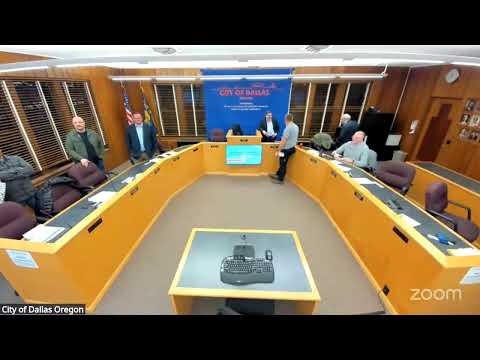
Polk County Sheriff Mark Garten and Oregon State Police Northwest Region Captain Chris Zoner briefed the Dallas City Council at the Feb. 18 work session on Highway 22 enforcement, grant funding for speed and DUI patrols, and the limits that staffing shortages place on round‑the‑clock coverage.
The briefing matters to motorists and local officials because Highway 22 carries the safety corridor between mile posts 5 and 15, a stretch where county and state agencies have focused crash‑reduction efforts and where the council requested an update on enforcement and collaboration.
Sheriff Mark Garten told the council that in federal fiscal 2024 the sheriff’s office worked speed and DUI grant funding totaling roughly $20,000 and that the department used a mix of overtime and integrating grant hours into deputies’ regular shifts to stretch the funds. “In 2024, there was about 4,100 traffic stops just generally across the county,” Garten said, and he estimated roughly 1,500 of those were on Highway 22 from the safety corridor to the 50‑zone. He said enforcement tactics and timing change because violations decline when officers are visibly present.
Captain Chris Zoner, northwest region captain for the Oregon State Police (OSP), described OSP patrol staffing and how grants are applied. He said OSP used grant‑funded enforcement in the corridor in 2024—recording 78 trooper hours, 237 traffic stops and a mix of speed and DUI citations—and that a separate roadway‑departure grant had about 50 hours allocated, with the office using approximately 48.25 hours.
Zoner said the Salem Area Command covers Polk and Marion counties from the Sanien Pass to Linn County and that staffing is constrained; the command is authorized for 24 troopers but has been below that level for an extended period. He explained OSP does not maintain 24/7 trooper coverage and typically does not schedule troopers between 2 a.m. and 6 a.m. because of staffing limits dating to prior layoffs and ongoing recruitment and retention challenges. “When I have my discretionary time, which is few and far between sometimes, I try to spend it in Polk County,” Zoner said.
Officials discussed the ODOT safety corridor designation for Highway 22 (mile post 5 to 15), which supplies grant funding, enhanced signage and higher fines in that stretch. Garden and Zoner both said ODOT reviews multi‑year crash data when approving safety corridors and that ODOT has been selective about adding corridors.
Garten and Zoner described recent joint operations with Polk County Sheriff’s Office and Salem Police that ran in the winter months; those operations combined troopers, deputies and motors and produced hundreds of citations and multiple DUI arrests during single‑day operations. As an example, the agencies’ November operation produced roughly 120 citations and about three impaired‑driver arrests, Garten said.
Polk County patrol staffing numbers discussed at the meeting: Polk County reported being budgeted for 16 patrol deputies but operating with 12 assigned; OSP reported variable staffing across the Salem Area Command and described routine shortfalls that require cross‑agency coordination. Garten told the council that hiring and completing the academy pipeline can take up to two years for new applicants and that pay at some agencies affects retention.
Councilors did not take formal action after the briefing. Sheriff Garten and Captain Zoner encouraged the council to continue engagement with state leaders and ODOT on engineering and enforcement solutions for problem intersections such as Highway 51 and the Highway 22/51 approaches.