Get Full Government Meeting Transcripts, Videos, & Alerts Forever!
Get email alerts on the Ballot Measures topic
No spam. Unsubscribe anytime.
Greeley council agrees to poll voters on housing, economic development and public-safety measures
Summary
City staff will field a two‑stage public opinion process this spring to test voter appetite for several potential ballot measures; councilors signaled consensus to include funding for homeless/housing, economic development/community revitalization and public safety in the first comparative poll.
The Greeley City Council instructed staff to field a public poll this month to test voter support for several potential ballot measures and related funding ideas, with staff planning a two‑stage polling approach to narrow options before a targeted survey in June.
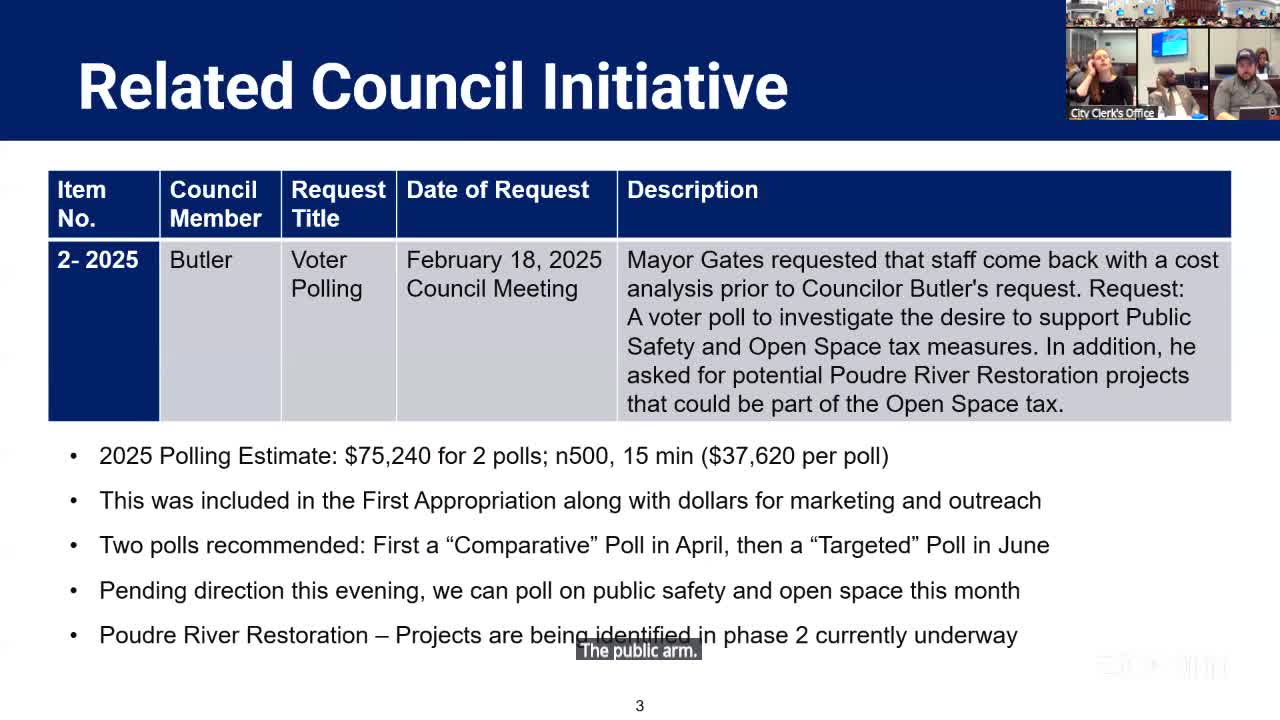
Caitlin, the city presenter, said staff recommends two polls: an initial comparative poll to measure relative voter priorities across a wide set of concepts, and a follow‑up targeted poll to test specific, viable ballot language. “The first, because we have such a broad range of topics that we’re considering, would really be a high level comparative poll,” Caitlin said, noting the first poll would use a 500‑person sample and that staff has budgeted roughly $75,000 to field it.
On the merits, council members repeatedly discussed mixing project‑level asks (for example, a dedicated downtown or civic‑campus question) with broader categories (public safety, open space, general city services). After a lengthy discussion, staff summarized council direction for the comparative poll: no consensus to pursue a property‑tax increase or a general sales‑tax increase; consensus to include a dedicated homeless and housing funding question; consensus to include an economic development/community revitalization funding question; no consensus to pursue an open‑space tax in this round; and consensus to include a public‑safety increase.
That directional outcome will shape the first survey that staff plans to field “in the next week or so,” with results to be presented at a May work session, Caitlin said. The second, more detailed poll would be fielded in mid‑June so the council would have results before it needs to decide whether to place measures on an August or November ballot.
Councilors debated whether to test focused, dedicated measures or a single general revenue measure that could be used more flexibly. Some members said voters respond better to narrowly defined, accountable revenue questions; others favored flexibility. Staff and the polling consultant will model both approaches in the comparative survey and then use the targeted poll to refine language and price points if measures test well.
Why this matters: any ballot‑funded measure would create an ongoing revenue source that could pay debt service or recurring costs; the poll results will determine whether the city proceeds to a more specific roll‑out for the 2025–2027 ballot calendar. Councilors asked staff to return with clear language and cost scenarios before any final placement on the ballot.