Get Full Government Meeting Transcripts, Videos, & Alerts Forever!
Get email alerts on the Education Funding topic
No spam. Unsubscribe anytime.
Lawmakers weigh using fair-share surplus to shore up special education, preschool and literacy after federal cuts
Summary
Education leaders urged the Joint Committee on Ways and Means to use surplus fair-share funds to stabilize special education reimbursements, expand preschool and scale high-dosage early literacy tutoring, citing recent federal grant rescissions that threaten district budgets.
Education secretariat witnesses and representatives from teachers and business groups told the Joint Committee on Ways and Means that House Bill 55 could be used to protect local school budgets and expand critical programs amid recent federal funding uncertainty.
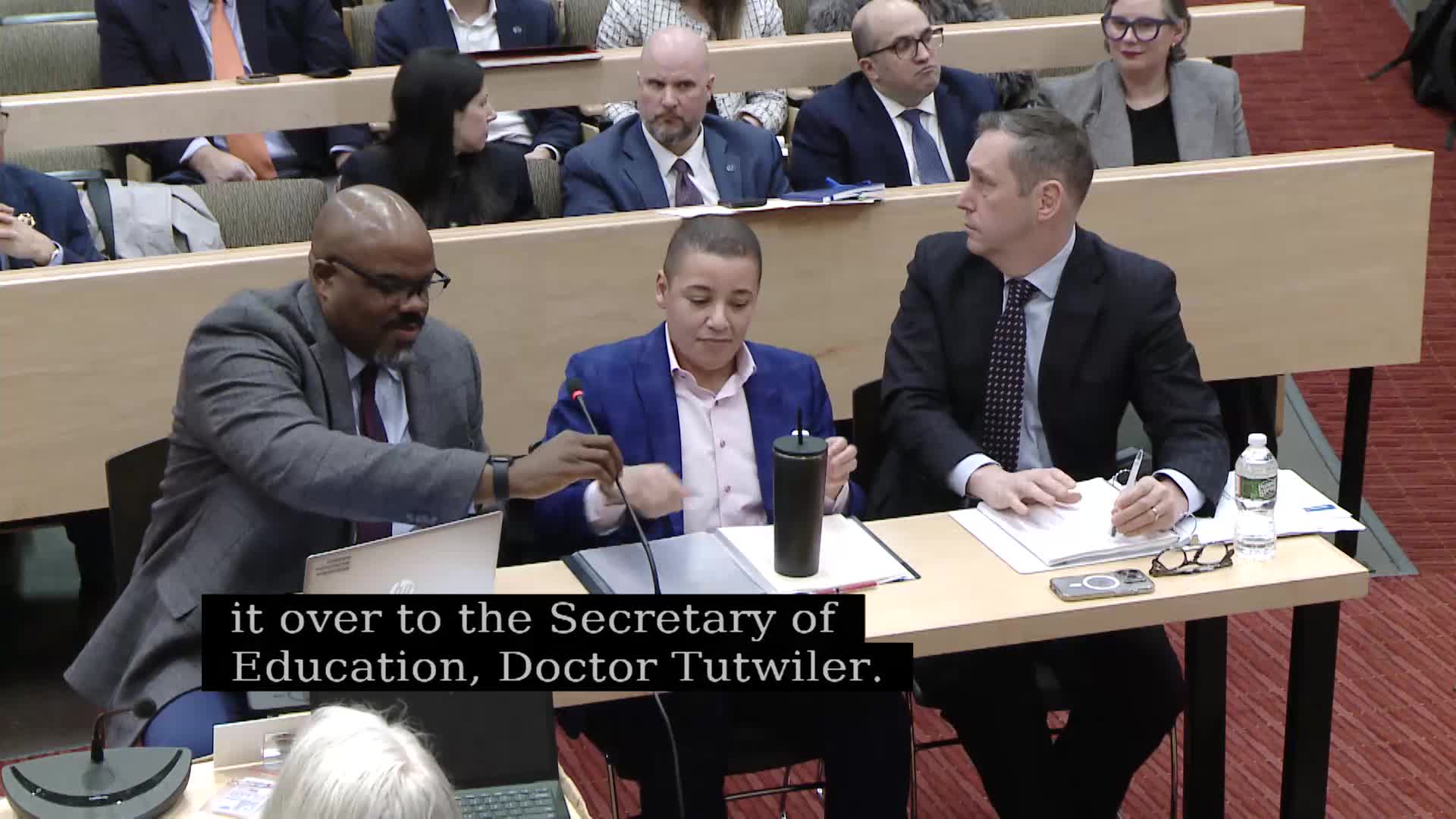
Pat Tutwiler, the administration’s Secretary of Education, described an education package in the supplemental that included investments in preschool, adult education, early-literacy tutoring, early college and career and technical education (CTE), and a meaningful increase to the special education circuit breaker. Tutwiler said the supplemental includes $50,000,000 for the Commonwealth Preschool Partnership Initiative (CPPI), $25,000,000 in near-term support to maintain current CPPI grantees and $43,000,000 to expand access over three years; $100,000,000 for early education and care capacity and workforce supports; $25,000,000 for an early literacy high-dosage tutoring initiative aimed at supporting 10,000 students; $30,000,000 for adult basic education and ESOL; $32.5 million to scale early college and career pathway programs; $75,000,000 to add more than 3,000 career and technical education seats over three years; and $150,000,000 for the special education circuit breaker, with an FY26 proposal to bring the circuit breaker total to $682,000,000.
“Governor Healy's fair share supplemental budget is meaningfully anchored in these core values and will expand existing efforts that are currently working well to close gaps and provide all students with a high-quality education,” Tutwiler told the committee.
Union and education advocates emphasized the urgency. Jessica Tang, president of the American Federation of Teachers Massachusetts, said school systems are already “at the edge of a fiscal cliff” and that recent federal actions are compounding the problem. Tang described a U.S. Department of Education notice that she said arrived on a Friday evening directing the return of approximately $106,000,000 in ESSER funding from about 20 districts that had been granted extensions; Tutwiler also testified to that timeline and described the resulting implementation challenges for local districts that had planned facilities upgrades and other projects around the federal grants.
The education witnesses and business advocates also argued for scaling initiatives that have evidence of impact: business-education groups backed the proposed $25,000,000 early-literacy tutoring pilot, citing external research showing meaningful reading gains for participating students, and urged funding structures that would let successful pilots be integrated into district operating budgets later. Multiple witnesses stressed that some supplemental uses — for example, preschool expansion and CTE capacity — were appropriate as time-limited investments that could seed longer-term, recurring state support through the FY26 process and beyond.
Committee members asked detailed questions about special education circuit breaker projections, how to protect districts that face immediate layoffs, and how one-time surplus funds should be balanced against recurring needs. Members and witnesses repeatedly emphasized that one-time appropriations can temporarily avert layoffs and program cuts but that recurring obligations require durable revenue decisions.
Why it matters: Districts facing unexpected federal rescissions, ongoing special-education and transportation cost growth, and declining federal support contend with immediate cash pressures that could force personnel reductions and program cuts. The supplemental presents a near-term opportunity to direct one-time funds toward programs that proponents say will stabilize districts and target students with the greatest needs.
What comes next: Education officials and stakeholder groups asked the committee to consider early action to protect districts ahead of final FY26 allocations. The committee asked for more information on projected circuit breaker reimbursements and said it would solicit written testimony from districts and other stakeholders before reporting the supplemental.