Get Full Government Meeting Transcripts, Videos, & Alerts Forever!
Get email alerts on the Healthcare topic
No spam. Unsubscribe anytime.
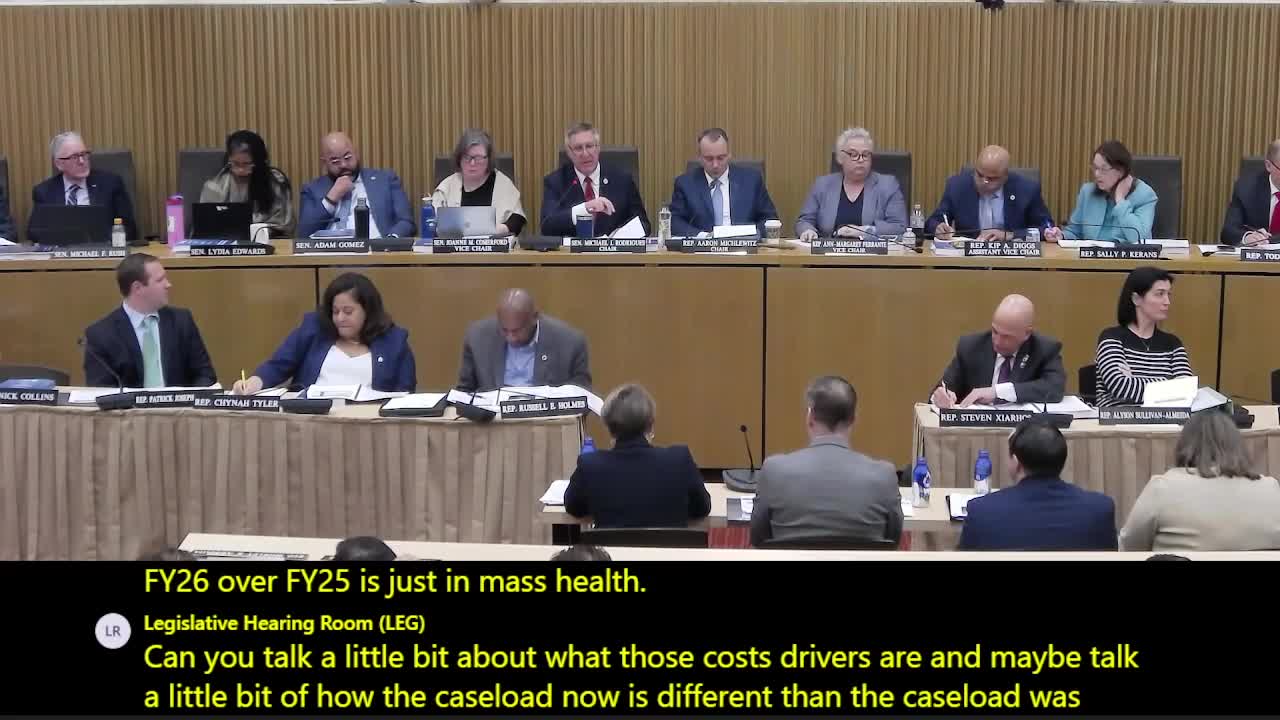
MassHealth drives the largest growth in the FY26 budget, administration says; enrollment and acuity cited
Summary
Administration testimony identified MassHealth as the biggest single driver of FY26 spending growth and explained that higher enrollment, greater acuity among remaining members, prescription drug costs and MCO rate pressures are key causes.
Secretariat and administration officials told the Joint Committee on Ways and Means that MassHealth (Massachusetts Medicaid) accounts for a large share of the FY26 expenditure growth and will require significant budget attention.
Secretary Matt Gorkewitz said MassHealth growth is “one of the bigger challenges” for FY26. He told the committee MassHealth enrollment stands at about 2.2 million members—roughly 260,000 more than pre-pandemic levels—and that the program emerged from the COVID-era continuous enrollment period with a higher-acuity caseload. "A lot of the members who did leave MassHealth were low utilizers, low acuity. And so therefore, we were left with a higher acuity population," he said.
Officials identified several cost drivers: higher enrollment (post-pandemic redetermination), increased acuity among remaining enrollees, rising pharmacy costs (including a near 16% increase noted for certain pharmacy lines), and managed care organization rate pressures. Taken together, those items contributed to a substantial increase in MassHealth spending projections for FY26; Gorkewitz said the combined MassHealth dynamics were the single largest contributor to the budget growth between FY25 and FY26.
Committee members asked about containment strategies and whether additional state actions or federal developments (including potential federal funding reductions) would change the outlook. Administration officials said they are modeling multiple scenarios, conducting sensitivity analyses and prepared to revisit budget assumptions if federal funding flows change. Gorkewitz said the administration had included measures and reserves to cushion some of the volatility but flagged the program as “a big part of what’s driving that growth.”
No formal legislative action was taken at the hearing; lawmakers requested more detailed budget-by-line information and models on MassHealth caseload and spending drivers, and the administration agreed to provide further detail in follow-up sessions.