Get Full Government Meeting Transcripts, Videos, & Alerts Forever!
Get email alerts on the School Construction topic
No spam. Unsubscribe anytime.
Architects, districts and mayors press for MSBA overhaul, added funds for school construction
Summary
Witnesses at the Joint Committee on Education urged the Legislature to expand funding and review reimbursement formulas at the Massachusetts School Building Authority to address aging school stock, climate‑resilient builds and equity in access to construction dollars.
BOSTON — Architects, school officials and municipal leaders told the Joint Committee on Education that Massachusetts needs more resources and new policy tools to address aging school buildings and inequities in access to capital funding.
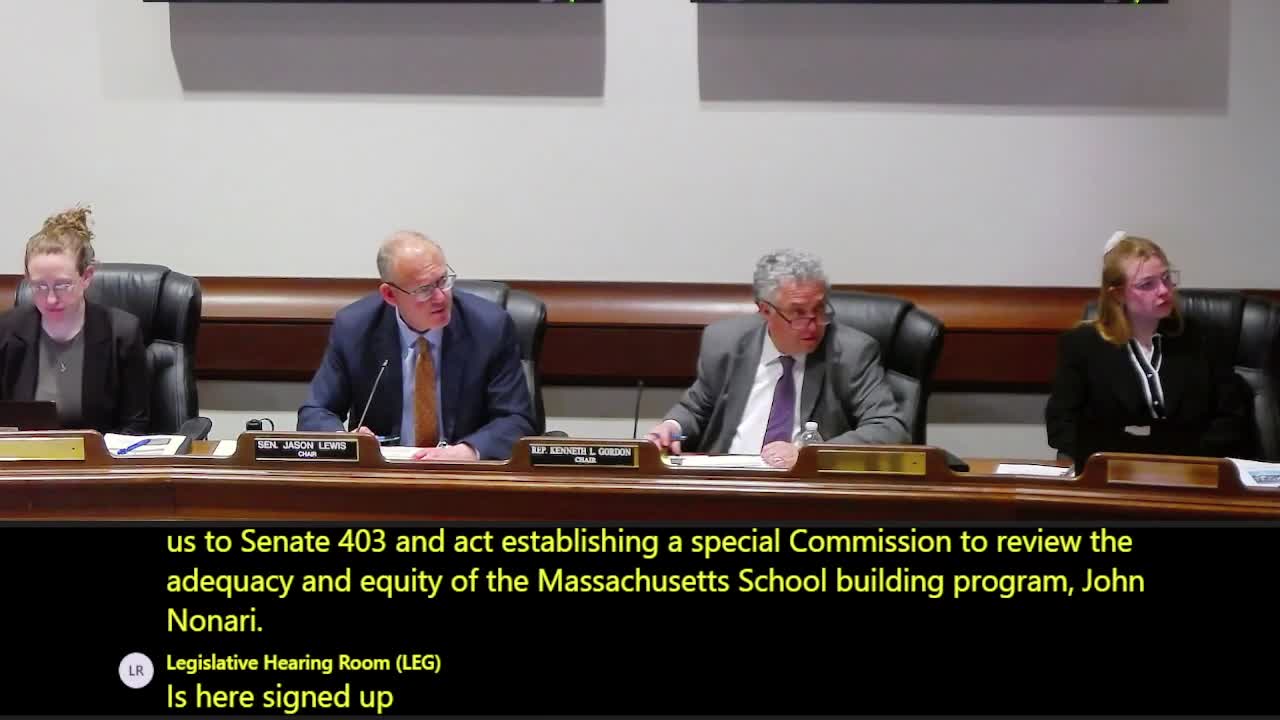
The testimony came during hearings on bills including Senate Bill 403, which would create a special commission to review MSBA adequacy and equity, and House Bill 526/Senate Bill 318, which propose broader modernization and resource increases for school construction.
John Nunnery, executive director of the Massachusetts chapter of the American Institute of Architects, said well‑designed buildings matter for learning and health: "Too many public school facilities, particularly in historically underserved communities, are aging, inefficient and no longer meet the needs of modern education," he said, and voiced support for a commission to review reimbursement formulas and environmental priorities.
Boston Public Schools officials detailed their portfolio’s scale and age: "Over half of the 133 buildings in our portfolio were built before World War II," said Deputy Superintendent Samuel DePina; Chief of Capital Planning Delavern Stanislaus described recent openings and ongoing projects and urged greater MSBA capacity to handle feasibility studies and accelerated repairs.
Why it matters: Witnesses argued that MSBA’s current capacity and reimbursement rules slow needed work, particularly in gateway cities. Speakers proposed both immediate funding increases for MSBA to expand project capacity and statutory changes to reimbursement calculations that now leave some high-need communities carrying excessive local shares.
Local examples and equity: Lynn officials described decades of underinvestment and a reimbursement reality that left them paying well above the intended local share. Mayor Nicholson said recent projects required local creativity and one‑off solutions: "Without further reform, we're going to have to go another generation to build another school under the current system," he said.
Policy options discussed: Proposals ranged from a special commission to a direct doubling of MSBA resources and changes to the 80% statutory reimbursement cap. Supporters said a combination — capacity increases at MSBA plus a formal equity review — would both accelerate projects and reform incentives so that gateway cities and regional districts could compete for state assistance.
Process notes: The committee received testimony from municipal leaders, architects, district officials and teachers’ unions. The hearing on H.526/S.318 closed after testimony; committee chairs signaled the topic would be a continuing priority as the Legislature debates capital and operating budgets.
Ending note: Witnesses framed school construction as both a physical‑plant and equity issue: aging, overcrowded buildings pose educational and health disadvantages; the witnesses urged the Legislature to combine funding increases with structural reforms to MSBA reimbursement and prioritization rules.