Get Full Government Meeting Transcripts, Videos, & Alerts Forever!
Get email alerts on the Housing topic
No spam. Unsubscribe anytime.
State proposes $1.2 billion in housing investments; administration highlights shelter stabilization and vouchers
Summary
Secretary of Housing and Livable Communities said Governor Healey's House 1 proposes $1.2 billion in housing investments for FY2026, including increased public housing subsidies, expanded vouchers, and emergency assistance stabilization funding. She urged support for the Affordable Homes Act implementation and described measures to move families
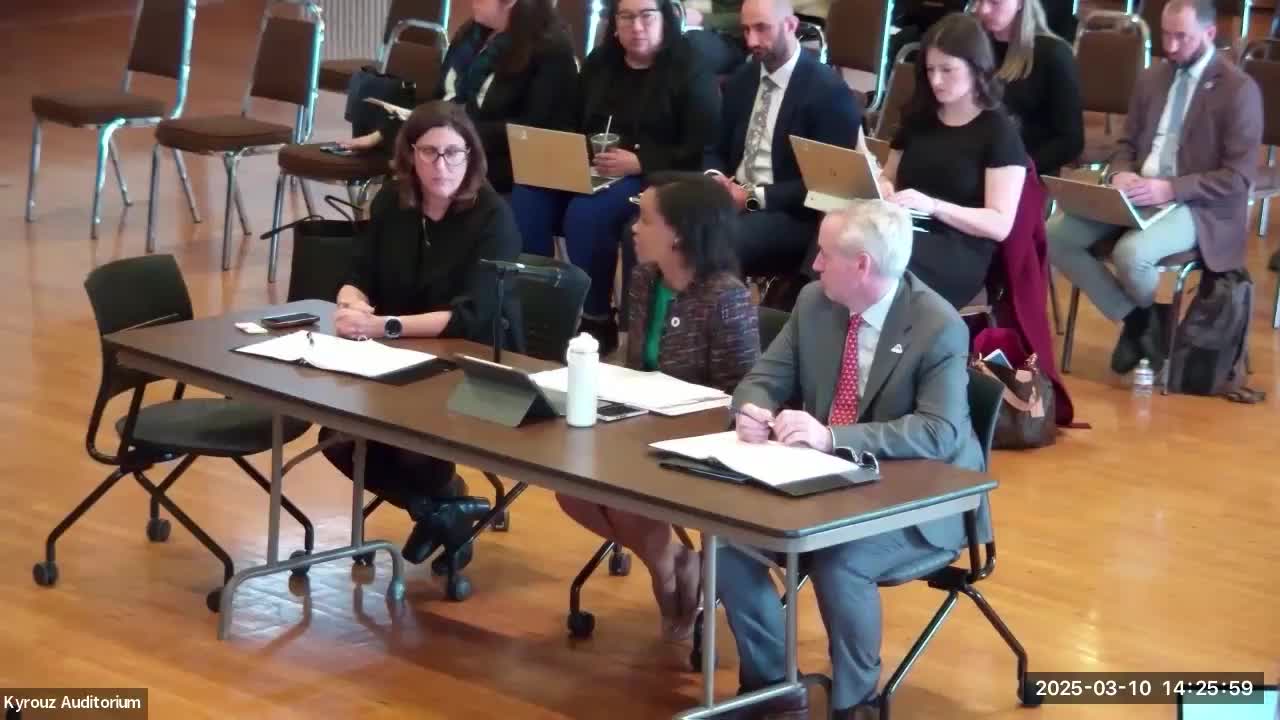
Housing and Livable Communities (EOHLC) Secretary addressed the Joint Committee on Ways and Means in Gloucester on March 10, outlining the administration’s FY2026 House 1 proposal that Secretary said totals roughly $1.2 billion in targeted housing investments.
Major components and priorities - Public housing and capital: House 1 recommends $125,000,000 for public housing programs (about a 4% increase over FY2025), including $115.5 million for subsidies to local housing authorities and $7.5 million for resident service coordinators to help preserve tenancies and connect residents to services. - Homelessness and emergency assistance (EA): The budget recommends $325,000,000 for emergency assistance and $57,000,000 for HomeBASE rapid rehousing; the administration said RAFT would be funded at $202.5 million for eviction prevention and short‑term assistance. - Rental assistance and vouchers: House 1 proposes a historic $253,000,000 for the Massachusetts Rental Voucher Program (MRVP), a 16% increase to preserve a payment standard at 110% of small area fair market rents; the package also beefs up alternative housing vouchers for people with disabilities and supports for Department of Mental Health clients. - Shelter reform and hotels: Secretary said the administration has been phasing out hotel/motel shelter use for families and implementing policy changes in the FY2025 supplemental to stabilize the EA system and encourage exits to permanent housing.
Why it matters: Secretary said public housing serves vulnerable populations and that capital and operating support prevent people from becoming homeless. The administration tied additional state funds to inflation‑linked costs and to increased program capacity for vouchers and rapid rehousing, arguing these steps will reduce shelter stays and improve outcomes.
Questions and follow up Committee members asked about vacancy rates in public housing and how the state can help small towns comply with MBTA zoning requirements tied to the Affordable Homes Act; Secretary answered with program examples and committed follow‑up on specific housing authority vacancies and to continued technical assistance for MBTA communities.
Ending: The secretary asked for legislative support for the House 1 funding levels and for sustained investment in public housing, voucher programs and homelessness prevention that the administration said are needed to implement the Affordable Homes Act and stabilize shelter systems across the Commonwealth.