Get Full Government Meeting Transcripts, Videos, & Alerts Forever!
Get email alerts on the Broadband Permitting topic
No spam. Unsubscribe anytime.
Providers and municipal advocates push 1‑touch make‑ready and faster pole access to speed broadband builds
Summary
Open Cape, Go Net Speed and municipal speakers told the Joint Committee slower pole licensing and make‑ready processes are delaying fiber builds; they urged passage of bills to create predictable timelines and authorize one‑touch make‑ready to reduce months‑long delays.
Broadband providers and local officials told the Joint Committee that permitting and pole‑attachment delays are a major hurdle to expanding high‑speed Internet across Massachusetts and urged lawmakers to adopt a one‑touch make‑ready framework and faster permitting timelines.
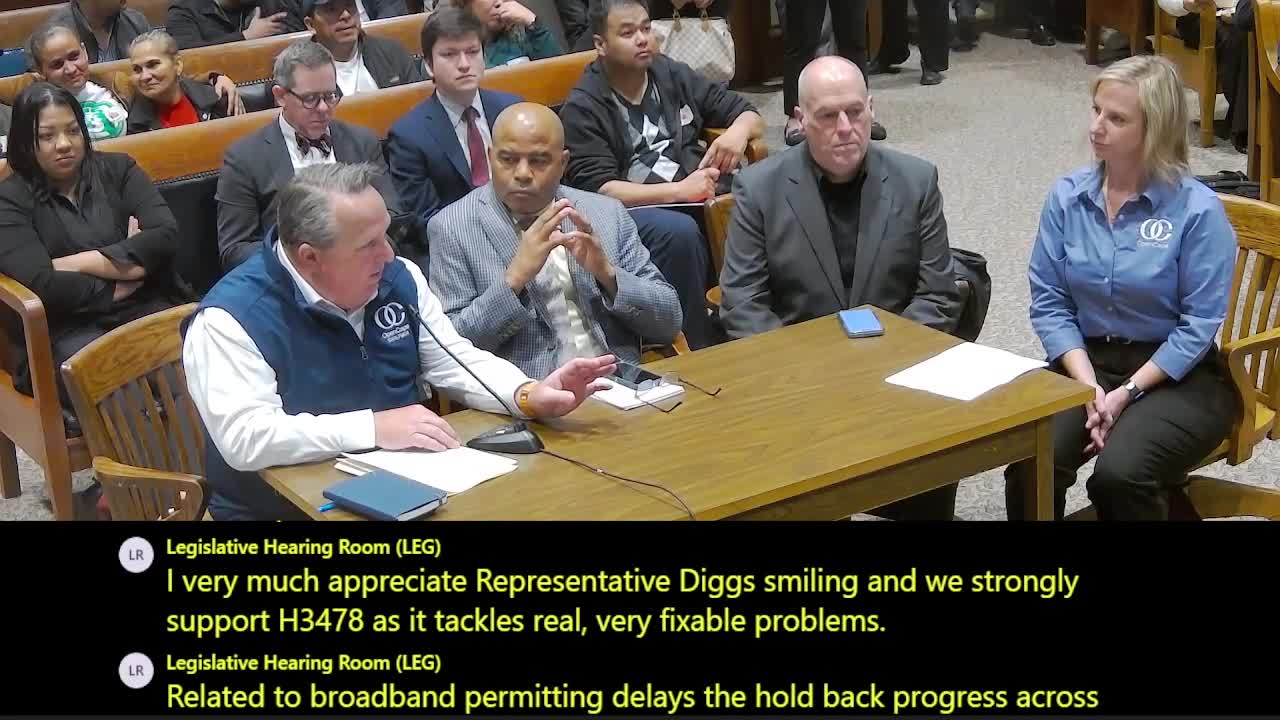
Steven Johnston, executive director of Open Cape, said a recent project to license 29 poles took 14 months even though the physical build required three days. “A recent project to license 29 poles took us 14 months, yes, 14 months, for a 3 day fibre build,” Johnston said, describing how long licensing times undermine the economics of smaller competitive providers.
Witnesses from Open Cape, Go Net Speed and other regional providers described large network upgrades and planned investments — Open Cape said it has grown from about 350 to over 700 miles of fiber and is upgrading backbone hardware to deliver 400–800 gigabit connectivity; Go Net Speed told the committee it is prepared to invest $250,000,000 in Massachusetts if access barriers are resolved. Heidi Mahoney of Go Net Speed gave a local example: a pole-attachment application submitted in October 2021 did not receive invoices for make-ready work until December 2022.
Speakers said one‑touch make‑ready (which allows an approved party to perform preparatory work on pole attachments in a single coordinated step) reduces timeframes from many months to a few months, following models in other states. Municipal officials and providers also asked for clearer conduit access rules, removal of abandoned infrastructure in conduit, and predictable permitting windows so BEAD and other federal funds can be deployed efficiently.
Health‑care witnesses said reliable wired broadband is essential to deliver telehealth and hospital‑at‑home programs; John Campbell, who spoke about hospital‑at‑home work, told the committee wired networks provide redundancy and reliability that satellite services cannot always match. “Starlink was great when it first came out. The more and more people have adopted it, if you've tried it recently, not so great anymore,” Campbell said, noting wired redundancy and planned capacity increases.
Industry witnesses urged legislative action even as administrative agencies — the Department of Public Utilities and the Department of Telecommunications and Cable — have opened inquiries into pole‑attachment rules. Proponents argued statutory change would provide a permanent, predictable framework that attracts private investment. Opponents were not recorded in the transcript excerpts.
No committee vote was taken. Sponsors asked the committee to report favorably on bills including H.3478, H.3546 and S.2285 and noted ongoing administrative rulemaking at DPU and other agencies.