Get Full Government Meeting Transcripts, Videos, & Alerts Forever!
Get email alerts on the Clean Fuel Standard topic
No spam. Unsubscribe anytime.
Clean fuel standard draws broad industry support and sharp critique over aviation provisions
Summary
Several industry and clean‑fuel proponents urged the committee to adopt a Low Carbon/Clean Fuel Standard (LCFS/CFS) to reduce transportation emissions and attract investment; opponents and independent researchers cautioned that including sustainable aviation fuel (SAF) or large biofuel scaling raises land‑use, cost, and equity concerns.
Multiple panels told the committee a clean fuel standard (variously called LCFS or CFS in testimony) would reduce carbon intensity of transportation fuels, create market signals to fund charging and other infrastructure, and incentivize low‑carbon alternatives including renewable diesel, renewable natural gas and biogas.
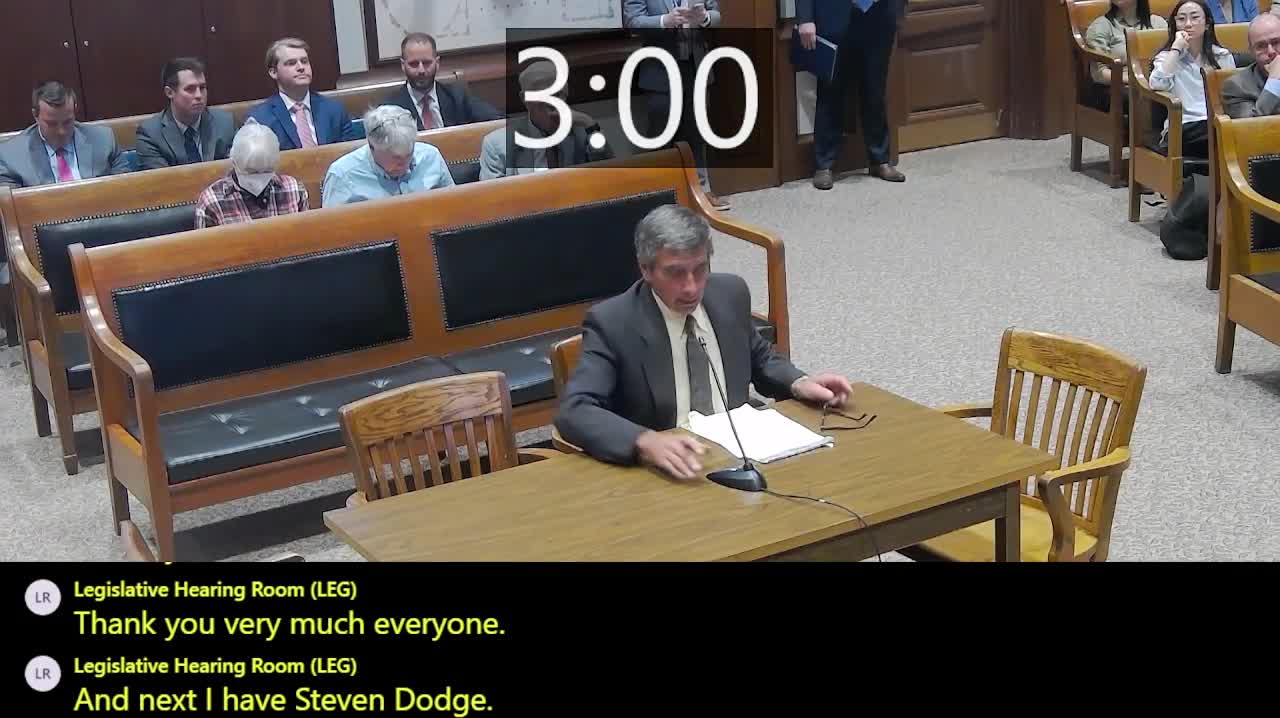
Steven Dodge (Clean Fuels Alliance America) said nationwide experience shows LCFS programs "effectively squeeze the carbon out of all transportation fuels" and can create revenues used to expand charging and other investments. Anthony Willingham of Electrify America said a CFS is "the single most effective policy tool that a legislature has to both increase the supply of alternative, more sustainable fuels and reduce carbon emissions," and that credits help attract private charging investment. Ender Reid of Neste, Yannick Torres (Coalition for Renewable Natural Gas) and Jonathan Harding (American Biogas Council) also described how credit revenue has funded charging infrastructure, low‑income programs, and new low‑carbon fuel production.
Opponents — including the group Stop Private Jet Expansion and independent researchers represented by Chuck Collins and Sue Swanson — urged caution about aviation provisions. Collins said sustainable aviation fuels "are not ready for prime time" and are "not scalable" at the pace climate change requires; Swanson added, "Labeling bio based aviation fuel as sustainable is misleading," and warned of land‑use and food‑price tradeoffs. Committee members pressed proponents about cost‑per‑ton metrics cited by economists and asked for independent analyses on fuel price impacts and land‑use tradeoffs.
Witnesses from charging‑network providers and Electrify America argued a CFS can directly support deployment and reliability of chargers, while biofuel and RNG proponents emphasized immediate greenhouse‑gas reductions from capturing methane and converting waste streams. The hearing produced no committee vote; proponents and opponents agreed written testimony and follow‑up analyses would be submitted.