Get Full Government Meeting Transcripts, Videos, & Alerts Forever!
Get email alerts on the Rideshare Unionization topic
No spam. Unsubscribe anytime.
Drivers, unions and labor experts urge committee to reject data bill they say would delay Question 3 unionization
Summary
Rideshare drivers, union representatives and labor-law experts told the Joint Committee on Telecommunications, Utilities and Energy that H.3470 and S.2259 — bills framed as data-privacy measures — would duplicate existing protections and delay implementation of Question 3, blocking drivers from moving forward with union recognition.
Rideshare drivers, union leaders and labor-law scholars told the Joint Committee on Telecommunications, Utilities and Energy that proposed legislation (H.3470 and S.2259) framed as protecting driver data would instead delay the implementation of Question 3 and slow drivers’ efforts to form a union.
Question 3, passed by Massachusetts voters last November, creates a path for app-based drivers to seek collective-bargaining recognition. Witnesses said the bills on the committee’s agenda would add new requirements that are redundant of existing law and of Department of Labor Relations rulemaking now underway, and would likely postpone drivers’ ability to submit authorization cards and seek recognition.
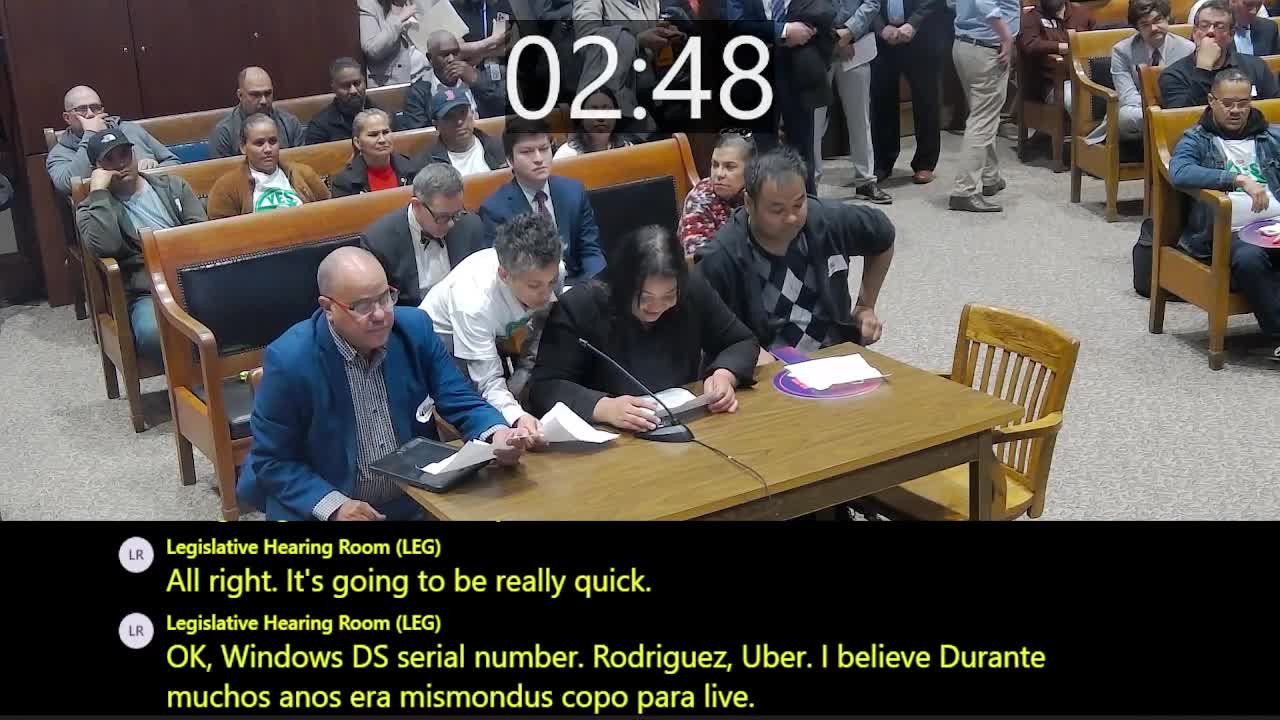
Drivers who testified described safety and economic pressures on the job and said they need the collective voice Question 3 promises. “This job is hard as a woman, especially as a mother,” testified Yolanda Rodriguez, a rideshare driver. “Every day that this process is delayed, drivers remain without a voice,” said Autumn Weintraub, executive director of the App Drivers Union, which is a project of the International Association of Machinists and 32BJ. Weintraub told the committee thousands of drivers have signed union cards and are ready to submit them to the state.
Labor-law experts who testified said the bills were unnecessary and risked postponing the law’s implementation. “The proposed bill is therefore unnecessary,” said Ben Sachs, a labor-law professor at Harvard Law School, adding that Question 3 and existing statutes already address many of the concerns the legislation purportedly targets. Alfred Gordon O’Connell, a labor-practice attorney, told the committee that many of the bill’s data provisions duplicate protections in existing statutes and in the Department of Labor Relations’ planned regulations.
Union and driver witnesses also pointed to prior enforcement and settlements as evidence that data protections can be managed under current law. Harris Gruman, executive director of the SEIU State Council of Massachusetts, said the companies and the state have already addressed many privacy concerns through previous Attorney General settlements and ballot-language protections.
Opponents of delaying measures told the committee the effect would be to give large platform companies more time to resist recognition and to keep drivers from bargaining over pay, deactivation policies and safety measures. Michael DeCocco, a business representative for IAM District 15, called the bills a “strategic diversion” by tech companies to “kick the can down the road.”
No committee vote was taken. Committee members limited testimony to brief statements because of room scheduling. Legislative staff and several witnesses said the Department of Labor Relations plans to circulate draft regulations to an advisory council this week. Committee members did not indicate a schedule for markup.
The hearing record contains driver testimony, union statements, and legal opinions opposing the two bills; proponents of H.3470 and S.2259 were not represented by witnesses in the transcript excerpts heard by the committee.