Get Full Government Meeting Transcripts, Videos, & Alerts Forever!
Get email alerts on the Corrections Prison Construction topic
No spam. Unsubscribe anytime.
Advocates, incarcerated people and service providers urge five‑year pause on new jail and prison construction
Summary
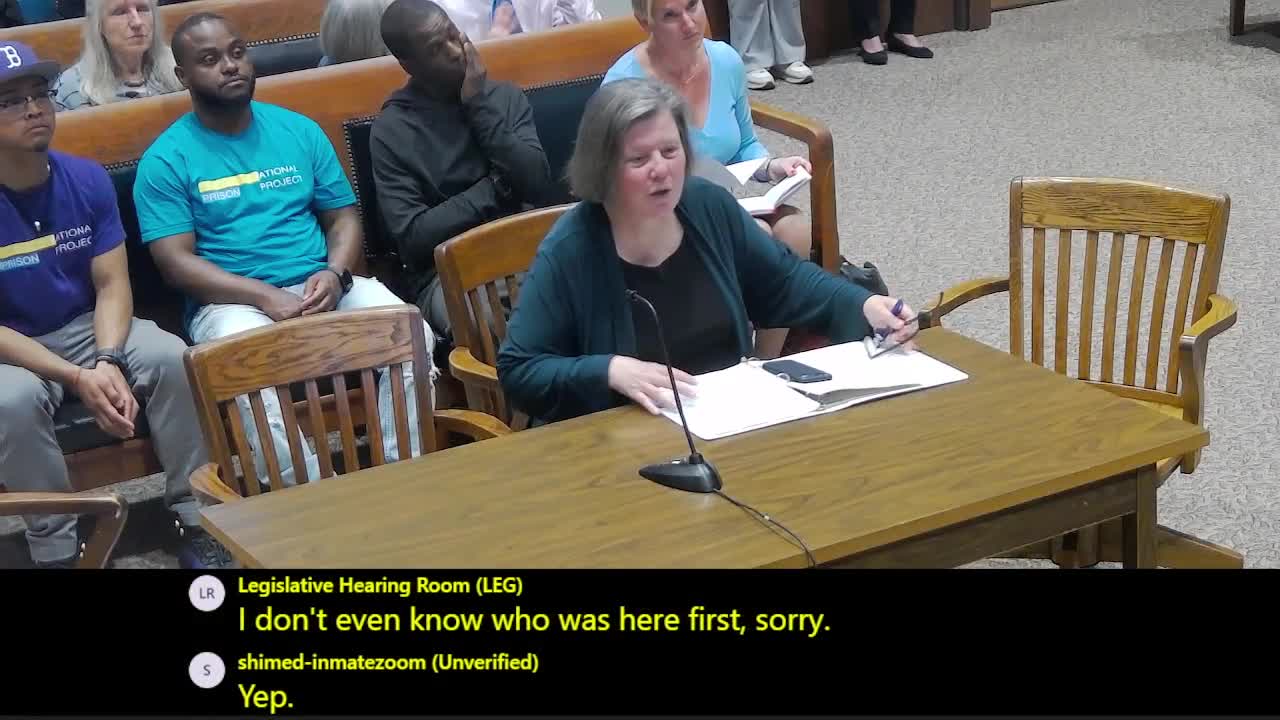
Dozens of currently and formerly incarcerated people, community organizers, public‑health researchers and clergy urged the Joint Committee on State Administration and Regulatory Oversight to advance bills that would pause new jail and prison construction for five years.
Dozens of currently and formerly incarcerated people, community organizers, public‑health researchers and clergy urged the Joint Committee on State Administration and Regulatory Oversight to advance bills that would pause new jail and prison construction for five years.
Supporters said the pause would give the Commonwealth time to pursue alternatives — housing, mental‑health and substance‑use treatment, pre‑release beds and other community investments — instead of spending an estimated $50,000,000 on a new women’s prison. That figure was cited repeatedly by multiple witnesses during the hearing.
Witnesses who testified from inside MCI Framingham and MCI Shirley described living conditions they said require repair but not a new lockup. “When we're building prisons today, we are building in prison for the future,” said one person testifying from MCI Framingham, arguing the state should invest in community‑based services and reentry supports instead. Other incarcerated witnesses described collapsing showers, shuttered day rooms, poor medical care and a shrinking population: “There are currently only about 225 women incarcerated here at Framingham,” one speaker said of current population levels.
Outside the facilities, families, community groups and policy advocates echoed those themes. Families for Justice as Healing representatives described door‑to‑door outreach in communities with high incarceration rates and urged investment in housing, jobs and trauma‑informed services. Public‑health researchers said the evidence links incarceration to poorer long‑term health outcomes and recommended funds be redirected to the social determinants of health. A public defender‑affiliated social worker and a state agency attorney noted that many people at Framingham are elderly or have chronic medical needs that could be addressed outside prison through medical parole, nursing‑home placement or community programs.
Speakers also raised operational and classification issues inside the prison system that they said inflate populations or block transfers to pre‑release centers. One witness pointed to underused county pre‑release beds and said reclassification practices sometimes prevent women from moving to lower‑security settings that would better support reentry. Several witnesses and organizers faulted a lack of transparency around planning for any new facility, including redacted public records about meetings between the Department of Correction, designers and other agencies.
Committee members did not vote on the bills at the hearing. Instead the session collected testimony in support and opposition and reiterated that the committee had previously advanced moratorium legislation in an earlier session. Several witnesses asked the legislature to prioritize releasing elderly and medically vulnerable people, expand alternatives to incarceration and invest in proven community resources.
The committee asked witnesses to submit written testimony for the public record. No formal action or vote on the moratorium bills occurred during the hearing.
Less urgent details: witnesses who testified included people incarcerated at MCI Framingham and MCI Shirley, leaders of Families for Justice as Healing, public‑health researchers, clergy and organizers; advocates asked the committee for a quick favorable report so the bills could be scheduled for floor consideration.