Get Full Government Meeting Transcripts, Videos, & Alerts Forever!
Get email alerts on the Public Pensions topic
No spam. Unsubscribe anytime.
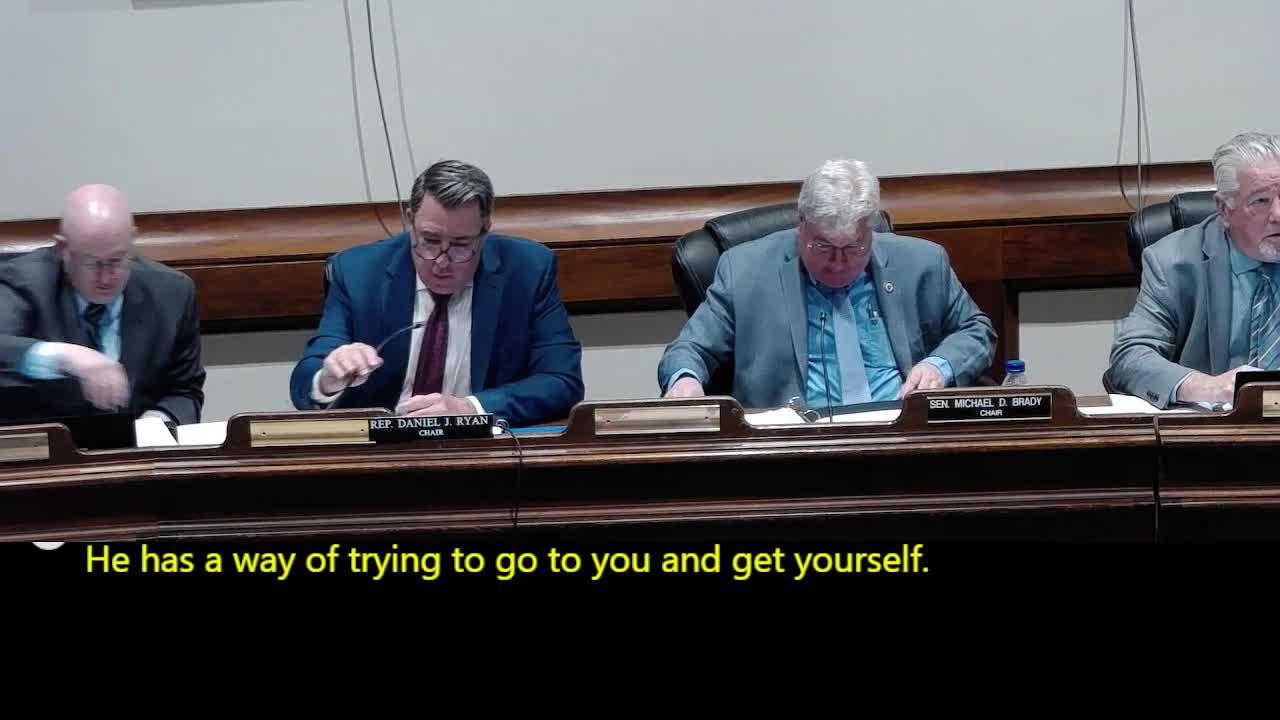
Joint Committee on Public Service hears multiple pension buyback and retirement-relief requests
Summary
The Joint Committee on Public Service took testimony from educators, retired troopers, municipal employees and retirement-system officials on bills to allow purchase of creditable service, to adjust income caps for medically retired officers, and to resolve a dispute over excess-earnings recovery by a regional retirement board.
The Joint Committee on Public Service heard testimony from a range of current and former public employees seeking legislative fixes to pension-credit rules and retirement-income limits, and from a retirement-system official opposing a bill that would reduce a repayment demand.
The matters drew teachers, water‑district workers, retired state troopers and retirement‑system representatives to explain how state rules on “creditable service” buybacks, post‑retirement earnings caps and recovery of alleged excess earnings affect their retirement income.
The panel first heard Representative Paul McMurtry and Kevin Costello on House Bill H2917, which McMurtry said would let a small group of Dedham‑Westwood Water District employees “buy into a pension system at no cost to any of the pension providers.” Kevin Costello, a 40‑year district employee, said that under current rules he has 18 years of qualifying service for a pension and “If I retired today with 18 years of service in the current state, I would receive $1,200 a month.” He asked the committee to move the bill forward so affected employees would not face a retirement shortfall.
Representative Mark Sylvia and Eileen Mullen testified on H2976, seeking permission to purchase three years of creditable service for pilot teaching she did in 2010 and 2013 that helped create chapter 74 criminal‑justice vocational programs. Mullen, a teacher and attorney, said her buyback application to the Massachusetts Teachers’ Retirement System was denied and appealed; she told the committee, “I was hired because I was an attorney. I still am an attorney,” and described the denial as a misreading that could penalize educators who developed pilot programs.
Several other educators and municipal employees asked to buy back earlier work that they say should count as creditable public service. Wendy LaFriari testified she was denied by MTRS for part‑time teaching at Bristol Community College because the college used a particular funding source; she provided a college letter saying she was a part‑time employee and said the system acknowledged the law “could be flawed.” Wayne Taylor described buying back 14 years as a selectman, later being told the award was a mistake and that only an act of the Legislature could remedy the error.
Retired and medically retired public safety employees pressed for relief on earnings caps. Retired trooper Jamie Magarian recounted the 2018 crash that ended his career and asked the committee to advance a bill the committee has favorably reported in prior years; he described ongoing injuries and years of effort to secure relief. Michael Palmer, a medically retired trooper shot on duty in late 2020, asked the committee to extend the relief created by last year’s Senate Bill 2887 to his case through Senate Bill S1841 so that injured public‑safety retirees could work in the private sector without triggering refund penalties.
The panel also heard a contested item, H2931, filed by Michael Sacco. Kevin Blanchett, chairman of the Worcester Regional Retirement System, told the committee the board opposes H2931 and described a calculation that the system says resulted in $186,722.77 in excess earnings owed by Sacco for a three‑month retirement period; Blanchett said the board views recovery as required to protect beneficiaries. Sacco, appearing remotely, said the larger number reflects gross receipts of an entity and that the law requires looking at an individual’s earnings; he said the retirement system paid him about $4,862 and that any recovery should not exceed what he actually received.
Committee chairs and members asked clarifying questions in several instances but took no final votes on the measures. The committee reminded witnesses that, consistent with House Rule 27, matters filed in the House and listed for the hearing must be reported by July 11, 2025 (subject to extensions), and requested written testimony be filed by email or delivered to the committee office by May 26, 2025, at 5 p.m.
The hearing closed with a motion to adjourn.