Get Full Government Meeting Transcripts, Videos, & Alerts Forever!
Get email alerts on the Athletic Training Licensure topic
No spam. Unsubscribe anytime.
Athletic trainers ask Legislature to lift workplace restrictions to expand care and retain workforce
Summary
A panel representing athletic trainers urged the Joint Committee on Public Health to remove workplace restrictions in state licensure law so trainers can practice in broader occupational and public‑safety settings.
A panel representing athletic trainers urged the Joint Committee on Public Health to update Massachusetts’ licensure law to remove outdated workplace restrictions and widen the settings in which licensed athletic trainers may practice.
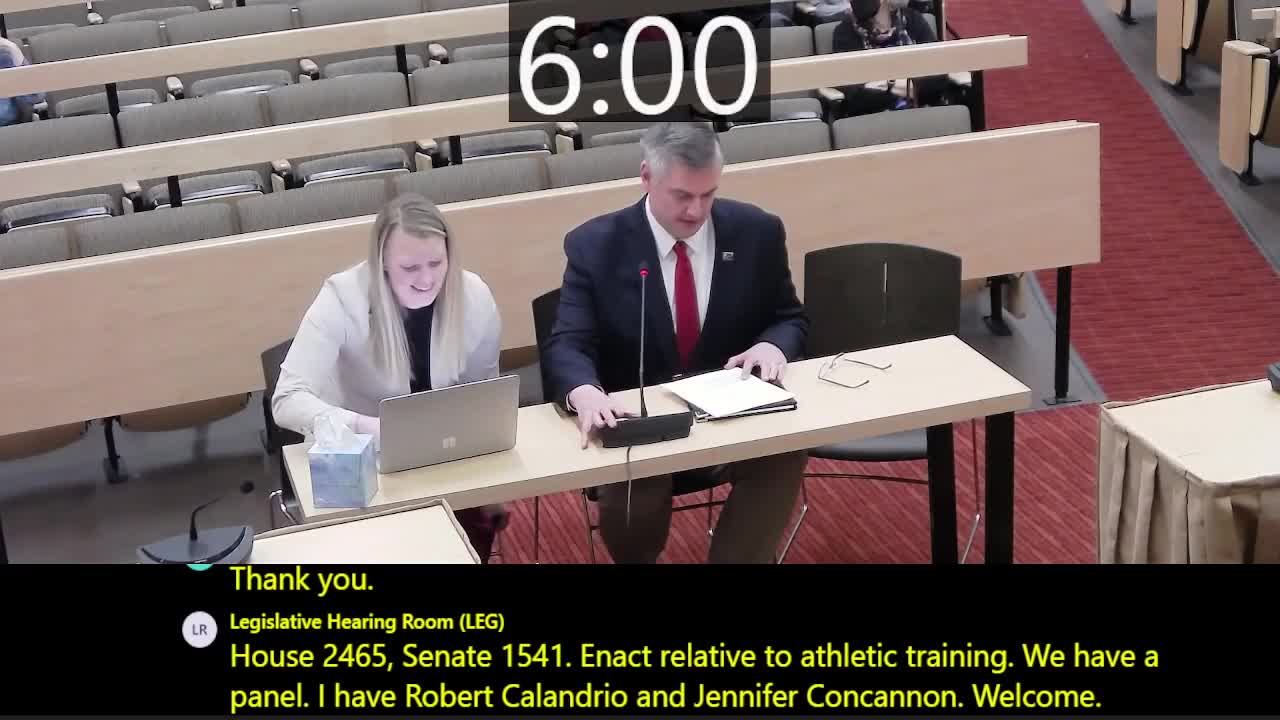
Robert Calandrio, a Bridgewater State professor and government affairs chair for Athletic Trainers of Massachusetts, summarized the profession’s history of licensure in the Commonwealth and argued that statute language adopted in 1981‑82 no longer reflects the profession’s scope of practice. "Expanding access to athletic trainers and athletic training by removing the workplace restriction language is [a] much needed first step to retaining our workforce," he told the committee, adding that new graduates often leave the state when they cannot apply the full range of their clinical skills locally.
Calandrio and Jennifer Conkannon, president of the Athletic Trainers of Massachusetts and owner of a private‑practice athletic training facility, said removing the restriction would allow athletic trainers to work in occupational health programs, private industry and public safety agencies (police, fire, emergency services). They described evidence from other jurisdictions and industry surveys showing reduced workers’ compensation claims, lowered care costs, faster return‑to‑work and safety benefits when employers employ athletic trainers for injury prevention and on‑site care.
Witnesses also said the bill would clarify athletic trainers’ role under Massachusetts’ high‑school football medical coverage law so that trainers present at weekday sub‑varsity games are explicitly covered by the statute and related MIAA rules.
Committee members thanked the witnesses and asked about educational standards, supervision, and how scope changes would be implemented and enforced by the Board of Allied Health Professions. The witnesses said they are prepared to work with regulators and with the committee to craft language that preserves public protection while expanding practice settings.
Ending: The committee asked for follow‑up materials and indicated it will work with witnesses on statutory language if the panel can provide specific draft amendments.