Get Full Government Meeting Transcripts, Videos, & Alerts Forever!
Get email alerts on the Aed Requirements topic
No spam. Unsubscribe anytime.
Committee hears push to require AEDs at athletic events and facilities
Summary
Witnesses urged the Joint Committee on Public Health to expand AED requirements beyond schools to athletic fields, public stadiums and health clubs; advocates cited survival benefits while parks and recreation staff warned about costs and maintenance burdens for small towns.
The Joint Committee on Public Health heard testimony in support of bills that would require automated external defibrillators (AEDs) and trained personnel at athletic events and in certain facilities.
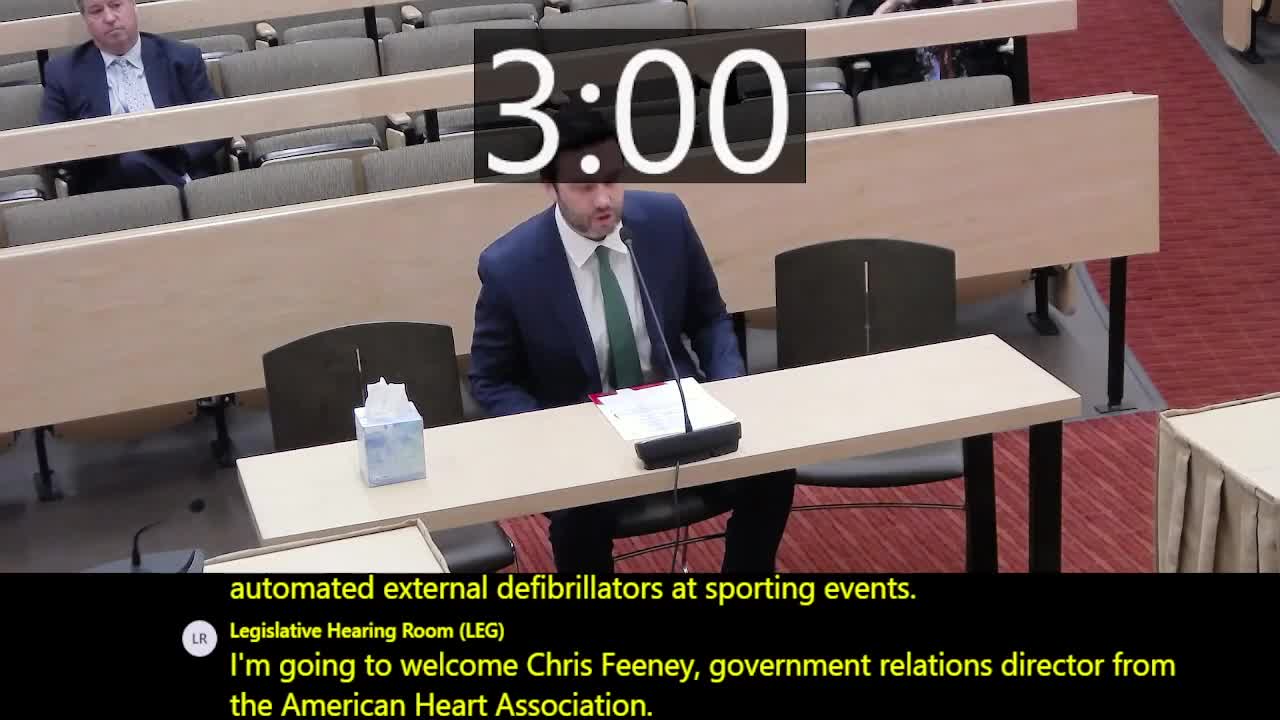
Chris Feeney, government relations director for the American Heart Association, told the committee that sudden cardiac arrest is a leading cause of death at athletic activities and that “automated external defibrillators or AEDs … can restore the heart's normal rhythm and are life saving tools.” He noted that while schools must have AEDs, many community athletic facilities do not.
Senate and House sponsors have introduced bills — including House Bill 2391 and Senate Bill 1489 — to require at least one AED on site at athletic events and in defined facilities, to ensure locations are posted and to encourage facility operators to have a cardiac emergency response plan (SERP) and trained volunteers able to use the devices. Senator Collins and other legislative supporters urged a favorable report and said the bills are intended to reduce deaths by ensuring quick access and trained responders.
Melissa Terminie (testifying as a parks and recreation professional) supported access to AEDs but raised implementation concerns for under‑resourced municipalities. She told the committee that many small towns have part‑time parks departments or a single staffer and that purchasing, training, maintaining and securing AEDs — and powering them in tree‑covered or remote park locations — could be “a hardship for many communities” and may require different deployment strategies.
Witnesses and legislators discussed complementary provisions in other bills addressing health clubs and signage. Senators and representatives asked about funding options, whether state grant programs or municipal public health funds could be used to defray costs, and how plans should handle facilities without electricity or staff present during open hours.
The committee did not vote on the bills and asked witnesses to submit written cost estimates, sample emergency response plans, and examples of state or private funds used elsewhere to deploy AEDs in community settings.
Ending: Chairs encouraged written follow‑up from municipal parks officials and the American Heart Association; no committee action was taken at the hearing.