Get Full Government Meeting Transcripts, Videos, & Alerts Forever!
Get email alerts on the Masshealth Primary Care System Capacity topic
No spam. Unsubscribe anytime.
MassHealth outlines primary‑care sub‑capitation and behavioral‑health investments; hospitals and community health centers warn of financial strain
Summary
MassHealth told the Joint Committee on Public Health it is two years into a primary‑care sub‑capitation model and a behavioral‑health roadmap that have shown early signs of progress; other witnesses warned hospitals and community health centers face operating deficits and that federal Medicaid cuts would further destabilize care.
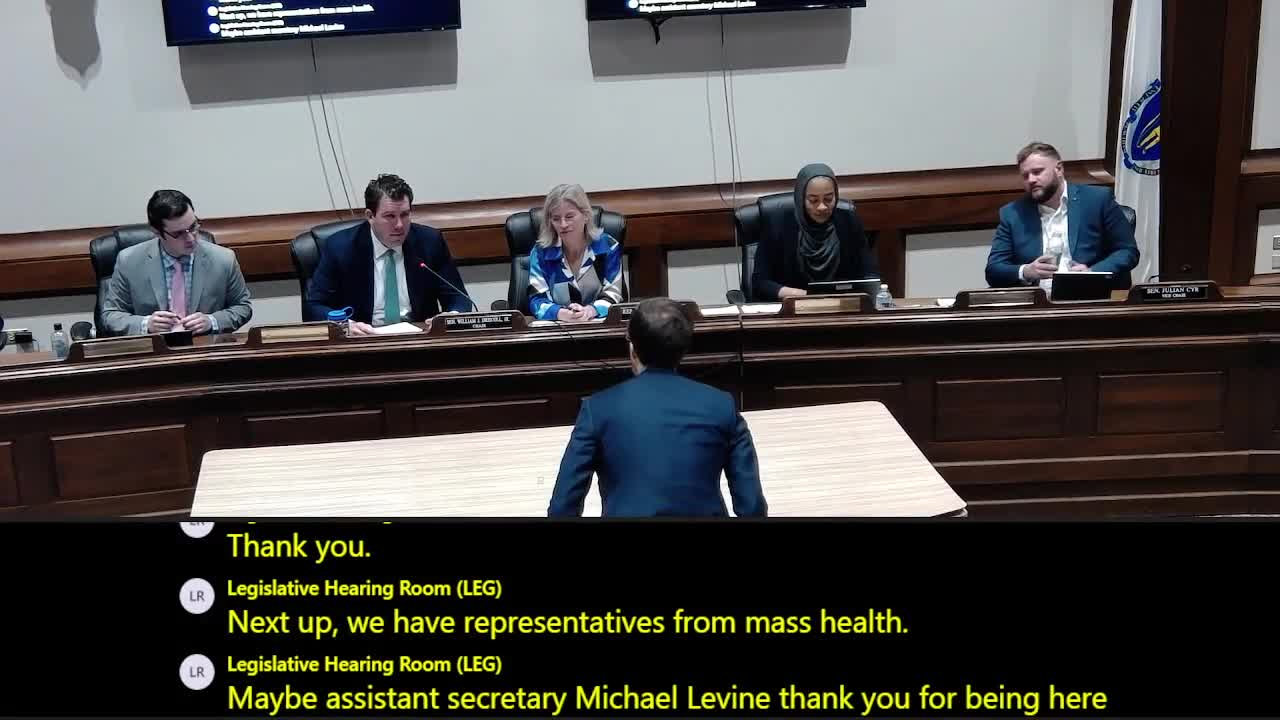
Assistant Secretary Michael Levine of MassHealth told the Joint Committee on Public Health that MassHealth covers about 1 in 4 Massachusetts residents, including 45 percent of children and 70 percent of long‑term‑care residents. He described four priorities aligned with the committee’s charge: health equity, strengthening behavioral health in primary care, promoting member independence through community‑based services, and improving member experience and customer service.
Levine said MassHealth’s primary‑care sub‑capitation program — two years in operation — now includes about 1,000 practices and that about 20 percent of those practices have “leveled up” to higher tiers of service. He said the program has added roughly $150 million above previous payments to participating primary‑care providers to support expanded access and integrated behavioral health.
On behavioral health, Levine highlighted the rollout of over two dozen community behavioral health centers offering 24/7 crisis care and said Massachusetts has reduced psychiatric boarding in emergency departments by more than half in two years. He also described rebalancing long‑term supports (Money Follows the Person) that helped hundreds of nursing‑facility residents move back to community settings.
Multiple witnesses testified that hospitals, nurses and community health centers are operating under severe financial strain. The president of the Massachusetts Nurses Association described a workforce “crisis” driven by difficult working conditions and a high turnover rate; community health center leaders warned of operating deficits and asked the Commonwealth to consider additional bridge funding (a request framed as $75 million by the association, with $12.5 million already provided and an ask for an additional $65 million). The Health Policy Commission and Mass Hospital Association spoke of ongoing task forces on primary care and maternal health to produce actionable recommendations.
Witnesses cautioned that federal Medicaid reductions proposed in Washington could have a major effect on MassHealth’s budget — MassHealth’s total spending cited at about $21 billion with about $14 billion from federal funds and roughly $8 billion from state general funds — and urged state contingency planning to preserve coverage and services.