Get Full Government Meeting Transcripts, Videos, & Alerts Forever!
Get email alerts on the Suicide Coercion topic
No spam. Unsubscribe anytime.
Senator Feingold renews push for 'Conrad's Law' to criminalize coerced suicide
Summary
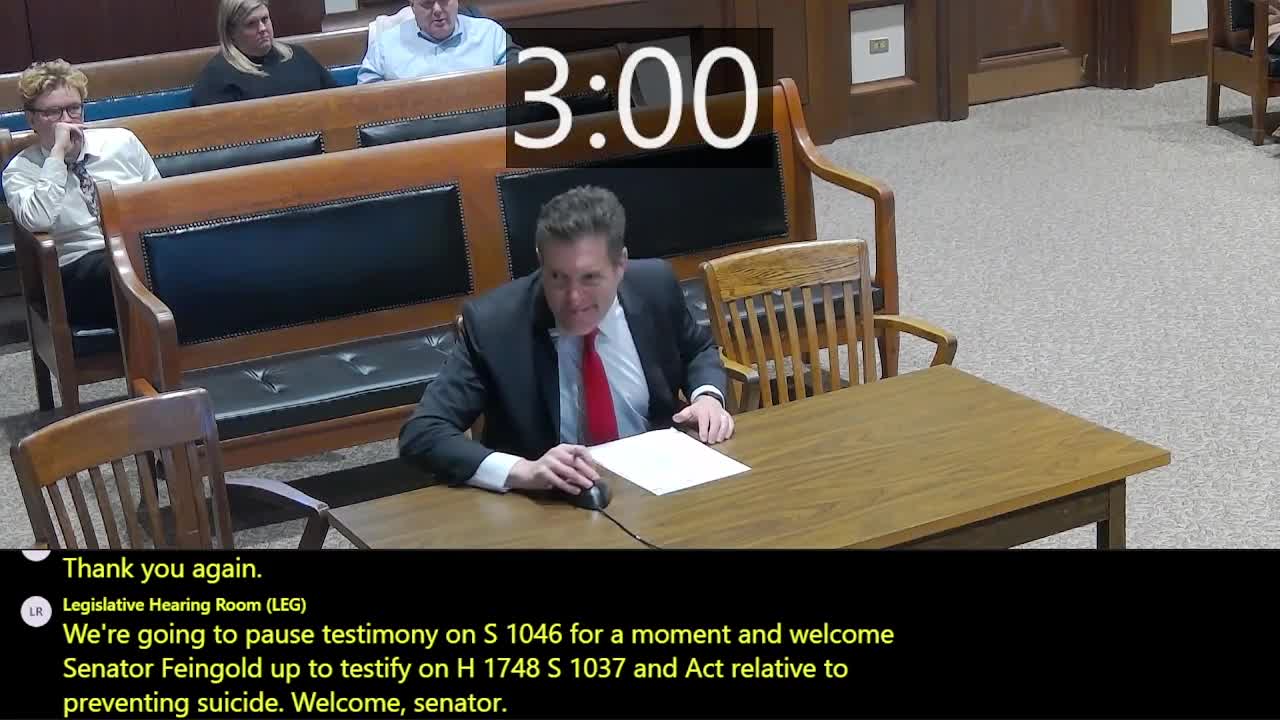
Senator Nick Collins? (transcript: Senator Feingold) introduced H.1748 / S.1109 — known as "Conrad's Law" — to create a criminal offense for coercing another person into dying by suicide; testimony emphasized teen suicide trends and sought a narrowly tailored statute to give prosecutors a specific tool.
Senator (filed speaker) urged the Joint Committee on the Judiciary to consider H.1748 / S.1109, legislation sometimes described as “Conrad’s Law,” which would make it a crime to coerce another person to die by suicide.
The bill’s sponsor described the law as narrowly tailored to allow prosecutors a discrete charge for coercing suicide rather than relying solely on involuntary manslaughter charges. The sponsor said the measure was developed with criminal-justice scholars and family members of Conrad Roy, and noted that Massachusetts is one of a minority of states without a standalone coerced‑suicide statute.
The sponsor cited national and state trends in youth suicide rates and told the committee that a tailored criminal statute can give prosecutors appropriate options and provide clarity to courts and victims’ families. Under the bill as described, an individual who "knew that someone else was experiencing suicidal ideation and intentionally coerced them into taking their own life or provided them with means to do so" could face up to five years in prison, according to the sponsor’s summary.
Committee members asked about addressing cases involving young people or those with serious mental illness; the sponsor said the bill’s intent is to create a clear, narrowly tailored tool for prosecutors and that his team was open to working with committee staff on precisely calibrated language and appropriate exceptions or sentencing guidance.
No committee vote or formal action on H.1748 / S.1109 was recorded during this session.