Get Full Government Meeting Transcripts, Videos, & Alerts Forever!
Get email alerts on the Labor Misclassification topic
No spam. Unsubscribe anytime.
Advocates urge law change to harmonize employee test to curb misclassification
Summary
Legal aid and labor groups urged the Joint Committee on Labor and Workforce Development to align employee-status tests across statutes so misclassified workers can access benefits and enforcement can be more effective.
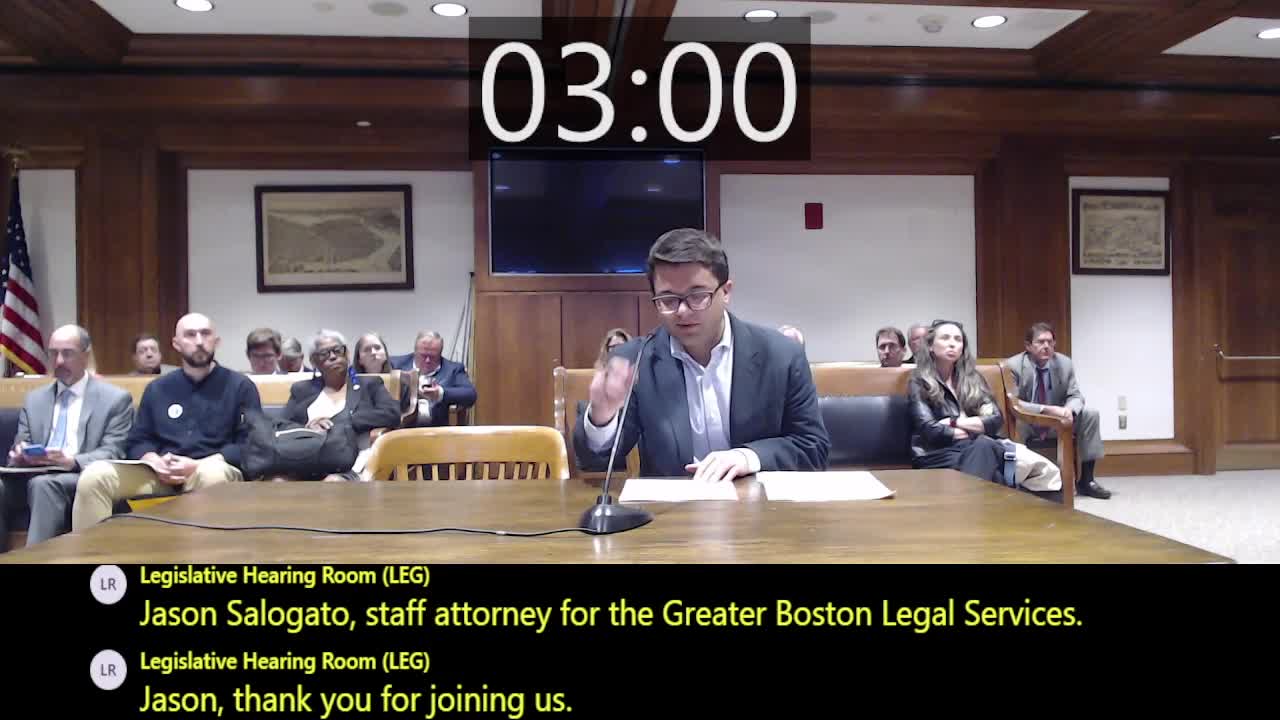
Jason Salgado, a staff attorney in the employment law unit at Greater Boston Legal Services, told the Joint Committee on Labor and Workforce Development that SB 1338 and HB 2141 would “help address the pervasive issue of employee misclassification, which deprives hundreds of thousands of workers across the Commonwealth fundamental workplace rights.”
The bills would align the employee-status test used for unemployment insurance with the test in wage-and-hour statutes, and because the Paid Family and Medical Leave statute relies on the unemployment-insurance test, backers said harmonizing those definitions would clarify eligibility across programs.
“We represent numerous workers who, as a result of being misclassified, face significant difficulties and delays obtaining unemployment insurance benefits for which they are in fact eligible,” Salgado said. He told the committee that misclassification can block workers from minimum-wage and overtime protections and from benefits including earned sick time, workers’ compensation, PFML and unemployment insurance.
Lindsey Kenny, legislative director for the Massachusetts AFL-CIO, said the discrepancy arises from a “slight difference in the so-called ABC test between chapter 149 and chapter 151A.” She added that “misclassification is a tactic used by unscrupulous employers to avoid paying their workers properly or giving them the benefits required by law.”
Testimony described how misclassification can be both a worker-protection issue and a fiscal problem for the state: Salgado said misclassification reduces employer payments into state trust funds and that correcting eligibility errors for UI benefits can take months or years. Kenny noted that two large national companies, Uber and Lyft, have owed “somewhere north of $25,000,000” to the UI trust fund because of misclassification.
Supporters asked the committee to report the bills favorably; no committee votes on the bills were taken during the hearing.
Why this matters: Proponents said harmonizing statutory definitions would simplify enforcement across agencies, reduce delays for workers claiming benefits, and limit an unfair competitive advantage for employers who misclassify workers.