Get Full Government Meeting Transcripts, Videos, & Alerts Forever!
Get email alerts on the Fafsa Completion topic
No spam. Unsubscribe anytime.
Advocates press committee to require FAFSA completion or opt‑out for high school seniors
Summary
Supporters of H1467/S921 told the Joint Committee on Higher Education that requiring students to complete the FAFSA or explicitly opt out at graduation would close completion gaps between wealthier and lower‑income districts; witnesses cited recent federal form simplifications and examples from other states.
Legislators and nonprofit advocates urged the Joint Committee on Higher Education to advance legislation requiring students to complete the Free Application for Federal Student Aid (FAFSA) or explicitly opt out prior to high school graduation.
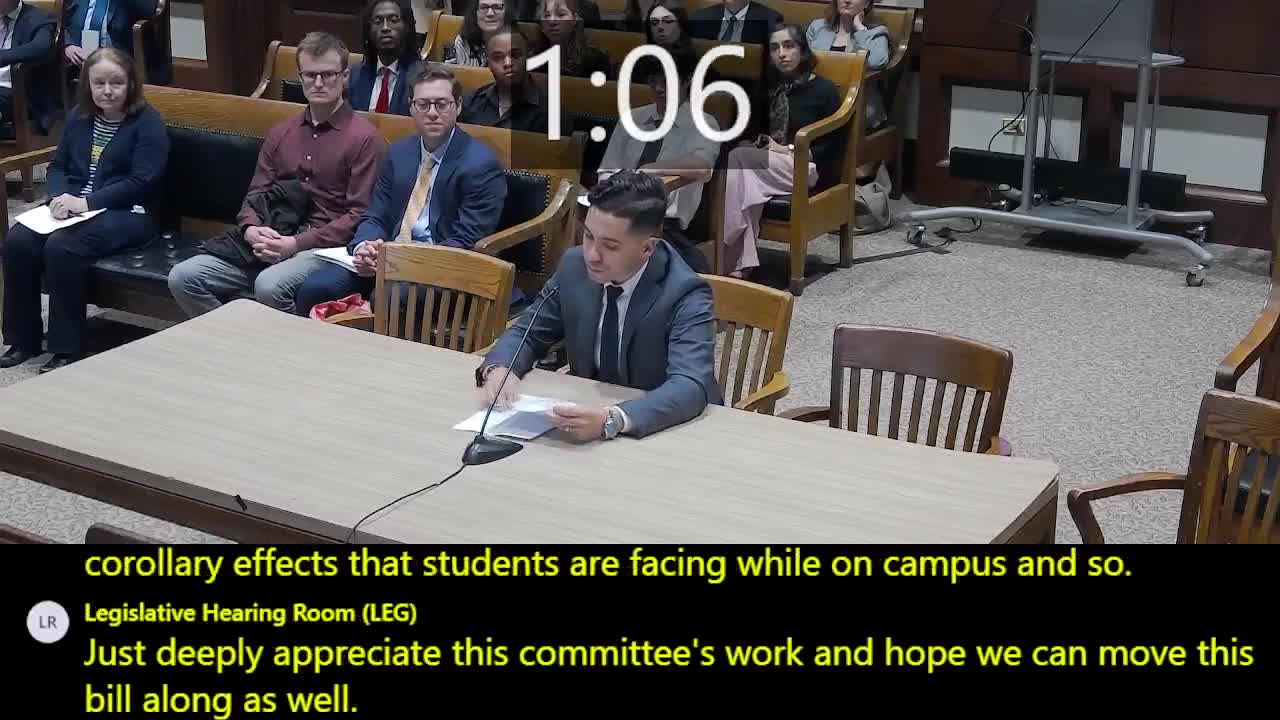
Representative Andy Vargas and advocates from uAspire and The Education Trust testified in support of H1467/S921, describing evidence that the students most likely to benefit from federal aid are disproportionately least likely to complete the FAFSA. Vargas described the bill as a simple policy that requires an individualized FAFSA conversation at or near graduation — students would either complete the FAFSA or opt out without explaining the reason.
"We have to do a better job of making sure we're closing that gap," Vargas told the committee. Advocates said states that implemented similar policies have seen fast increases in completion rates. Testimony from uAspire cited Department of Elementary and Secondary Education data showing fewer than 38 percent of low‑income Massachusetts high school seniors completed the FAFSA in a recent year and noted that Massachusetts students left about $63 million in aid unclaimed.
Witnesses said federal simplifications to the FAFSA form have reduced technical barriers but not outreach gaps. They told the committee that counseling, workshops and a FAFSA trust fund for support services would be needed to help students and families complete applications, particularly first‑generation and lower‑income students.
Committee members asked about federal rollout issues and whether the revised FAFSA reduced completion barriers. Vargas and uAspire staff said the simplified form helped in some places but that targeted outreach and in‑person assistance remain critical to closing completion gaps.
No formal committee votes were taken during the hearing. Supporters urged the committee to report the bill favorably and to couple any mandate with funding for in‑school supports and tracking of completion rates.