Get Full Government Meeting Transcripts, Videos, & Alerts Forever!
Get email alerts on the Medical Debt topic
No spam. Unsubscribe anytime.
Attorney general and advocates push for standardized hospital financial assistance to curb medical debt
Summary
The attorney general’s office, patient advocates and health‑policy groups urged the Joint Committee to pass bills that would require both nonprofit and for‑profit hospitals to use a uniform financial‑assistance application, standard eligibility thresholds and clearer notice rules to reduce medical debt for insured and uninsured patients.
Boston — The Joint Committee on Health Care Financing heard support from the attorney general’s office, patient‑advocacy organizations and clinicians for legislation that would standardize hospital financial‑assistance policies and reduce medical debt collections.
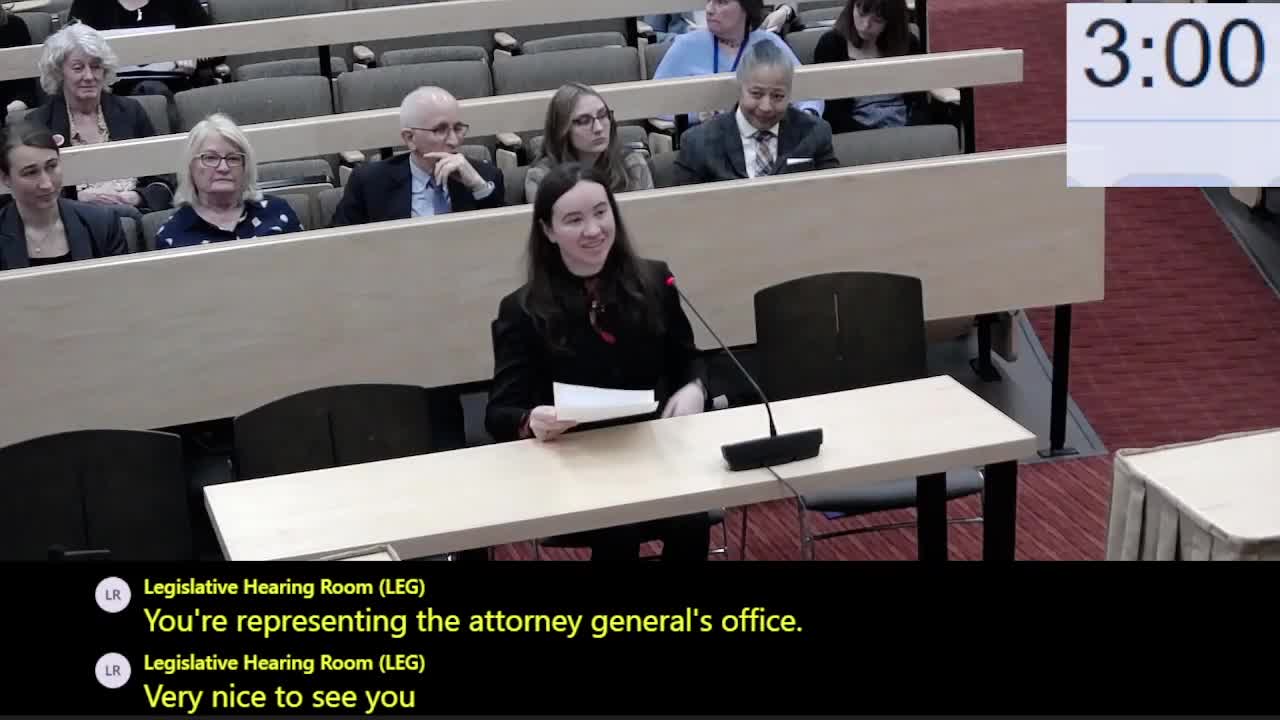
Assistant Attorney General Chloe Cable told the committee the attorney general’s office strongly supports H 13 50 and S 8 42, bills filed by Representative Christine Barber and Senator Joanne Comerford. “Even with near‑universal coverage in Massachusetts, residents are still struggling to afford their medical bills,” Cable said. She cited the office’s 2024 cost‑trends report showing that hospital medical debt disproportionately affects women, Black patients and low‑income patients.
What the bills would do: Witnesses described three main changes: require all hospitals (nonprofit and for‑profit) to adopt a standard eligibility floor and discount schedule, mandate a single uniform financial‑assistance application, and impose clearer notice and website requirements so patients can find and apply for assistance before or after care. Health Care for All and Health Law Advocates presented examples where hospitals in a small geographic area had widely divergent income limits, inconsistent online accessibility, and multi‑page applications in English only.
Key policy points and trade‑offs: Panelists said the bills would raise the eligibility cutoff in some hospitals from the current health‑safety‑net threshold (300% of the federal poverty level) to 400% of FPL for a partial discount tier, with a 25% discount for the 351%–400% band; the health‑safety‑net reimbursement for those under 300% would remain intact. Health‑plan and hospital representatives on the panel said variability among hospitals reflects differing current practices and that implementation would require operational changes for some institutions. Health Care for All noted existing federal rules permit hospitals to set their own policies, creating a patchwork that confuses patients.
Stories and impact: Health Law Advocates shared client stories of patients who were not notified about assistance and whose bills went to collections — including a Portuguese‑speaking patient who received a $12,000 bill after a hospital stay and was not offered application assistance in his language until counsel intervened. Health centers, patient groups and cancer advocates emphasized that medical debt can lead patients to delay or forgo treatment.
Questions from the committee centered on implementation details: whether hospitals that already offer generous assistance would be disadvantaged (panel said some hospitals already meet or exceed the proposed floor), how health‑safety‑net payments interact with the proposal (witnesses described the proposed change as a wraparound for those up to 400% FPL), and whether insurers or employer‑sponsored plans could be asked to help fund an expanded safety net (some plans already contribute to the health safety net). No formal vote was taken; sponsors agreed to supply additional financial‑impact estimates and comparative policy examples from other states.
Ending note: Advocates urged the committee to act, saying standardization would give patients timely and equitable access to assistance and reduce downstream economic harms from medical debt.