Get Full Government Meeting Transcripts, Videos, & Alerts Forever!
Get email alerts on the Hunger Free Campus topic
No spam. Unsubscribe anytime.
Lawmakers consider codifying Hunger Free Campus grants after advocates cite 44% food insecurity on public campuses
Summary
Lawmakers heard testimony supporting H1466/S939 to codify and stabilize the Hunger Free Campus Initiative that funds pantry programs, meal credits and SNAP outreach for public colleges; advocates and state senators described prior ARPA and budget appropriations and urged statutory permanence to sustain services.
Legislators and dozens of advocates testified in favor of legislation to make the Hunger Free Campus Initiative a statutory program after several witnesses described food insecurity among public college students and the program’s recent, temporary funding.
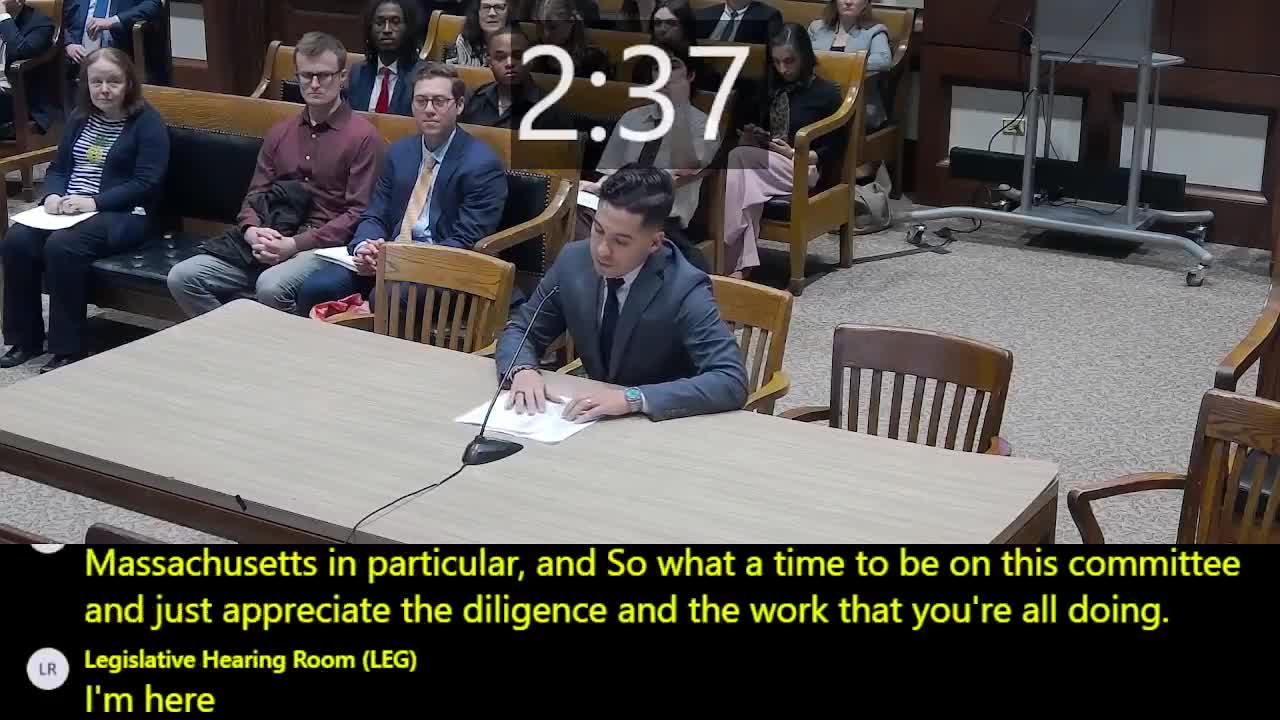
Representative Andy Vargas, Senator Jo Comerford and Senator Becca Lovely — among others — told the Joint Committee on Higher Education the initiative has shown results in pilot funding but needs legislative codification and stable funding.
"This would really be about codifying a hunger free campus into law to make sure that this ... continues to move forward," Representative Vargas told the committee, referring to H1466. He cited a study the Greater Boston Food Bank and Mass General Brigham published that found 44 percent of public university and community college students faced food insecurity in 2023.
Senator Lovely and other witnesses described past and current appropriations: advocates said the initiative received $3.7 million in ARPA funds in 2022 and a $500,000 earmark in the FY2025 budget. Supporters asked the committee to convert that recurring grant work into a statutory program run through the Department of Higher Education so campuses and minority‑serving institutions receive administrative guidance, capacity funds, and anti‑stigma outreach.
Witnesses described a mix of interventions the bill would support: campus meal credit sharing programs, emergency funds for students in crisis, SNAP/WIC enrollment assistance, culturally appropriate meal procurement, pantry partnerships and capacity building for basic‑needs offices. Kate Adams of the Greater Boston Food Bank told the committee evidence links food insecurity to lower graduation and degree attainment; she cited NIH research showing students from food‑insecure households were "43 percent less likely to graduate with an associate's degree."
Student advocates and community college leaders told the panel they rely on pantry and basic‑needs staff and that uncertain, short‑term funding undermines program planning. Michael Hannigan, student senate president at Greenfield Community College, told the committee pantries are often the difference between a student staying enrolled and dropping out, and that late arriving grant funds hampered program delivery.
No formal legislative actions or votes were taken in this hearing. Advocates urged a favorable report and asked that the committee consider pairing longer‑term funding with reporting requirements so the legislature can track outcomes such as SNAP enrollment, retention and degree completion.