Get Full Government Meeting Transcripts, Videos, & Alerts Forever!
Get email alerts on the Foreclosure Prevention topic
No spam. Unsubscribe anytime.
Advocates urge state to require pre-foreclosure mediation under S.765/H.1090
Summary
The Joint Committee on Financial Services heard more than a dozen witnesses on a bill to create a statewide foreclosure prevention program, S.765 (Senate)/H.1090 (House), that would require mortgage servicers to participate in pre-foreclosure mediation with homeowners.
The Joint Committee on Financial Services heard more than a dozen witnesses on a bill to create a statewide foreclosure prevention program, S.765 (Senate)/H.1090 (House), that would require mortgage servicers to participate in pre-foreclosure mediation with homeowners.
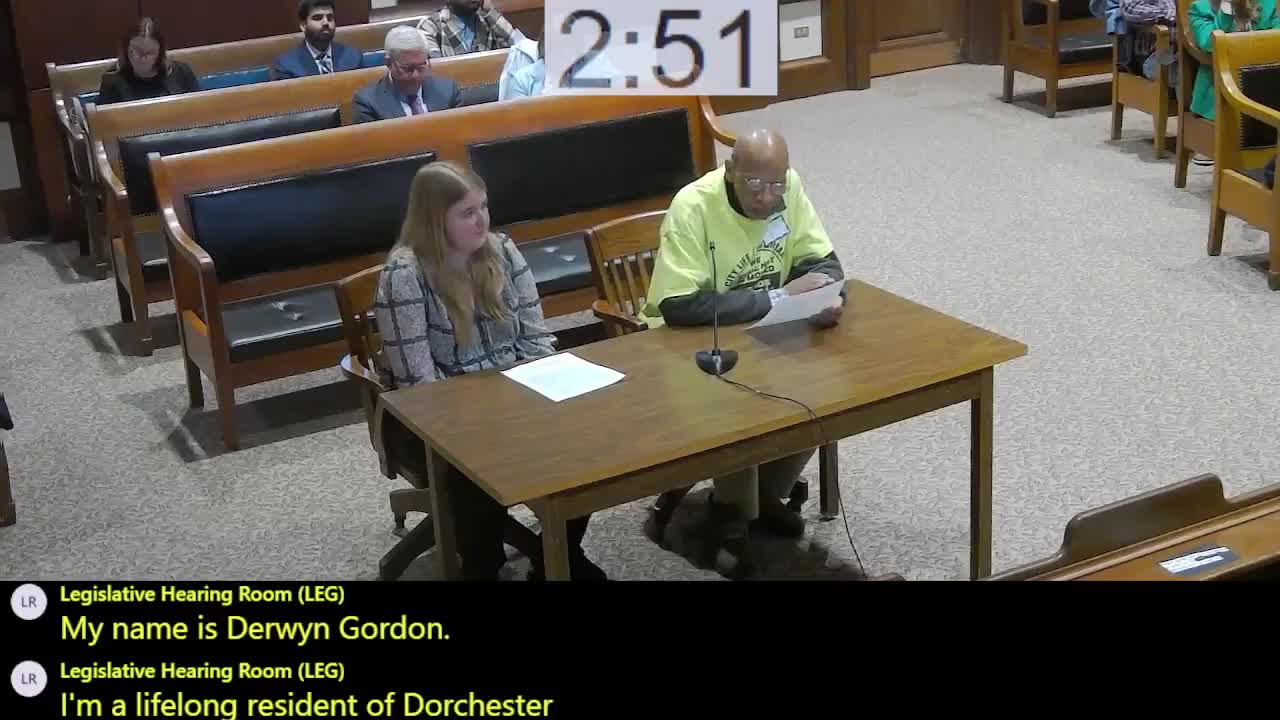
Derwin Gordon, a lifelong Dorchester resident, told the committee that the proposal "would make it possible for homeowners like me and my family to stay in our homes." Gordon described months of missed payments after his stepfather fell ill and a lender-initiated auction despite the mortgage being nearly paid off.
Katie McCann, community organizer at City Life/Vida Urbana, said her group works with tenants and homeowners and that many foreclosure cases "could be easily resolved if the bank were willing to mediate as this bill would require." McCann referenced public health research showing foreclosure and displacement harm physical and mental health and disproportionately affect communities of color.
Rose Webster Smith, director of Springfield No One Leaves, recounted her own five-year fight to win a house back after foreclosure and said confusion about servicers and note holders—"one entity can collect your money and a whole other entity can hold the note"—is common. She told the committee that mediation would eliminate confusion and provide a meaningful chance to avoid foreclosure.
Todd Kaplan, an attorney who represents consumers in Massachusetts courts, and other legal-aid and advocacy witnesses described the bill as a voluntary, revenue-neutral program that requires accurate loan information, an opportunity to explore options such as loan modification or placing missed payments at the end of the loan, and a face‑to‑face conference with someone who has authority to offer alternatives before foreclosure proceeds.
Isaac Simon Hodes, executive director of Lynn United for Change, said a local mediation program run in Lynn in 2014 achieved striking results. Hodes said Mass Dispute Resolution Services, which administered that program, found that "97% of the cases that reached an in‑person mediation were concluded with a foreclosure alternative," usually allowing families to remain in their homes.
Supporters framed the bill as a practical, state-level fix to minimize displacement, preserve generational wealth and reduce the public‑health harms associated with housing loss. They asked the committee to report the bill favorably and to make the program available statewide rather than left to individual municipalities.
The committee did not take final action on S.765/H.1090 at the hearing. The panel adjourned by voice vote at the end of the session.