Get Full Government Meeting Transcripts, Videos, & Alerts Forever!
Get email alerts on the Home Care Licensure topic
No spam. Unsubscribe anytime.
Providers, unions and families urge licensure for nonmedical home care at Joint Committee hearing
Summary
Industry groups, labor representatives, providers and family caregivers told the Joint Committee on Aging and Independence they support legislation (H.789 / S.470) to license nonmedical home care agencies, citing consumer protection, workforce standards and dementia training. No committee vote was recorded at the hearing.
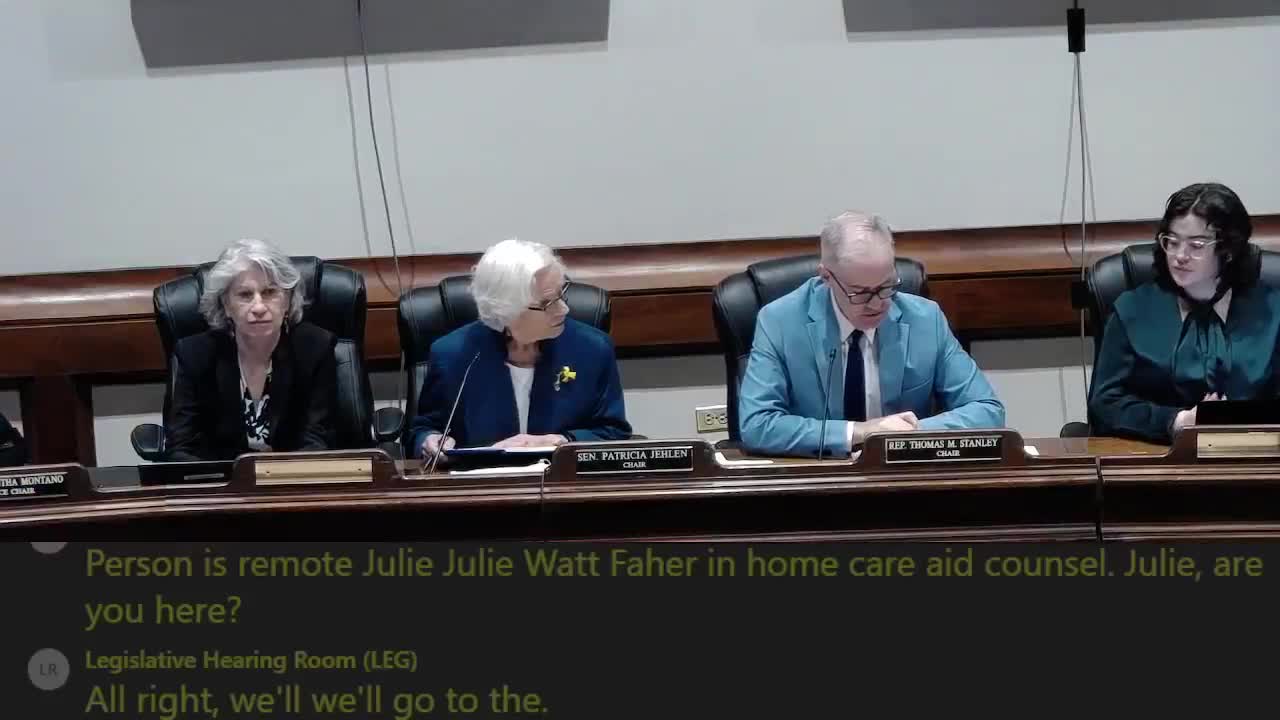
At a hearing of the Joint Committee on Aging and Independence, providers, labor representatives and family caregivers testified broadly in favor of H.789 / S.470, legislation to create a statewide licensure system for nonmedical home care agencies in Massachusetts.
Supporters told committee members the bill would set baseline standards for agencies, ensure background checks and training for workers, and protect consumers and caregivers. "It's often easier to open a home care agency than it is a pizza shop in Massachusetts," said Jake Krolovich, executive director of the Home Care Alliance of Massachusetts, arguing the current business-registration process allows operators to enter the market without consistent standards. "We believe agencies should be held to a baseline set of standards that would protect consumers and the workforce."
The bill would direct the Executive Office of Health and Human Services (EOHHS) to establish licensing standards, in consultation with the Executive Office of Elder Affairs and the Department of Mental Health, and would authorize state departments to conduct surveys and investigations, set background-screening rules, require minimum consumer-specific care plans, training and competency requirements, and establish procedures for complaints and enforcement. Julie Watt (executive director, Home Care Aid Council) said the council supports the draft legislation and noted the bill reflects recommendations from the Home Care Licensure Commission established by section 97 of chapter 227 of the acts of 2020.
Why it matters: witnesses said licensure would protect older adults from unvetted providers, reduce the risk of abuse and fraud, and level the competitive field so providers that invest in training and insurance are not undercut by operators who do not meet those standards. Larry Michael, owner of two Visiting Angels offices, described clients who need services ranging from a few hours a week to around‑the‑clock care and urged safeguards for liability insurance, workers' compensation and written care plans.
Areas of discussion and questions from legislators included how the bill would treat individuals offering occasional paid help (for example, lawn mowing or household chores) and volunteers. Several witnesses and committee members said the regulatory definitions and enforcement mechanism will be shaped during rulemaking. "I think it's something that the regulatory process is going to have to sort through," Jake Krolovich said, adding that the bill's drafters envisioned coverage for anyone "advertising themselves as providing home care services." Panelists said enforcement and sanctions would be administered by state regulators and noted the bill prescribes fines for unlicensed advertising or provision of services.
Speakers also highlighted workforce pressures and the role of private investment. Tim Foley, outgoing executive vice president of 1199SEIU, told the committee the bill would protect workers and consumers and flagged the rise of private equity acquisitions in home health and home care markets. "The majority of private equity transactions are in the home health care space," Foley said, citing a Health Policy Commission report.
Family caregivers and Alzheimer’s advocates pressed for dementia‑specific training in the licensure language. Susan Ankoviak of the Alzheimer’s Association said expanding dementia training across all home care settings would help workers detect changes in client status and reduce avoidable hospital visits.
What the record shows: witnesses described persistent problems — providers operating without proper background checks, insufficient insurance, and spotty training — and urged the committee to report the bill favorably. Several witnesses said Massachusetts is one of only a few states without such licensure. The hearing did not record a committee vote on H.789 / S.470.
Clarifying details reported to the committee included that the Home Care Aid Council represents about 100 nonprofit and for‑profit agencies that directly employ, supervise and manage more than 50,000 home care aides (testimony of Julie Watt), and that some providers serve large regional populations (Larry Michael testified his offices serve more than 20 communities representing a combined population of about 600,000, including more than 100,000 residents aged 65 and older).
Next steps: witnesses repeatedly urged the committee to move the bill forward and for EOHHS to craft regulations that protect consumers without imposing unnecessary burdens that would push private‑pay consumers into an underground market. The committee did not take a formal vote on the day’s testimony; additional consideration and rulemaking were discussed as expected follow‑up actions.