Get Full Government Meeting Transcripts, Videos, & Alerts Forever!
Get email alerts on the State Highways Funding Safety topic
No spam. Unsubscribe anytime.
MassDOT outlines highway workload, safety priorities and local grant access
Summary
MassDOT officials told the Joint Committee on Transportation the Highway Division manages nearly 10,000 lane miles and more than 5,000 bridges, is running a multibillion-dollar capital program and is prioritizing work zone safety, expanded municipal grant access and program modernization.
MassDOT told the Joint Committee on Transportation that its Highway Division is managing a large capital program while prioritizing safety and better access to municipal grant programs.
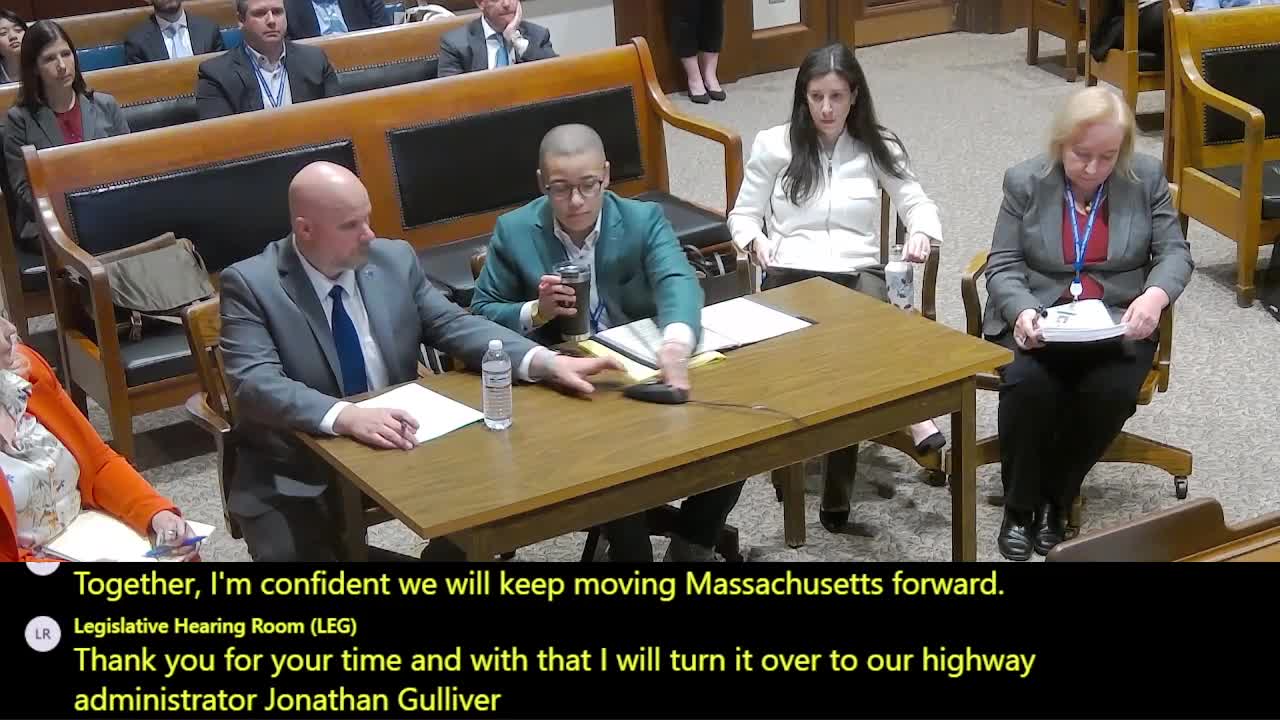
The Highway Division’s administrator, Jonathan Gulliver, told the committee, “We manage nearly 10,000 lane miles of state highway, over 5,000 bridges,” and said the division leads about 2,800 staff who run day-to-day operations. He described an annual capital program that “currently exceeds $2,000,000,000” in spending and nearly 700 active maintenance and construction contracts totaling “just under $7,000,000,000” planned for 2025.
Those investments, Gulliver said, have targeted aging bridges and local needs through chapter 90 funding and multiple municipal grant programs. He described a new online portal, Grant Central, for municipalities to apply for programs including municipal pavement, local bottlenecks, shared streets and complete streets, and said the division aims to add culverts and small bridges to that portal in the near term.
The highway administrator emphasized operations and emergency response outside of construction season: “When emergencies strike, whether it’s a snowstorm, a hurricane, a flood or even a natural gas explosion…our team is there to work with communities,” he said, describing the Highway Operations Center in South Boston and a backup in Worcester.
Committee members pressed MassDOT on safety and automated enforcement after members noted increased serious injuries and fatalities since the pandemic. Gulliver said work-zone incidents have been particularly deadly and that the division will “take whatever tool that the legislature wants to give us and try to put it to good use,” including automated enforcement tools where appropriate to improve worker and public safety.
Representatives also raised access issues for small and rural communities under state grant programs such as Complete Streets. MassDOT staff acknowledged reimbursement structures can be a barrier and said staff would review options, including combined applications and shifting reimbursable models to a grant approach where feasible.
The Highway Division told the committee it is institutionalizing agile process improvements, expanding workforce hiring and seeking efficiencies so it can take full advantage of available federal and state funding. The division noted safety is central across design, construction and maintenance work.
Less critical details: MassDOT said it coordinates closely with MEMA during emergencies and continues to refine project planning, advertising and hiring practices to speed delivery and improve access to smaller municipalities.