Get Full Government Meeting Transcripts, Videos, & Alerts Forever!
Get email alerts on the Transportation topic
No spam. Unsubscribe anytime.
Committee hears debate on bill letting counties permit UTVs on township and county roads
Summary
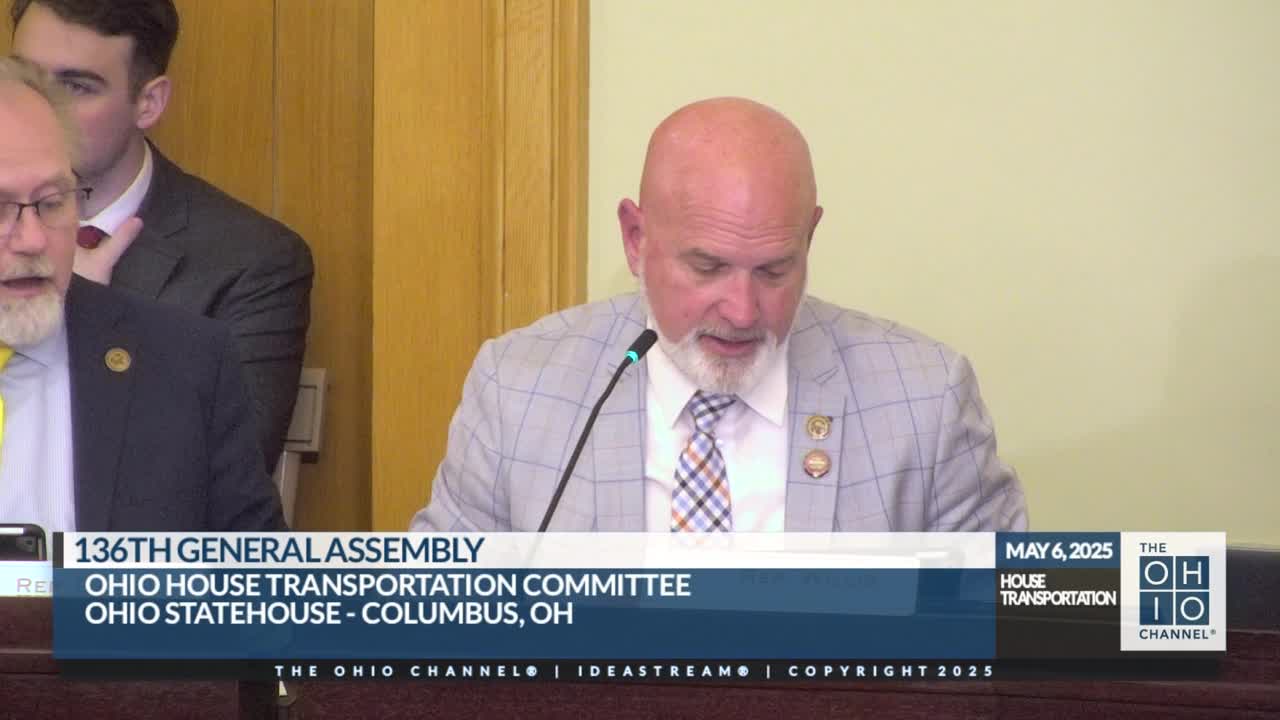
House Bill 199 returned to the House Transportation Committee on May 6 for a second hearing aimed at updating Ohio law to address growing use of utility terrain vehicles (UTVs) on county and township roads.
House Bill 199 returned to the House Transportation Committee on May 6 for a second hearing aimed at updating Ohio law to address the growing use of utility terrain vehicles, commonly called UTVs or "side-by-sides."
Tim Bubb, a county commissioner and past president of the County Commissioners Association of Ohio, testified in favor of the bill. "House Bill 199 would provide those important updates to the revised code and allow counties to either allow or prohibit permissive the vehicles on their local county or township roads as well as generally regulate their operation," Bubb said. He told the committee the bill preserves current agriculture exemptions and that the measure's permissive approach would give counties uniform statutory authority to regulate UTVs, improving consistency for law enforcement.
Matthew (Matt) Lutz, sheriff of Muskingum County, also testified as a proponent, saying the current patchwork of county rules "is confusing and detrimental, not to only those who own and operate those vehicles, but also to the ability to properly enforce traffic laws and maintain safety." Lutz described UTVs as "side-by-sides" with steering wheels, factory seat belts and roll bars and argued the bill would apply to secondary roads — county and township roads — not state routes or interstates. He told the committee that if vehicles are registered and plated under the bill, law enforcement could treat them like other licensed vehicles instead of generating inconsistent enforcement across counties.
Committee members pressed witnesses on safety data and design differences between UTVs and passenger vehicles. Ranking Member Grimm cited owners' manuals that advise against road use and noted many UTVs lack airbags and some modern crash-protection features. Representative Miller and Representative Lorenz asked whether the bill requires inspections, license plates, operator licenses and insurance; witnesses said the bill anticipates inspections and registration, and that counties could require licensing and minimum equipment. Sheriff Lutz said in some counties title offices and license bureaus apply different standards today, and standardized registration would reduce uncertainty and pursuits that begin when officers attempt to stop unplated vehicles.
Witnesses acknowledged there may be more UTVs on roads if counties allow them and that could increase crash counts, but they argued many serious injuries reflect operator error and that UTVs include roll bars and safety harnesses. Sheriff Lutz said anecdotal experience in other states did not indicate a vehicle-design safety problem on the roads he had observed and that UTVs can be safer than some older motor vehicles in comparable conditions.
No votes or motions on HB 199 were taken at the hearing. Committee members asked the sponsors to consider data from other states and to clarify enforcement, equipment standards and the interaction with existing under-speed and golf-cart laws. The committee discussion underscored the tension between granting local authorities flexibility and the public safety concerns raised by several members.